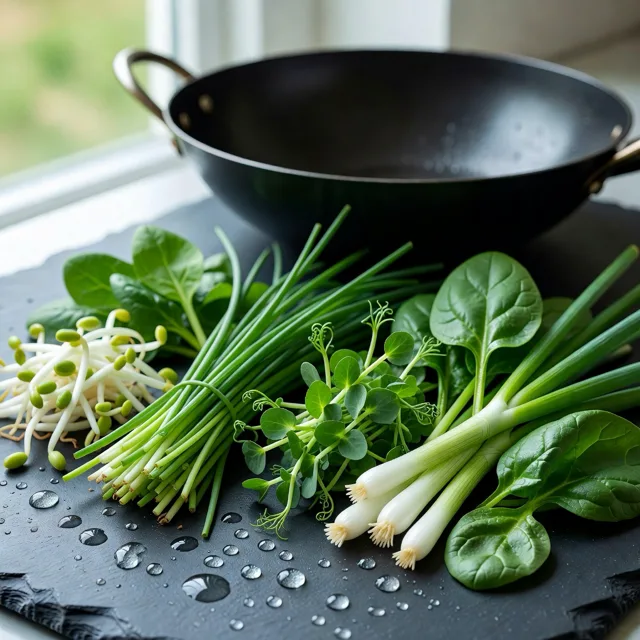
In TCM food therapy, there is a principle so intuitive it barely needs explanation: eat what the season is doing. In autumn, roots burrow downward, and we eat roots. In winter, life withdraws inward, and we eat warming, stored foods. And in spring? Everything sprouts. Shoots push upward through soil. Buds crack open. Green returns.
The foods that mirror this rising energy — bean sprouts, garlic chives, pea shoots, spring onions, young spinach — aren't just fresh produce arriving at the market. In TCM, they are edible expressions of 生发 (shēngfā) — the upward, outward movement of Wood-element energy that the 肝 (gān) — Liver system — needs to function well in its season.
February sits at the hinge. 立春 (Start of Spring) has passed. 雨水 (Rain Water) is arriving. The shift from Water season to Wood season is underway, but it's not yet warm. These sprouting foods are nature's transition diet — light enough to match spring's rising qi, but cooked (not raw) to respect February's lingering cold.
Table of Contents
Why Sprouting Foods in Spring
The logic runs deeper than "eat what's in season." In Five Element theory, spring belongs to the Wood element, which governs the Liver and Gallbladder systems. Wood's movement is upward and outward — like a tree pushing growth from roots through trunk to branches. When your Liver qi flows freely in this direction, you feel energized, clear-headed, and emotionally balanced.
When it stagnates — stuck, compressed, sluggish from winter's heavy diet — you get irritability, tight shoulders, headaches, and the heavy fatigue the Chinese call 春困 (chūn kùn) — spring fatigue.
Sprouting foods have a TCM property called 升散 (shēng sàn) — "rising and dispersing." They gently encourage qi to move upward and outward, supporting the Liver's natural spring direction. This is why classical Chinese dietary texts recommend 春食芽 (chūn shí yá) — eating sprouts in spring — as a fundamental seasonal principle.
The spring pancakes and spring rolls of 立春 are the ceremonial expression of this idea. What follows is the everyday version — the greens that should appear on your plate throughout February and into March.
The Six Sprouting Greens
| Food | Chinese Name | TCM Nature | What It Does |
|---|---|---|---|
| Mung bean sprouts | 绿豆芽 (lǜdòu yá) | Cool, sweet | Clears residual heat from festival feasting. Gentle on the Stomach. The most accessible sprout — available in every grocery store. |
| Soybean sprouts | 黄豆芽 (huángdòu yá) | Cool, sweet | Stronger than mung sprouts. Nourishes Spleen and clears dampness. The crunchy, thicker sprout. Holds up better in soups. |
| Garlic chives | 韭菜 (jiǔcài) | Warm, pungent | The king of spring vegetables in TCM. Warms the Kidney, moves Liver qi, and adds yang energy. Classically called "起阳草" (the yang-raising herb). |
| Pea shoots | 豌豆苗 (wāndòu miáo) | Cool, sweet | Delicate, tender tips. Clears heat, promotes fluid production. Beautiful in stir-fries and soups. |
| Spring onion / scallion | 葱 (cōng) | Warm, pungent | Opens the surface, disperses cold, aids Lung qi. The simplest way to add rising energy to any dish. |
| Young spinach | 菠菜 (bōcài) | Cool, sweet | Nourishes Blood, moistens the intestines, supports the Liver. Available year-round, but the tender young leaves of late winter are the sweetest. |
Balancing Warm and Cool
Notice the table contains both warm and cool foods. This balance is intentional. Garlic chives and scallion provide the warming, yang-moving energy that February still needs. Bean sprouts and pea shoots contribute cooling, clearing energy that begins the shift away from winter's heavy warmth. Together, they create the balanced plate that suits the transitional weeks between 立春 and 惊蛰.
If you run cold — cold hands, preference for warm drinks, loose stools — favor the chives and scallion. If you run hot — warm palms, dry mouth, restless sleep — lean toward the sprouts and pea shoots. Both groups should appear on your table this month; just adjust the ratio.
Why Cooked Beats Raw in February
You might be tempted to toss these greens into a raw salad. In TCM, that's a February mistake. The reasoning is straightforward:
- February is still cold. The Spleen (Earth) system, which transforms food into qi, works best with warm, cooked food. Raw food requires the Spleen to do extra warming work before it can extract nutrients — and in cold weather, the Spleen is already working harder than usual.
- Sprouts are delicate. A quick stir-fry (30-60 seconds) breaks down the cellulose just enough for easy digestion while preserving the rising, fresh quality you want. Overcooking defeats the purpose — wilted, gray sprouts have lost their 生发 energy.
- Warm food opens the channels. Cooked food helps qi and Blood flow. Raw food can constrict channels, especially in the Liver and Stomach, leading to bloating and discomfort.
The exception: by late March or April, when outdoor temperatures have genuinely warmed, raw sprouted salads become appropriate. But in February? Cook everything. Quickly, briefly, respectfully — but cook it.
The Quick Stir-Fry Method
All six sprouting greens respond well to the same fast, simple technique. The goal is high heat, short time, and minimal sauce — letting the ingredient's own flavor and 生发 quality come through.
| Step | Action | Time |
|---|---|---|
| 1. Prep | Wash sprouts or greens. Remove any wilted pieces. Drain well — water in a hot wok causes splattering and steaming instead of searing. Pat dry if needed. | 3 min |
| 2. Heat the wok | High heat until the wok just begins to smoke. Add 1 tablespoon of neutral oil (peanut, sunflower, or avocado). Swirl to coat. | 30 sec |
| 3. Aromatics | Add 2 cloves sliced garlic and (optionally) 2 slices fresh ginger. Stir until fragrant — do not let garlic brown. | 15 sec |
| 4. Greens in | Add the sprouts or greens in one batch. Toss continuously with a spatula or by flipping the wok. Season with a pinch of salt and a splash of light soy sauce (optional). | 30-60 sec |
| 5. Serve immediately | The moment the greens are barely wilted and still bright green, transfer to a plate. Residual heat will continue cooking for a few seconds. Do not let them sit in the wok. | Instant |
7-Day Sprouting Plan
Rotate through the six greens across a week. Each day features a different sprout or green as a side dish or incorporated into a main.
| Day | Green | Dish | TCM Focus |
|---|---|---|---|
| Monday | Mung bean sprouts | Quick stir-fry with garlic and a splash of rice vinegar | Clear residual festival heat. Light Stomach reset. |
| Tuesday | Garlic chives | Chive and egg stir-fry (韭菜炒蛋) — the classic spring dish | Warm Kidney yang. Move Liver qi. The single best spring vegetable. |
| Wednesday | Pea shoots | Wok-tossed pea shoots with ginger, served over rice | Clear heat gently. Support fluids. Delicate and refreshing. |
| Thursday | Soybean sprouts | Added to a simple tofu and vegetable soup, last 3 minutes of cooking | Drain dampness. Support Spleen. Hearty crunch in soup. |
| Friday | Young spinach | Blanched 15 seconds, dressed with sesame oil and a pinch of salt | Nourish Liver Blood. Moisten intestines. Perfect alongside any protein. |
| Saturday | Spring onion | Scallion oil noodles (葱油拌面) — chopped scallion fried slowly in oil until golden, tossed with noodles and soy sauce | Open the surface. Disperse cold. Comfort food with rising energy. |
| Sunday | Mixed sprouts | A combination plate: mung sprouts + chives + pea shoots, quick stir-fried together with garlic | The full spectrum — clearing, rising, warming. A complete Wood-season plate. |
Buying & Storage Tips
Sprouting foods are perishable. Their freshness is their medicine — wilted, browning sprouts have lost the 生发 energy that makes them valuable.
| Item | What to Look For | Storage |
|---|---|---|
| Bean sprouts | Crisp, white, no brown tips. Avoid any with a sour smell. | Submerge in cold water in a covered container in the fridge. Change water daily. Use within 2-3 days. |
| Garlic chives | Deep green, firm stems. Limp chives are past their peak. | Wrap in a dry paper towel, then in a loose bag. Fridge for up to 4 days. Do not wash until ready to use. |
| Pea shoots | Tender tips with small leaves. Thick, tough stems mean older growth. | Very perishable — use within 1-2 days. Store in a container lined with a damp paper towel. |
| Scallions | Firm white roots, bright green tops. Avoid slimy layers. | Stand upright in a jar with 1 inch of water, cover loosely with a bag. Fridge for up to a week. They may even grow new green shoots. |
| Young spinach | Small, tender leaves. No yellowing or slime. | Store dry in the crisper drawer. Use within 3-4 days. Wash only before cooking. |
⚠️ Disclaimer: The TCM food properties described here (warming, cooling, rising, dispersing) are classifications from traditional Chinese dietary therapy, not medical claims. Sprouting foods are everyday vegetables, not medicine. If you have specific digestive conditions, food allergies, or are taking blood-thinning medications (garlic chives are high in vitamin K), consult your healthcare provider.
Eat for Your Season
Your ideal spring diet depends on your personal elemental balance. A BaZi reading reveals whether your Liver system needs more rising foods or more calming support as Wood season arrives.
Book a Consultation