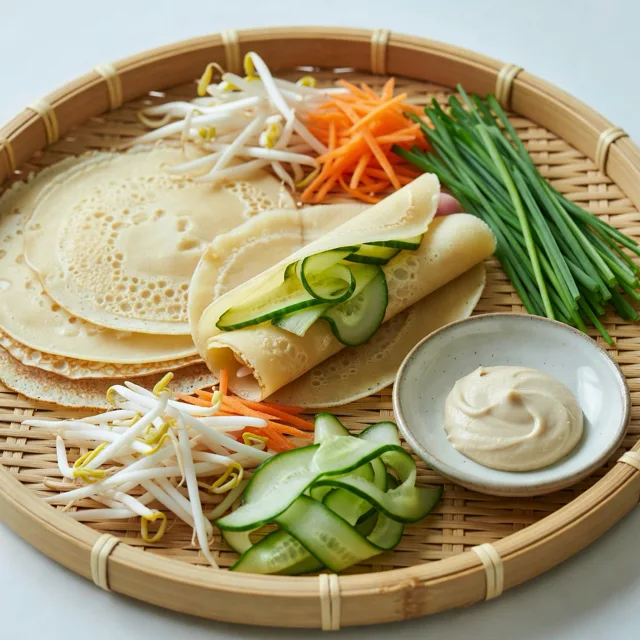
咬春 (yǎo chūn) — Biting Spring — is one of the most satisfying food traditions on the Chinese calendar. On 立春 (lìchūn), the Start of Spring, you literally bite into the season's arrival: thin pancakes wrapped around fresh, pungent vegetables, or crispy spring rolls stuffed with the year's first green fillings. It's not a feast. It's a single, deliberate mouthful that says: winter is over, and I'm ready for what's growing.
This year, 立春 falls on Thursday, February 4, 2027. That means Wednesday evening — tonight, if you're reading this on the day it publishes — is your prep window. The good news: 春饼 (chūnbǐng, spring pancakes) are fast to make, and 春卷 (chūnjuǎn, spring rolls) can be assembled ahead and fried or baked right before serving.
In TCM, the foods you choose for 咬春 aren't random. They are pungent, green, and rising — exactly the qualities that help 肝 (gān), the Liver system, begin its work as the new season's ruling organ. After weeks of heavy warming winter foods, this is the first gentle push toward lighter eating.
Table of Contents
The 咬春 Tradition
The custom dates back centuries. On the day of 立春, families eat raw or lightly cooked spring vegetables — often wrapped in a thin pancake. The act of biting into something fresh and green on the exact day spring begins is both symbolic and practical: you're welcoming the Wood element's rising energy through the most direct channel available — your mouth.
Regional variations abound. In northern China, 春饼 (spring pancakes) dominate — large, thin wheat wrappers filled with shredded vegetables, sometimes with egg or pork. In the south, 春卷 (spring rolls) — smaller, crispier, often fried — are more common. Both count. Both are delicious. Both work.
The key ingredients almost always include at least one of these: bean sprouts (especially mung bean), garlic chives (韭菜, jiǔcài), scallion, radish, lettuce, or thinly shredded carrot. Every one of these is a spring-rising food in TCM terms.
TCM Logic: Why Pungent and Green
In the Five Element dietary system, spring belongs to Wood, which is nourished by foods that are green, mildly pungent, and upward-moving in energy. After months of salty, heavy, warming winter foods designed to anchor Kidney qi downward, the body needs a nudge in the opposite direction.
| Quality | What It Does | Example Ingredients |
|---|---|---|
| 🌿 Green color | Enters the Liver channel; supports Wood element | Lettuce, pea shoots, scallion greens, spinach |
| 🌶️ Mild pungency | Disperses stagnant qi; helps Liver qi flow | Garlic chives, mustard greens, radish, ginger |
| 🌱 Sprouting / rising | Mirrors spring's upward energy | Bean sprouts, chive tips, young greens |
| 🍃 Light and fresh | Eases the Spleen's burden after heavy winter diet | Shredded vegetables, thin wrappers, less oil |
The pungent flavor in TCM is associated with the Lung and Metal element, which in the generating cycle produces Water, which generates Wood. So a little pungent flavor at the start of spring is not random — it's the energetic push that helps Wood take root.
There is also a seasonal logic at work. After months of heavy, salty, downward-anchoring winter foods — black rice, lamb stew, bone broth — your body needs a shift in direction. The Liver's job is to ensure smooth flow, and the foods of 咬春 support exactly that: they are light, they are upward-moving, and they gently push open the pathways that winter sealed shut. Think of it as oiling a door hinge that hasn't moved since November.
This is also why the preparation should be simple. 咬春 is not about culinary showmanship. It's about a direct encounter between you and the season's first green, pungent, living ingredients. The wrapper is thin. The fillings are fresh. You bite, you taste spring, and your body knows the season has changed.
春饼 Spring Pancakes
Spring pancakes are the simpler of the two options — and the more traditional for 咬春 in much of China. They are thin, flexible wheat wrappers, just big enough to hold a generous pile of fillings. Think of them as Chinese crepes with a mission.
The Wrapper
You need just three things: all-purpose flour, boiling water, and a touch of sesame oil. The boiling water is key — it partially cooks the starch, giving the pancake flexibility without toughness.
- 2 cups all-purpose flour
- 3/4 cup boiling water, added gradually
- Sesame oil for brushing between layers
Mix the flour and water into a dough, rest it for 30 minutes, then divide into small balls. Roll two balls flat, brush sesame oil between them, stack them, and roll out together into a thin double pancake. Dry-cook on a medium skillet for about one minute per side — they should puff slightly and develop a few golden spots. Peel the two layers apart while warm. Each yields two ultra-thin pancakes.
The Classic Filling
Stir-fry your vegetables quickly — high heat, minimal oil, just enough to wilt without losing the crunch. A traditional combination:
- Mung bean sprouts (a big handful)
- Shredded carrot
- Garlic chives (韭菜), cut into 2-inch segments
- Shredded cabbage or lettuce
- A scrambled egg, broken into strips
- Optional: thin-sliced pork belly or shredded tofu
Season with a splash of soy sauce, a pinch of white pepper, and a few drops of sesame oil. That's it. Pile the fillings onto a warm pancake, roll, and bite. This is 咬春.
春卷 Spring Rolls
If you prefer crunch, spring rolls are the way to go. The filling is similar — shredded vegetables, sometimes with minced pork or shrimp — but wrapped in a thinner, crispier skin and either fried or baked.
For a Lighter Version: Baked or Pan-Fried
Not everyone wants deep-fried food the night before a three-day feast begins. For a lighter approach:
- Use store-bought spring roll wrappers (widely available at Asian markets).
- Fill with the same vegetable stir-fry mixture used for spring pancakes.
- Brush the outside with a thin coat of oil.
- Bake at 400°F (200°C) for 15–18 minutes, turning once, until golden and crisp.
- Or pan-fry in a lightly oiled skillet, turning to brown all sides, about 3 minutes per side.
The result is lighter than deep-frying but still satisfyingly crispy. Your Spleen will thank you — especially if you're about to eat three large meals in three days.
Fillings by Constitution
Not every filling suits every person equally. In TCM, your body constitution shapes what you need most at the start of spring.
| Constitution | Best Fillings | Avoid or Reduce |
|---|---|---|
| Cold / Yang-deficient | Garlic chives, ginger, scallion, scrambled egg, a little pork | Raw vegetables, cold bean sprouts, cucumber |
| Heat / Yin-deficient | Lettuce, pea shoots, mung bean sprouts, celery, carrot | Too much garlic chive, ginger, chili |
| Damp / Spleen-weak | Cooked bean sprouts, radish, a little ginger, less oil | Greasy fillings, too much pork, heavy sauce |
| Balanced | A mix of everything — the classic combination works beautifully | Nothing specific — just don't overdo one type |
Make-Ahead Plan for Feb 4
立春 is on a Thursday this year. If you're working during the day, here's how to prep ahead so you can 咬春 in the evening:
| When | Task | Time |
|---|---|---|
| Wed evening (Feb 3) | Make pancake dough, wrap in plastic, refrigerate. Wash and shred vegetables, store in separate containers. | 25 min |
| Thu after work (Feb 4) | Roll and cook pancakes (15 min). Stir-fry fillings (10 min). Assemble and eat. | 30 min |
For spring rolls, you can assemble them Wednesday night and refrigerate them on a parchment-lined tray, covered loosely. Bake them Thursday evening straight from the fridge — add two extra minutes to the baking time.
Serving the Table
咬春 is best served family-style: a stack of warm pancakes, bowls of different fillings, and everyone assembling their own wraps at the table. This is part of the ritual. You choose your fillings, you roll your own, and you take that first bite of the new season yourself. Children especially love the hands-on aspect — and it turns a simple meal into an event.
For dipping sauce, keep it simple: soy sauce with a few drops of sesame oil and a tiny grate of fresh ginger. Some families add a splash of black vinegar. Sweet hoisin or chili paste are fine additions but not traditional for 咬春 — the point is tasting the vegetables, not masking them.
Pair the meal with warm jasmine tea or a light chrysanthemum brew. Avoid cold drinks — your Spleen is about to face a three-day feast starting tomorrow night with the reunion dinner, and keeping it warm now gives it a running start.
⚠️ Disclaimer: The TCM dietary principles discussed here reflect traditional Chinese food therapy perspectives. They are not a substitute for professional medical or nutritional advice. If you have specific dietary needs, food allergies, or health conditions, consult your doctor or a registered dietitian.
What's Your Spring Diet?
Your ideal spring menu depends on your body constitution and your BaZi chart's elemental balance. A personalized consultation reveals which foods and seasonal adjustments matter most for your health this year.
Book a Wellness Consultation