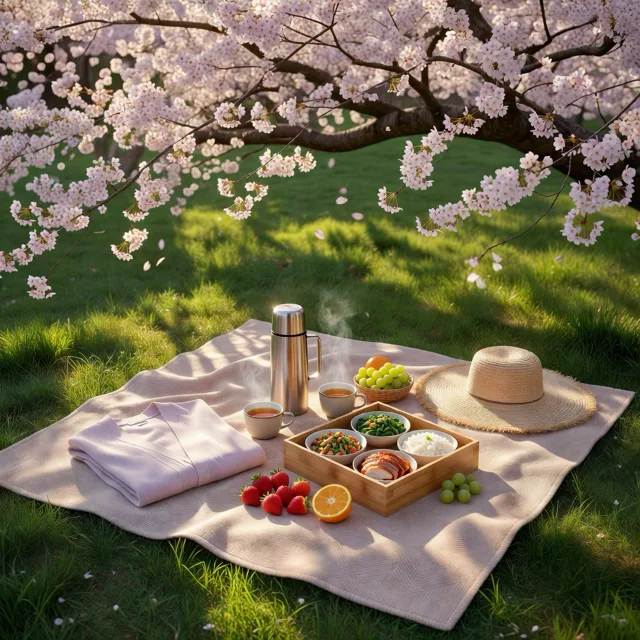
April is the month when picnic blankets come out, hiking boots get laced, and families discover — sometimes the hard way — that spring weather is not as reliable as it looks at noon. That sunny 70-degree afternoon can give way to a 50-degree wind by five o'clock, and the person who left the house in a t-shirt comes home with a stiff neck and a scratchy throat.
In TCM, 踏青 (tàqīng) — the spring outing — is not just encouraged, it is considered essential. Getting outside moves Liver qi, which has been building pressure all winter. Sunlight warms the body's yang. Fresh air clears the lungs. But the same tradition that celebrates spring outings also warns about their specific risks: 风 (fēng) — Wind, the dominant climatic pathogen of spring, which enters through exposed skin at exactly the moment you think you do not need a jacket.
This guide is about enjoying April outdoors without paying the TCM price. Timing, layering, food, sitting, insects, and a two-hour outing plan that works for families.
Table of Contents
Choosing the Right Time of Day
Not all hours are equal for a spring outing. In TCM, the body's defensive qi — 卫气 (wèi qì) — circulates on the body's surface during the day and retreats inward at night. The strongest surface protection happens between late morning and early afternoon, roughly 10 AM to 3 PM.
Best Window: 10 AM to 2 PM
This is when the sun is warm enough to nourish yang without being harsh, the morning dew has dried, and the late-afternoon wind has not yet picked up. For families with young children or elderly members, this window is especially important.
Avoid Dusk Outings
The traditional caution against lingering outdoors past 4 or 5 PM in spring is rooted in observation: temperatures drop fast, wind picks up as the land cools, and the body's surface defenses begin their nightly inward shift. A picnic that stretches into sunset is the classic setup for a stiff neck the next morning.
Layering for 倒春寒 Cold Snaps
倒春寒 (dào chūn hán) — late-spring cold snaps — are the defining weather trap of April. A warm front gives you three beautiful days, then a cold front drops temperatures overnight. The danger is not the cold itself but the swing: your body opens to the warmth, your pores relax, and then cold wind catches you exposed.
The traditional layering rule for spring is 春捂 (chūn wǔ) — "cover in spring." It means keeping an extra layer even when the sun makes it feel unnecessary. The specific areas to protect:
| Body Area | Why (TCM View) | What to Bring |
|---|---|---|
| Neck & Upper Back | Wind enters through 风池 (fēngchí) and 风门 (fēngmén) points at the base of the skull and upper back | A light scarf or hoodie you can pull up |
| Lower Back | Home of 命门 (mìngmén, Gate of Vitality) — cold here weakens Kidney yang | A shirt that stays tucked in; a light jacket that covers the waist |
| Feet & Ankles | The Kidney channel begins at the sole; cold enters upward through bare ankles | Closed-toe shoes, socks — save the sandals for May |
Our spring wind guide covers the wind-pathogen connection in full. The practical takeaway for outings: always carry one more layer than you think you need, and put it on before you feel cold — by the time you shiver, wind has already entered.
Sun Exposure: The TCM Sweet Spot
Sunlight in April is a tonic after winter's darkness. In TCM, moderate sun exposure — especially on the upper back between the shoulder blades — is said to warm the 督脉 (dū mài, Governing Vessel), the main yang channel of the body. This is traditionally recommended in spring as a way to boost defensive qi.
How Much Is Enough
- 15 to 30 minutes of direct sun on exposed skin (arms, face) is a reasonable April target for most people. This is not a sunbathing session.
- Protect the head: A hat or cap prevents the top of the head from overheating. In TCM, the head is "the meeting of all yang" — too much direct sun on the crown can create headaches and irritability.
- Sunscreen for longer outings: If you are out for more than an hour in midday sun, use sunscreen. TCM supports sun exposure, not sunburn.
The point is not to avoid the sun. It is to use it deliberately, in moderate doses, and to protect the head and neck from excess.
What to Pack — and What to Leave Home
The spring picnic basket matters more than most people think. In TCM, the Spleen — the organ system responsible for digestion — is already under pressure in spring from rising dampness and irregular temperatures. What you eat outdoors should support digestion, not challenge it.
Bring
- Warm tea in a thermos: Green tea (lightly brewed), ginger tea, or jasmine tea. Warm drinks keep the Stomach's "digestive fire" from going out. A thermos is non-negotiable for an April outing.
- Cooked foods over raw: Rice balls, cooked dumplings, roasted sweet potatoes, hard-boiled eggs. These are easier for the Spleen to process than raw salads in cool weather.
- Room-temperature fruit: Apples, oranges, grapes — washed and at room temperature. Fruit straight from the fridge is harder on the Stomach in spring.
- Simple proteins: Sliced roast chicken, tea eggs, or edamame. Light, cooked, not cold-cut heavy.
Leave Home
- Iced drinks: Cold water, iced coffee, and sodas with ice challenge the Spleen when the body is adjusting to outdoor temperatures. If you want something cold, bring it at room temperature and add a single ice cube at most.
- Raw sushi or ceviche: Raw proteins in an uncontrolled outdoor temperature are a food-safety concern — and in TCM, raw-cold foods are the hardest combination for the Stomach.
- Heavy, greasy snacks: Chips and fried foods generate internal dampness, which is already rising with the season.
Sitting on Cold Ground & the Kidney Caution
Here is a rule your Chinese grandmother would insist on: 不坐冷地 (bù zuò lěng dì) — "do not sit on cold ground." In TCM, cold and dampness from the earth can enter the body through the buttocks and lower back, affecting the Kidney system and the reproductive organs. This is a traditional caution that applies especially to women and children.
What to Do Instead
- Bring a thick blanket or foam pad. A thin sheet on cold grass does not provide enough insulation.
- If the ground is damp, consider a foldable camp chair or sitting on a bench.
- Do not let children sit directly on stone or concrete surfaces for extended periods. These materials hold cold.
- After sitting, stand and move every 20 to 30 minutes. Movement prevents cold from settling in the lower body.
This is one of those traditional cautions that modern medicine does not specifically address — but generations of Chinese families have observed the connection between sitting on cold surfaces and subsequent lower-back pain, digestive upset, or menstrual irregularity. Use your judgment, and at minimum, put something between you and the ground.
Insects Wake Up Too
惊蛰 (Jīngzhé, Awakening of Insects) passed in March, and by April the insects are fully active. Mosquitoes, ticks, ants, and bees are part of the spring landscape. A few practical notes from both traditions:
- Mugwort smoke: Burning dried 艾草 (àicǎo, mugwort) is a traditional insect repellent. If you are in a campfire-friendly area, a small bundle of dried mugwort in the fire keeps mosquitoes at a distance.
- Light-colored clothing: Ticks are easier to spot on light fabrics. Long pants tucked into socks protect the ankles during grass walks.
- Check after the outing: A full-body tick check when you get home is essential, especially for children and pets. Ticks in April are small and hard to see.
- Bee awareness: If you are near flowering trees or open drinks, be alert. Move calmly around bees — they are not aggressive unless threatened.
The Two-Hour Family Outing Plan
Here is a structured, TCM-informed outing that works for families with children of any age. Adjust the timing to fit your schedule, but keep the sequence.
| Time | Activity | Why |
|---|---|---|
| 0:00 | Arrive, set up blanket, layer check | Establish your base. Everyone puts on their light layer. |
| 0:10 | Walk together for 20–30 minutes | Movement warms the body, moves Liver qi, and acclimates you to outdoor temperature. |
| 0:40 | Settle at your blanket. Snack and warm tea. | Eating after movement aids digestion. Warm tea protects the Stomach. |
| 1:00 | Free play, reading, or simply sitting in the sun | Sun on the upper back warms yang. Relaxation soothes Liver qi. |
| 1:30 | Short closing walk (10 minutes) | Movement before departure prevents stiffness from sitting on cool ground. |
| 1:50 | Pack up, tick check, head home | Leaving before temperatures drop. Tick check is a habit, not optional. |
Two hours is enough. You get sunlight, movement, fresh air, and a shared meal — the four things that TCM considers essential for spring wellness — without the fatigue, sunburn, or chill that comes from overstaying.
For the complete spring walk protocol — including pace, breathing, and route selection — see our March guide. And if a cold snap catches you unprepared, our travel health guide covers recovery basics.
⚠️ Disclaimer: The TCM perspectives in this article reflect traditional practices and are not a substitute for modern medical advice. If you or a family member experiences heat stroke symptoms, allergic reactions, or tick-borne illness symptoms after an outing, seek medical attention promptly.
Outdoor Energy, Aligned
Your BaZi chart reveals how your body responds to spring's Wind and warmth — and which outdoor activities suit your constitution best. Let's design your spring.
Book a Spring Wellness Reading