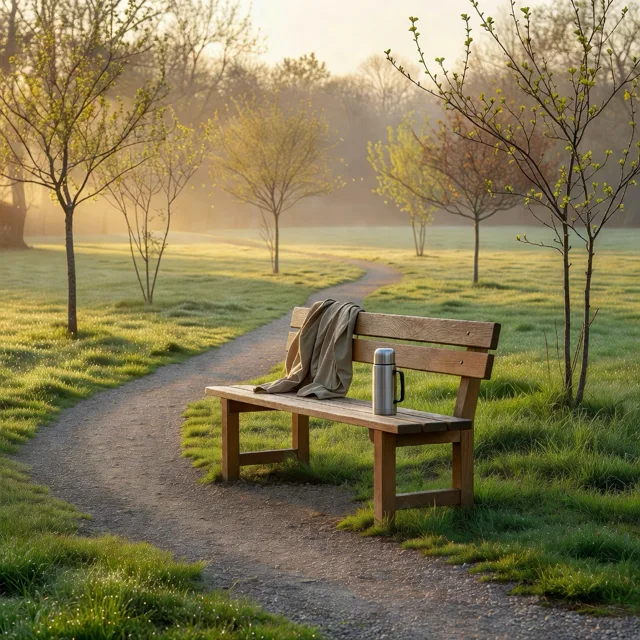
踏青 (tàqīng) — "treading the green" — is one of the oldest spring traditions in Chinese culture. For centuries, people have left their homes in early spring to walk through fields, along riverbanks, and across hillsides where the first green shoots are pushing through the earth. It is not hiking. It is not exercise in the modern, gym-derived sense. It is a slow, deliberate immersion in the season's energy — and in TCM terms, it is one of the most effective things you can do for your 肝 (gān) — Liver system — right now.
March is peak Liver season. The Liver governs the smooth flow of qi, and its energy naturally rises and expands in spring. When that energy gets stuck — from sitting too long, sleeping too late, stewing in frustration — you feel it as stiffness, irritability, headaches, and the heavy fatigue we call 春困 (chūn kùn). Movement disperses stagnation. Morning light resets your internal clock. Green surroundings calm the Liver directly through the eyes (the Liver opens to the eyes in TCM).
You do not need an hour. You do not need special equipment. Twenty minutes of intentional walking in the morning is enough to shift your entire day.
Table of Contents
Why Walking Beats Intense Exercise in Spring
There is a classical TCM saying: 春夏养阳 (chūn xià yǎng yáng) — "in spring and summer, nourish yang." This does not mean pushing yourself to the limit. It means coaxing your yang energy upward and outward — gently, the way the season itself works. A tree does not explode into leaf. It buds, opens, then expands over weeks.
Intense cardio, heavy lifting, and competitive sport all have their place. But in early spring, when the body is still transitioning from winter's conservation mode, sudden exertion can scatter qi before it is consolidated. The result: fatigue that hits two hours later, lowered immunity, or the spring cold that "comes out of nowhere."
Walking is different. It moves qi without depleting it. It warms the muscles without producing the excessive sweat that, in TCM, disperses 卫气 (wèi qì) — your defensive energy. And it pairs naturally with the one thing most Americans are chronically starved of: morning light.
What the research says
Modern research broadly supports that morning light exposure helps regulate circadian rhythm and mood. The specific mechanisms are still being studied, but the alignment with TCM's emphasis on early-morning outdoor activity is notable. This is not a case of ancient wisdom predicting modern findings — it is two frameworks observing the same phenomenon.
The 20-Minute Morning Protocol
This is a structured walk, not a stroll to the mailbox. Twenty minutes, ideally before 9 AM, ideally outdoors where you can see trees, grass, or sky.
Minutes 0–3: Warm-up at the door
- Stand just outside your door. Roll your shoulders backward five times, then forward five times.
- Gently turn your head left, center, right, center — three rounds. The neck is where wind enters in TCM, and loosening it before walking is protective.
- Shake your hands loosely at your sides for 15 seconds. This wakes up the peripheral qi.
- Take three slow breaths: inhale through the nose for a count of four, exhale through the mouth for six.
Minutes 3–8: Gentle pace
- Walk at a conversational pace — you should be able to talk comfortably. This is not power walking.
- Breathe through your nose. Mouth-breathing bypasses the nasal warming and filtering that protects against spring wind and pollen.
- Let your arms swing naturally. Do not carry anything if you can help it — a phone in a pocket is fine, but holding a coffee disrupts your gait and your arm swing.
- Look around. Actively notice what is green, what is budding, what is blooming. This is not sentimentality — it is using the Liver's connection to the eyes. Green calms the Liver directly in Five Element color theory.
Minutes 8–15: Steady stride
- Pick up the pace slightly. You should feel warm but not sweaty. In TCM terms, the goal is to move qi to the surface and gently open the pores — not to produce dripping sweat.
- If the route allows, walk uphill for a stretch. Upward movement mirrors and supports the Liver's natural rising energy.
- Continue breathing through your nose. If you need to mouth-breathe, you are going too fast.
Minutes 15–18: Cool-down pace
- Slow back to the gentle pace from the first phase.
- Roll your shoulders again — three rounds, backward.
- If you have been walking with earbuds, take them out for these final minutes. Let the ambient sound register.
Minutes 18–20: Standing finish
- Stop. Stand still for one to two minutes.
- Place your palms over your lower abdomen (below the navel — the 丹田 dāntián area). Take five slow, deep breaths.
- This closing grounds the qi you have just moved. Without it, the energy stays at the surface and dissipates. The Liver qi stretches are a good follow-up if you have a few extra minutes.
What to Wear: The 春捂 Layering Rule
春捂 (chūn wǔ) — "spring bundling" — is the classical rule that you should stay dressed warmer than you think you need in early spring. March mornings are deceptive: the sun looks warm, the air temperature reads mild, but the wind carries genuine cold. Walking outdoors in a T-shirt because it is "50 degrees" is a textbook way to catch a spring wind-cold.
Layering protocol
- Base: A breathable long-sleeve layer that wicks moisture.
- Mid: A light fleece, zip hoodie, or knit sweater you can open or remove as you warm up.
- Shell: A windbreaker or light jacket. The critical piece. Wind is the primary pathogenic factor in spring TCM, and a wind layer over the neck and upper back is your first line of defense.
- Neck: A lightweight scarf or buff. The back of the neck houses the 风池 (fēngchí) and 风府 (fēngfǔ) points — the "wind pool" and "wind palace." These are where wind enters the body classically. Keep them covered.
Routes That Work (and Wind Tunnels to Avoid)
Not all walking routes are equal in spring.
Choose
- Tree-lined paths: Trees break the wind and provide the green visual stimulus that benefits the Liver.
- Parks and green spaces: Even a small neighborhood park works. Grass, trees, birdsong — the sensory input matters.
- East-facing routes: Walking toward the morning sun exposes your face and eyes to early light, which supports circadian rhythm. In Chinese cosmology, the east is the direction of spring, Wood, and the Liver.
- Water features: Walking alongside a stream, pond, or lake adds Water element to the experience, which nourishes Wood in the generative cycle.
Avoid
- Urban wind tunnels: Narrow streets between tall buildings funnel wind and amplify its force. A gust down a concrete canyon is not the gentle spring breeze your body needs.
- Exposed hilltops and open ridges: Too much wind exposure, especially for the neck and head.
- Heavily trafficked roads: Exhaust fumes and noise contradict the purpose of the walk entirely.
Adding Qigong Arm Swings
If you want to add a gentle qi-moving element to your walk, incorporate the basic qigong arm swing. This is one of the simplest and most effective qi circulation techniques, and it pairs naturally with walking.
How to do it
- Stand with feet shoulder-width apart, knees slightly bent.
- Let your arms hang loosely. Begin swinging both arms forward and back in a relaxed pendulum motion.
- The swing should come from the shoulders, not the hands. Your fingers stay loose — no fists.
- Swing gently for 2–3 minutes. The momentum should feel effortless.
This can be done during the warm-up phase, at the standing finish, or as a separate practice when you get home. Our qigong beginner's guide covers additional movements if you want to build a longer routine.
Spring vs Autumn Movement
If you followed our autumn exercise guide, you will notice a shift in emphasis. This is deliberate — the seasons ask for different things.
| Aspect | Spring Walking | Autumn Walking |
|---|---|---|
| Direction | Outward, expansive — let the gaze wander | Inward, consolidating — focus on breath |
| Pace | Slightly brisker — yang is rising | Slower, steadier — yin is gathering |
| Timing | Early morning — catch the rising yang | Mid-morning or late afternoon — avoid cold morning air on the Lungs |
| Sweat | Light warmth, minimal sweat | No sweat — autumn demands conservation of fluids |
| Key organ | Liver — move stagnation, look at green | Lung — protect moisture, breathe deep |
The same walk, done with seasonal awareness, becomes a fundamentally different practice. That is the beauty of living in rhythm with the calendar.
Your Walking Week
| Day | Walk Focus | Extra |
|---|---|---|
| Monday | Full 20-minute protocol | Set the week's rhythm |
| Tuesday | 15-minute walk + 5 min arm swings | Add the qigong element |
| Wednesday | 20-minute walk, new route | Novelty stimulates the Liver's love of variety |
| Thursday | Rest or gentle indoor stretching | Liver qi stretches if weather is bad |
| Friday | Full 20-minute protocol | Walk toward water if possible |
| Saturday | Extended walk — 30–40 minutes at gentle pace | The weekend 踏青 — a park, a trail, a botanical garden |
| Sunday | 15-minute walk + standing meditation | Close the week with stillness |
Start this week. The weather is warming, the daylight is growing, and your Liver is ready to move. Twenty minutes tomorrow morning will feel different from twenty minutes in January. That is the season talking.
⚠️ Disclaimer: This walking protocol is based on traditional Chinese wellness principles and is intended for generally healthy adults. If you have a heart condition, joint problems, balance issues, or any medical condition that affects your ability to walk safely, consult your physician before starting a new exercise routine. Stop immediately if you feel dizzy, short of breath, or experience chest discomfort.
Walk Your Element
Your personal BaZi chart reveals which times, directions, and types of movement suit your constitution best. A spring consultation can fine-tune your daily routine to your elemental makeup.
Book a Spring Consultation