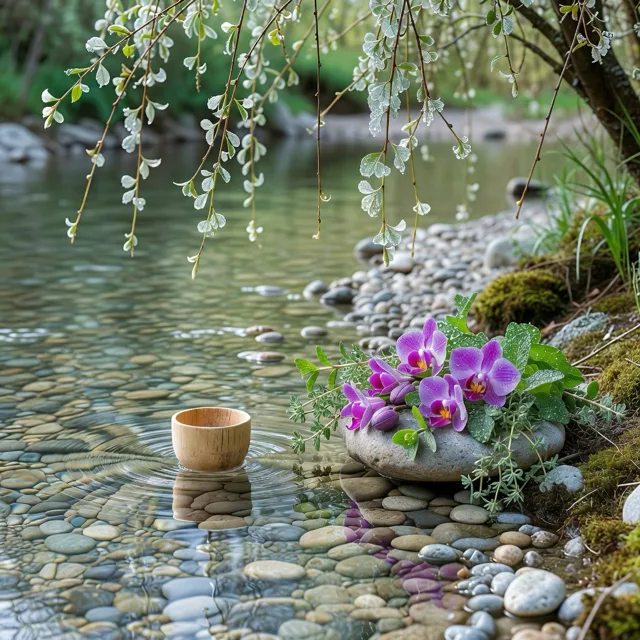
Of all the old Chinese festivals that modern life has quietly sidelined, 上巳节 (shàngsì jié) — the Spring Purification Festival — might be the one most worth reclaiming. It falls on the third day of the third lunar month, which in 2027 lands on Friday, April 9. While 清明 (Qīngmíng) a few days earlier asks you to honor the dead, Shangsi asks something different: wash yourself clean, step outside, and let the living water of spring carry away the staleness of the year so far.
This is not a solemn holiday. It is a day of water, flowers, poetry, and walking along rivers. For over two thousand years, people marked it by bathing in streams, tucking orchid leaves into their hair, floating cups of wine along winding waterways, and writing verses as those cups drifted past. If Qingming is a day of remembrance, Shangsi is a day of renewal — body, spirit, and home.
Most Americans have never heard of it. Even in China, it has largely merged into general spring outing culture. But the core idea — a purposeful, water-centered spring cleanse — is something any household can practice, no river required.
Table of Contents
Origins: Washing Away the Old Year
Shangsi dates back to at least the Zhou dynasty (1046–256 BCE). The name literally means the first 巳 (sì) day of the third lunar month — an auspicious day in the old calendar system. By the Han dynasty, it had been fixed to the third day of the third month (三月初三, sān yuè chū sān) regardless of which cyclical day it fell on.
The festival's earliest purpose was 禳灾 (rángzāi) — warding off misfortune. People believed that by the third month, the residual cold and stagnation of winter had accumulated in the body and could be released through contact with flowing water. So entire communities walked to the nearest river or stream and washed — hands, face, feet, sometimes the whole body.
This was not bathing for hygiene. It was 祓禊 (fúxì) — a ritual purification. The water carried away 不祥 (bùxiáng, ill fortune), and the person emerged symbolically renewed. Think of it as a spring equinox reset for the body, months before summer's heat could do the clearing on its own.
The Orchid Connection
兰草 (láncǎo) — orchid grass or fragrant thoroughwort — was the plant of the day. People placed it in the bathing water, wore sprigs of it, and used it to scent their clothes. In classical Chinese culture, the orchid represents refinement and moral integrity. On Shangsi, it also served a practical role: the aromatic oils were believed to repel insects and clear the senses after months of closed-window winter living.
祓禊 Fúxì — The Purification Ritual
The heart of Shangsi is the 祓禊 (fúxì) — the purification by water. In its original form, this was a communal event. Families and neighbors walked to a river, stream, or lake together. Officials sometimes organized the gathering. The Book of Rites (礼记, Lǐjì) references the practice, and the poetry of the era describes festive, joyful scenes — not austere religious ceremonies.
The ritual had a loose structure:
- Gather at water: A flowing stream was preferred over still water. Flowing water symbolized the movement of qi and the carrying away of stagnation.
- Wash hands and face: At minimum, the hands and face were rinsed in the stream. Some regions practiced full immersion.
- Add fragrant herbs: Orchid, mugwort (艾草, àicǎo), or other aromatic plants were placed in the water or worn on the body.
- Walk the banks: After the cleansing, people strolled along the river, picking wildflowers and spring greens — the same 踏青 (tàqīng, spring outing) practice associated with Qingming.
The distinction between Shangsi and Qingming was once clear: Qingming honors ancestors, Shangsi renews the living. Over centuries, the two festivals — falling within days of each other — gradually merged in popular practice, with Qingming absorbing most of Shangsi's outdoor customs.
曲水流觞 — Floating Wine Cups & Poetry
The most famous Shangsi tradition is 曲水流觞 (qū shuǐ liú shāng) — "floating wine cups along a winding stream." Guests sat along the banks of a deliberately curved or winding water channel. A cup of wine was placed on the current. Wherever the cup stopped or slowed, the person sitting nearest had to compose a poem on the spot — or drink the wine as a forfeit.
The most celebrated instance happened in 353 CE at the Orchid Pavilion (兰亭, Lántíng) near present-day Shaoxing, where the calligrapher Wang Xizhi hosted a Shangsi gathering of forty-two scholars. The verses composed that day were collected, and Wang Xizhi wrote the preface — the 兰亭集序 (Lántíng Jí Xù) — in a running-script calligraphy so perfect that it became the single most famous piece of Chinese calligraphy in history. The original is lost, but copies have been treasured for over 1,600 years.
The 曲水流觞 tradition captures something essential about Shangsi: it is intellectual, social, playful, and rooted in nature. It asks people to slow down, sit by water, and create something — even if that something is just a reason to share a drink with friends.
A Home Version
You probably do not have a winding stream in your backyard. But the spirit translates easily: gather friends, pour tea or wine, and take turns reading a poem, sharing a memory from the year so far, or naming something you want to release. The water can be a bowl with floating flower petals on the table — symbolic, not literal.
Living Traditions: 三月三 Across Cultures
While Shangsi as a named festival has faded in mainstream Han Chinese culture, 三月三 (sān yuè sān) — the third of the third month — remains vibrant across many communities.
| Community | How 三月三 Is Celebrated |
|---|---|
| Zhuang (壮族) | The biggest celebration — song festivals (歌圩, gēxū), five-color glutinous rice, young people singing antiphonal songs to find partners. It is an official holiday in Guangxi province. |
| Miao (苗族) | Riverside gatherings, lusheng pipe music, embroidered finery. A day for courtship and community bonding. |
| Li (黎族) | On Hainan Island, 三月三 involves mountain songs, bamboo dances, and offerings to ancestors — a blend of the Shangsi and Qingming spirits. |
| Yao (瑶族) | Water-splashing, herbal baths, and community feasting. The bathing element of the original Shangsi survives here most directly. |
| Japan (上巳の節句) | Transmitted from China, 三月三 evolved into Hina Matsuri (Girls' Day / Doll Festival) — a day of wishing health and happiness for daughters, with ornamental dolls and peach blossoms. |
The thread running through all of these is the same: spring, water, community, renewal. The Shangsi impulse — to step outside, wash clean, gather with others, and celebrate the return of warmth — is not a relic. It lives in every culture that marks the turning of the season.
A Modern Home Observance
You do not need a river. You do not need forty-two scholar friends. Here is a Shangsi observance that works in any American home on April 9, 2027 — or any spring day you choose.
Morning: The Herbal Bath
Draw a warm bath and add aromatic herbs. Traditionally, this would be orchid grass or mugwort. In practice, a few drops of essential oil (lavender, eucalyptus, or a floral blend) or a sachet of dried mugwort in a muslin bag does the job. The point is scent and warmth — a sensory signal that you are washing away the old season.
- Water temperature: warm, not hot. In TCM, spring bathing should be gentle — the body's yang is still rising, and overheating can scatter it.
- Duration: 15 to 20 minutes. Longer baths in spring can leave you feeling drained rather than refreshed.
- If you do not have a bathtub, a foot soak with the same herbs works. Or simply wash your hands and face with herb-infused warm water — the original 祓禊 was often just this.
Afternoon: The Riverside Walk
After the bath, go outside. The classical Shangsi outing was to the riverbank, but any green space with moving water — a creek, a park fountain, even a neighborhood with a decorative stream — captures the spirit. If there is no water nearby, a spring walk through a park still honors the 踏青 tradition.
- Dress in layers. April mornings and evenings can still carry a chill, even when afternoons are warm.
- Notice the spring greens, the early flowers, the birdsong. Shangsi is about sensory engagement with the season.
- If you have children, let them splash in a stream or play near water (safely supervised). The festival was always intergenerational.
Evening: Tea, Poetry & Release
In the evening, gather your household — or call a friend — and share a cup of tea or wine. Read a poem aloud. It does not have to be Chinese. Any verse about spring, water, or renewal fits the day. If you are feeling ambitious, try the 曲水流觞 format: take turns sharing, and anyone who cannot think of something to say finishes their cup.
Name one thing from the winter or early spring that you are ready to release — a grudge, a worry, a habit that no longer serves you. Shangsi is a day of symbolic cleansing. The naming is the letting go.
TCM View: Bathing in Spring
In TCM, spring is the season of the Liver and the Wood element. Yang energy is rising, pores are beginning to open after winter's contraction, and the body is more sensitive to both external wind and internal emotional shifts. Bathing in spring, from a traditional perspective, should respect this transitional state.
Warm, Not Cold
The Shangsi purification was always in temperate or warm water. Cold-water immersion in early spring — trendy as it may be — goes against the classical guidance for this time of year. In TCM, cold water in spring can drive 寒 (hán, cold) into the muscles and joints while the body's protective qi (卫气, wèi qì) is still consolidating.
Aromatic Herbs Serve a Purpose
The use of orchid, mugwort, and other fragrant herbs in the bath was not merely aesthetic. In TCM, aromatic substances 开窍 (kāi qiào) — "open the orifices" — meaning they activate circulation, clear the sinuses, and move stagnant qi. After months of winter closure, a fragrant bath is seen as a way to wake the body's surface layer and help the skin resume its role as the body's boundary with the outside world.
Timing Matters
Late morning to early afternoon is the best window for a spring bath, traditionally speaking. This is when yang energy is at its daily peak and the body can handle the brief temperature shift of getting wet and drying off. Bathing late at night in spring — especially with wet hair — is cautioned against in TCM, as the open pores can admit wind and dampness during sleep.
Your Shangsi Day Plan
Here is a simple, doable plan for Friday, April 9, 2027:
| Time | Activity | The Tradition Behind It |
|---|---|---|
| Morning | Herbal bath or foot soak with mugwort, lavender, or orchid oil | 祓禊 — purification by scented water |
| Late Morning | Open all windows for 20 minutes to air the home | Releasing stagnant winter qi from the house |
| Afternoon | Walk near water — a creek, park, or fountain | 踏青 — the spring outing |
| Late Afternoon | Pick up spring greens or flowers from the market | Bringing the season's freshness home |
| Evening | Tea or wine, a poem, and one thing to release | 曲水流觞 — the literary gathering by the stream |
Shangsi is not about perfection. It is about pausing, mid-spring, to acknowledge the season's shift and to let the water — real or symbolic — carry away what you no longer need. The scholars at the Orchid Pavilion in 353 CE were doing exactly this, and their afternoon produced the most celebrated calligraphy in Chinese history. Your afternoon might just produce a cleaner house and a lighter spirit. That is enough.
For the feng shui and wellness rhythms of this entire month — including the Qingming guide and what comes next at the Flower Festival — check the sidebar links. And for the bathing space itself, our bathroom feng shui guide covers placement, mirrors, and drainage.
Ready for Your Spring Reset?
A BaZi reading reveals which elements your body needs most this spring — and where your home's energy is ready for renewal. Let's find your personal Shangsi prescription.
Book Your Spring Consultation