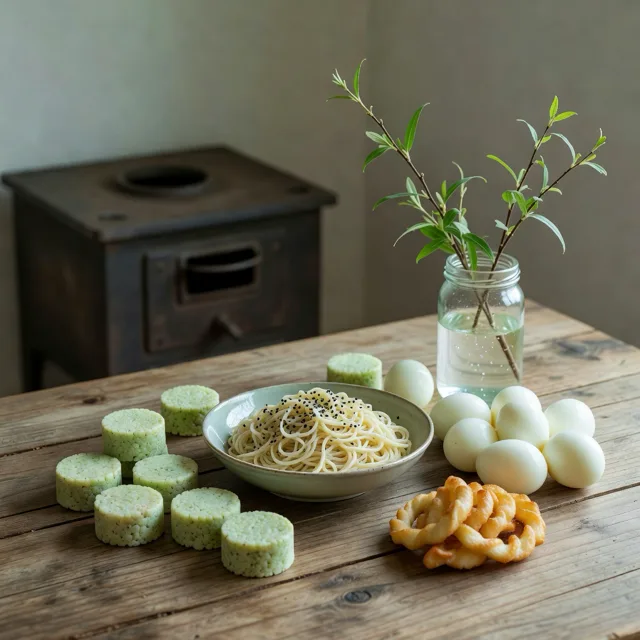
Before there was 清明, there was 寒食 (hánshí) — Cold Food Day. For at least two thousand years, 寒食节 (hánshí jié) was the bigger, older festival: a day when every hearth in the land was extinguished, no fire lit, no cooking done, and families ate food prepared the day before. It falls on Sunday, April 4, 2027 — the day before 清明 — and its story is one of loyalty, regret, and the strange power of grief turned into custom.
Over the centuries, 清明 gradually absorbed 寒食, and today most people treat the two as a single holiday. But the Cold Food tradition carries its own beauty: a day of stillness, remembrance, and simple food. If you enjoy the Qingming season, understanding 寒食 adds a deeper layer — and gives you a compelling reason to let the kitchen rest for a day.
For the full Qingming customs and ancestor remembrance traditions, see our complete Qingming guide. This article focuses on what makes Cold Food Day distinct.
Table of Contents
The Legend of Jie Zitui
The story behind 寒食 is set in the Spring and Autumn period (roughly 770-476 BCE) in the state of Jin. 介子推 (Jiè Zǐtuī) was a loyal retainer of Prince Chong'er, who was forced into exile. During nineteen years of wandering, Jie Zitui served the prince faithfully. When the party ran out of food, Jie Zitui is said to have cut flesh from his own thigh to make broth for the starving prince — an act of devotion so extreme it became legendary.
When Chong'er eventually returned to power as Duke Wen of Jin, he rewarded all the followers who had supported him in exile. But Jie Zitui refused any reward and retreated to the Mian Mountains with his elderly mother, choosing seclusion over official life. The duke sent messengers, but Jie Zitui would not come out.
In a decision that would haunt him, Duke Wen ordered the mountain set on fire, thinking the flames would force Jie Zitui to emerge. Instead, Jie Zitui and his mother perished in the fire, found sheltering beneath a willow tree. Stricken with grief and remorse, the duke decreed that on the anniversary of Jie Zitui's death, no fires would be lit throughout the land — and the people would eat only cold food.
This is the origin of 寒食节. Whether the historical details are accurate matters less than the emotional truth the story carries: a reminder that loyalty sometimes goes unrewarded, that power can be destructive even when well-intentioned, and that some debts can never be repaid. It is a somber story for a somber day — and it explains why the Chinese festival calendar places reflection before celebration, 寒食 before 清明's outings and springtime joy.
Cold Food Day Traditions
Though 寒食 is less widely observed today than it once was, several traditions have survived — some merged into 清明, others standing on their own.
| Tradition | What It Looks Like | Significance |
|---|---|---|
| No fire, no cooking | All hearths extinguished for the day. Families eat food prepared the previous day. | Honoring Jie Zitui. A day of deliberate restraint — the kitchen rests as an act of remembrance. |
| Willow branches at the door | Fresh willow branches hung above the door or worn in the hair. | Jie Zitui died beneath a willow. Willow also symbolizes spring vitality and is traditionally said to ward off negative spirits. This custom carries into 清明. |
| Kite flying | Families fly kites, sometimes releasing them into the sky by cutting the string. | Releasing a kite is symbolically releasing worries and misfortune into the wind. Cutting the string lets them go for good. |
| Outdoor outings (踏青) | Walking in fields and parks. Enjoying the spring scenery. | The 踏青 (tàqīng, treading on green) tradition begins at 寒食 and continues through 清明 — a reminder that life goes on, even in remembrance. |
| Egg games | In some regions, boiled eggs are painted or dyed and used in competitive egg-knocking games. | Eggs represent new life and fertility in spring. The games add lightness to a reflective day. |
The Traditional Cold Foods
The original 寒食 menu was whatever could be prepared the day before and eaten at room temperature. Over the centuries, specific regional specialties became associated with the day.
| Food | Description | Region |
|---|---|---|
| 青团 Qingtuan | Mugwort-green glutinous rice cakes with sweet or savory fillings. Steamed the day before and eaten cold. The signature food of the Qingming season. | Jiangnan (Shanghai, Suzhou, Hangzhou). See our qingtuan recipe. |
| Cold noodles (凉面 or 冷面) | Wheat noodles cooked, cooled, and dressed with sesame paste, vinegar, soy, and shredded vegetables. | Northern China, especially Shanxi and Shaanxi — the historical heartland of the 寒食 tradition. |
| 馓子 Sanzi | Thin, crispy fried dough twists. Deep-fried before the holiday and stored. Crunchy, lightly sweet or salty. | Widespread, especially in northern and western China. Also common at Eid celebrations in Muslim communities. |
| Boiled eggs (茶叶蛋 or plain) | Hard-boiled eggs, sometimes simmered in tea and spices (tea eggs), eaten at room temperature. | Across China. Portable, protein-rich, and easy to prepare in advance. |
| 子推燕 Zitui Swallows | Steamed buns shaped like swallows, named after Jie Zitui. Made with wheat flour and decorated with food coloring or jujube accents. | Shanxi province — Jie Zitui's homeland. The swallow shape symbolizes spring's arrival. |
A Modern No-Cook Menu
You do not need to follow every ancient restriction to honor the spirit of 寒食. A modern interpretation: give the kitchen a one-day rest. No stove, no oven, no elaborate preparation. Everything prepared the day before or assembled cold.
| Meal | Menu | Prep Notes |
|---|---|---|
| Breakfast | Qingtuan (steamed the day before) + warm tea from a thermos prepared Saturday night | Fill the thermos with boiling water and tea leaves before bed. It stays warm through the morning — no fire needed. |
| Lunch | Cold sesame noodles with shredded cucumber and scallion + tea eggs + sliced fruit | Cook noodles Saturday. Dress and refrigerate. Take out 30 minutes before serving to reach room temperature. |
| Afternoon snack | Sanzi (buy from a Chinese bakery or make ahead) + warm ginger water from the thermos | If you cannot find sanzi, any shelf-stable pastry works — the principle is pre-made, not the specific item. |
| Dinner | Congee reheated in a thermos or insulated pot + pickled vegetables + cold sliced braised meat or tofu | Cook congee Saturday evening and keep in a vacuum-insulated container. It holds temperature for hours. |
TCM Note: Cold Food Without Cold Damage
A full day of cold food in early April raises a fair TCM question: is not cold food bad for the Spleen? The answer is nuanced.
"Cold food" in the 寒食 context means food that has cooled to room temperature, not food served iced or raw from the refrigerator. Room-temperature qingtuan, tepid noodles, and warm-from-a-thermos tea are not the same as an iced smoothie in January. The Spleen can handle room-temperature food on a spring day — especially when the ambient temperature is already mild.
That said, if you run cold (always chilly hands, loose stools, preference for warm drinks), modify freely:
- Use the thermos strategy heavily — fill it the night before with ginger tea, hot congee, or warm broth.
- Take the qingtuan out of the refrigerator an hour before eating. Room temperature, not cold.
- Skip the cold noodles and eat congee from the insulated pot instead.
- Dress warmly. April mornings can be chilly, and eating cool food while cold amplifies the effect.
One day of room-temperature food in spring will not damage a healthy digestive system. The point is the gesture — a pause, a rest, a day of remembering — not a test of endurance.
Observing Cold Food Day Today
Most families today blend 寒食 and 清明 into a single weekend of remembrance and outings. If you want to observe Cold Food Day with intention, here is a simple shape for the day:
Morning
Begin quietly. Light no stove. Eat qingtuan or tea eggs with thermos tea. If you maintain an ancestor space at home, this is a good morning for a brief offering — cold food on the altar mirrors the day's custom. See the home ancestor space guide for setup.
Midday
Go outside. 寒食 and 清明 share the 踏青 tradition — treading on green, walking in nature, feeling the spring. Fly a kite if you have one. A park, a trail, a garden — the form matters less than the going.
Afternoon
This is a day for conversation, not productivity. Talk with family about the people you remember. Share stories. Look at old photos. The 寒食 impulse is reflection — let it be reflective.
Evening
Eat simply — congee from the thermos, pickled vegetables, cold meat or tofu. If the day felt good, you will notice something unexpected: the relief of not cooking. The kitchen rested. So did you. Tomorrow is 清明 — the air clears, the outings deepen, and the stove returns to life. For the full 清明 guide, see our Qingming festival article.
Honor Your Roots
Cold Food Day and Qingming are about connection — to the past, to the land, to the people who shaped you. A BaZi reading can illuminate the ancestral patterns in your birth chart and how they influence your path.
Book a Reading