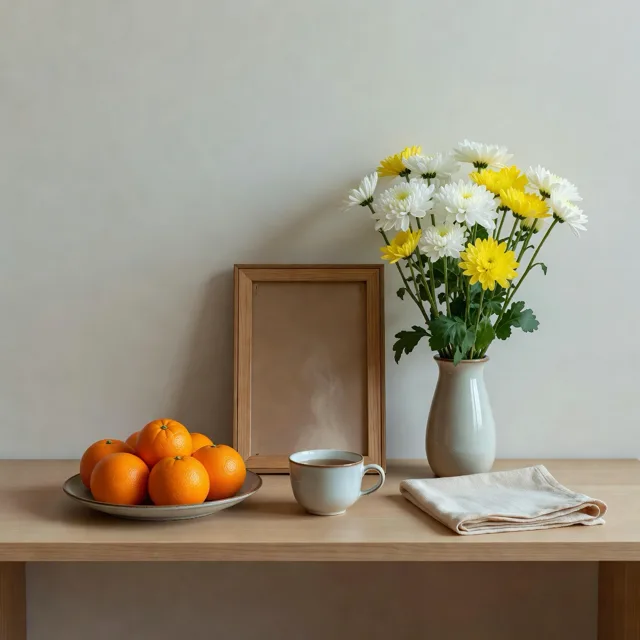
清明节 (Qīngmíng Jié) — the Qingming Festival — falls on Monday, April 5, 2027. It is the day when Chinese families traditionally visit the graves of their ancestors: sweeping the tombs, pulling weeds, placing fresh flowers, and sharing a meal with the departed. Our complete Qingming guide covers the history, customs, and significance of the festival.
But many of this site's readers live thousands of miles from their family graves. Some have lost family members whose remains are in another state or another country. Others are first-generation immigrants whose parents and grandparents are buried in China, Taiwan, Southeast Asia, or elsewhere. For these families, visiting a grave on Qingming is not possible.
This article is for you. It is about creating or refreshing a small ancestor space at home — a shelf, a table, a corner — where you can observe Qingming with sincerity even when distance separates you from the physical resting place.
Table of Contents
Remembrance, Not a Feng Shui Cure
Before we get into the practical details, a clarification. An ancestor shelf is not the same as a feng shui enhancement. It is not a "cure" or a placement designed to attract wealth, health, or luck. It is a space for remembrance — a physical place where you honor the people who came before you.
In Chinese culture, the relationship between the living and the departed is continuous. It is expressed through attention, offerings, and conversation — not through magical thinking. Setting up a shelf does not "summon" anything. It creates a focal point for your own memory and gratitude. The distinction matters because conflating ancestor remembrance with feng shui cures cheapens both practices.
Our feng shui symbols guide covers the decorative and energetic side of home placement. This article is about something more personal.
Choosing the Location
Traditional placement rules for an ancestor shelf are straightforward and similar to the guidelines we discussed in the Guanyin's Birthday piece for a devotional shelf.
Where to place it
- Quiet area of the home. A living room wall, a study, a hallway alcove, or a dedicated shelf in a dining room. The space should not be in the busiest, loudest zone of the house.
- Elevated. Above waist height — a high shelf, a wall-mounted ledge, or the top of a bookcase. Ancestor spaces are kept high as a mark of respect.
- Not in the bedroom. Sleeping areas are private and yin. The ancestor space should be in a shared, yang area of the home.
- Not facing a bathroom door. In feng shui, the bathroom is a drain point for qi. An ancestor shelf facing a bathroom is considered disrespectful in traditional practice.
- Not directly facing the kitchen stove. The stove's Fire energy is strong, and traditionally the ancestor space is kept in a calmer zone. Across the room from the kitchen is fine; directly in the line of sight from the stove is not ideal.
- Clean and uncluttered. The shelf itself and the area around it should be tidy. No piles of mail, no stacked boxes, no forgotten clutter.
Photos and Their Arrangement
The centerpiece of most home ancestor spaces is photographs. Choose photos that show your loved ones as you want to remember them — healthy, happy, at ease. Formal portraits work, but so do candid shots that capture their personality.
Arrangement guidelines
- Generational order. If you are honoring multiple generations, the oldest generation goes to the center or highest position. Parents to one side, grandparents above or centered.
- Facing outward. Photos should face into the room, not toward the wall. They are "looking at" the living space and the family.
- Framed, not loose. Even a simple frame shows care. Loose photos taped to a wall or propped against books feel impermanent.
- Consistent framing. Matching frames create a sense of order and unity. If you cannot match exactly, choose frames in the same color family.
- No photos of living people on the ancestor shelf. This is a universal rule in Chinese practice. The ancestor space is for the departed only. Family photos that include living members go elsewhere in the home.
Offerings: Flowers, Fruit & Tea
Traditional offerings are simple. They are not about expense — they are about the act of giving attention.
| Offering | Traditional Meaning | Practical Notes |
|---|---|---|
| Fresh flowers | Life and beauty — a gift of the living world to the departed | White or yellow chrysanthemums are the classic Qingming flower. Lilies, white roses, or any fresh flower is appropriate. Replace when wilted. |
| Fresh fruit | Nourishment and abundance | 3-5 pieces of seasonal fruit on a small plate. Oranges, apples, bananas, pears. Replace before they spoil. |
| Tea | Warmth and companionship — sharing a cup with the departed | A small cup of freshly brewed tea, placed in the morning. Pour it out and refill daily or every few days. |
| Incense (optional) | Communication — the smoke traditionally carries messages upward | One stick, not a bundle. Use only if your home has good ventilation. Not required. |
| A candle (optional) | Light and guidance | A small, clean-burning candle. Never leave unattended. |
Some families add a small dish of cooked rice or a favorite food of the departed on Qingming day itself. This is a beautiful and personal gesture — you are sharing a meal, even across the distance.
The Respectful Clean
If you already have an ancestor space, the week before Qingming is the time to give it a thorough, gentle cleaning. This mirrors what families do at the graveside: clearing away the accumulated dust and restoring the space to freshness.
How to clean the ancestor shelf
- Remove everything carefully. Take down photos, cups, plates, and any decorative items. Handle each piece with attention.
- Wipe the shelf surface. A damp cloth, then a dry one. If the shelf is wood, use a gentle cleaner appropriate for the material.
- Clean each frame and item. Wipe photo frames with a soft cloth. Wash cups and plates. Replace any chipped or stained items.
- Replace offerings. Fresh flowers, fresh fruit, fresh tea. Discard anything wilted, dried, or stale.
- Rearrange with care. Place everything back in its position. Take a moment to look at the completed space. Is it clear, clean, and respectful? That is the standard.
If you use incense or sage, this is a good moment to clear the air around the shelf with a brief, light cleansing — a few seconds of smoke wafted gently, not a heavy smudging. The CNY sweep plan covered whole-home clearing; here, the focus is on one small, sacred space.
For Families Who Cannot Visit Graves
This section is specifically for families whose loved ones are buried in another country or a distant state — a reality for many Chinese Americans and other diaspora families.
What you can do from home
- Set up or refresh the home ancestor shelf as described above. This becomes your primary observance.
- Cook a meal the departed loved. Place a small portion on the shelf before serving the family. Eat together and talk about the person. Qingming is about connection, not location.
- Call or video-chat with family who are near the gravesite. If relatives back home are visiting the tomb, a video call lets you participate virtually. Many families do this now — it is not a lesser form of observance.
- Write a letter. Some families write a short letter to the departed on Qingming, placing it on the shelf for the day. You can burn it (safely, outdoors) or simply fold it and keep it. The writing itself is the practice.
- Take a nature walk. 清明 literally means "clear and bright." The festival marks the season when the world turns green and alive. A walk in a park or garden — noticing the new growth, breathing the spring air — is a way to honor the day's spirit even without a specific graveside ritual.
There is no wrong way to remember someone you love. The form adapts to circumstance. The intention does not.
The Week Before Qingming: A Checklist
| Day | Task |
|---|---|
| 6 days before (Tue, Mar 30) | Decide on your space — existing shelf refresh or new setup. Gather photos and frames. |
| 5 days before (Wed, Mar 31) | Clean the shelf and surrounding area. Wipe frames, wash cups and plates. |
| 4 days before (Thu, Apr 1) | Arrange photos and items. Step back and assess — is the space clean, elevated, respectful? |
| 3 days before (Fri, Apr 2) | Buy fresh flowers and fruit. Choose white or yellow chrysanthemums if available. |
| 2 days before (Sat, Apr 3) | Place flowers and fruit on the shelf. Brew and place a cup of tea. |
| 1 day before (Sun, Apr 4) | Plan the Qingming meal — a dish the departed loved, or a simple, intentional family dinner. |
| 清明 Day (Mon, Apr 5) | Morning: refresh tea, light a candle or incense if you wish. Cook and share the meal. Take a walk in nature. Call family near the gravesite. |
Honor Your Roots With Clarity
A BaZi reading connects you to your elemental lineage — the energies you inherited and how they shape your path. Understanding your chart is another way of honoring where you come from.
Book Your Reading