农历: 丙午年 二月十八 (Fire Horse Year, 2nd Lunar Month Day 18) · 清明 (Clear and Bright)
宜 (Auspicious): 祭祀 (Ancestral Rites) · 祈福 (Pray for Blessings) · 解除 (Cleansing) · 出火 (Light Sacred Fire) · 安床 (Place Bed) · 修造 (Build)
忌 (Avoid): 动土 (Break Ground) · 纳财 (Financial Transactions) · 开市 (Open Business)
🕯️ Qingming literally means "Clear and Bright" — the perfect day for ancestral remembrance and spring cleansing. The almanac confirms: "宜祭祀祈福" — auspicious for rituals and blessings.
Qingming (清明) — often translated as "Tomb Sweeping Day" or "Clear Brightness Festival" — falls on April 4-5 each year. It's one of China's most important festivals, a day when families honor their ancestors, tend grave sites, and celebrate the arrival of true spring. But its significance extends far beyond cemetery visits.
For feng shui practitioners, Qingming represents a powerful energy reset — the moment when winter's residual yin energy fully gives way to spring's yang expansion. It's the ideal time to refresh your home's energy, establish your connection to ancestral blessings, and plant the seeds (literally and figuratively) for the months ahead.
Table of Contents
What is Qingming? The Cultural Context
Qingming is one of the 24 Solar Terms (二十四节气) — a 2,000-year-old agricultural calendar that divides the year into precise energy phases. As a Solar Term, Qingming marks the point when temperature, daylight, and plant growth reach a specific threshold, signaling that spring is fully established.
The Three Traditions of Qingming:
- Tomb Sweeping (扫墓 sǎo mù): Families visit ancestor graves to clean the site, pull weeds, repair headstones, and leave offerings — food, incense, joss paper, flowers. The act of maintaining the grave maintains the ancestral connection.
- Spring Outings (踏青 tà qīng): Families walk through green spaces, fly kites, and enjoy nature. The Chinese character 青 means both "green" and "youth" — walking in spring greenery symbolizes renewal and vitality.
- Willow Branches (插柳 chā liǔ): Willow branches are placed above doorways to ward off negative spirits and invite spring energy into the home. The willow's flexible, flowing nature represents adaptability and resilience.
Flying kites during Qingming has a specific feng shui purpose: as the kite rises, it symbolically carries away illness and misfortune. In traditional practice, the string is cut once the kite is high, allowing it to fly away with whatever negativity it's absorbed. Today, simply flying a kite with your family is a beautiful way to connect with this tradition and enjoy spring's upward, expansive energy.
Setting Up a Home Ancestor Altar
You don't need to be Chinese to benefit from acknowledging your ancestors. In feng shui, ancestral connection provides "backing energy" (靠山 kào shān) — the spiritual equivalent of having a solid wall behind your chair. Strong ancestral connection = stronger foundation for everything you build.
Ancestor Altar Setup:
| Element | Details | Significance |
|---|---|---|
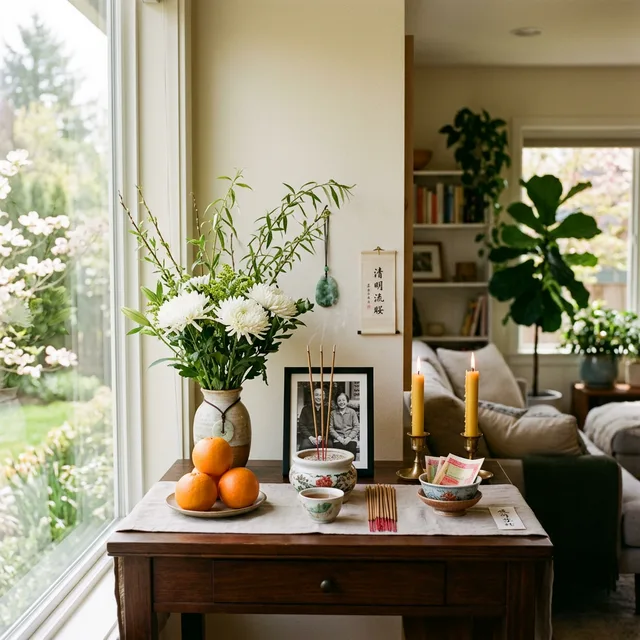
| 📍 Location | Living room or dedicated quiet space. Elevated surface (shelf, table, mantle). Never in the bedroom or bathroom. | Visibility honors their presence; elevation shows respect. |
| 🖼️ Photos | 1-3 framed photos of departed family members. Black-and-white or color both acceptable. | Creates a focal point for remembrance and connection. |
| 🕯️ Candles | Two white or soft-gold candles, one on each side of the photos. | Light = guidance. Ancestors are "the light that came before us." |
| 🌸 Flowers | White chrysanthemums (traditional), lilies, or any white/soft flowers. Replace when they wilt. | White flowers symbolize respect and spiritual purity. |
| 🍊 Offerings | 3 oranges, a cup of tea, or a small bowl of rice. Replace food offerings every 3-7 days. | Sharing nourishment with ancestors shows continued care. |
| 🪔 Incense | Sandalwood or natural wood incense. Light 1 or 3 sticks (odd numbers for yang energy). | Smoke carries prayers upward; fragrance purifies the space. |
| 💐 Willow | A small willow branch in a vase (Qingming tradition) | Wards off negative energy, invites spring vitality. |
Altar Maintenance:
- Keep the altar immaculate — dust it regularly. A neglected altar is worse than no altar.
- Replace flowers before they wilt. Dead flowers on an ancestor altar is deeply inauspicious.
- Light incense or candles at least during Qingming, Lunar New Year, Mid-Autumn Festival, and ancestor birthdays/death anniversaries.
- Never place the altar below eye level, in a pathway, or facing a toilet or staircase.
How Ancestral Energy Affects Your Feng Shui
In traditional feng shui (especially Yin Feng Shui 阴宅风水), the condition of ancestral graves directly influences descendants' fortune. While this might seem abstract, the practical principle is powerful:
The Three Levels of Ancestral Influence:
- Yin Feng Shui (阴宅风水) — Grave Site: The location, condition, and facing direction of family graves affect descendants' wealth, health, and career. If you have access to family graves, maintaining them is an act of feng shui.
- Ancestral Connection (祖先缘分): Simply maintaining awareness of your family lineage — knowing names, stories, and sacrifices of previous generations — creates an energetic link that provides support and guidance.
- Home Altar Energy: The ancestor altar in your living space serves as a "portal" — a focal point where ancestral blessings can flow into your daily life.
Signs Your Ancestral Connection Needs Attention:
- Recurring bad luck or obstacles despite good home feng shui
- Family disharmony that can't be traced to environmental causes
- Feeling "ungrounded" or lacking a sense of identity/belonging
- Dreams about deceased family members (they may be asking for attention)
- The NW corner (father/patriarch) or SW corner (mother/matriarch) of your home consistently has problems
The Qingming Spring Renewal Ritual
Beyond ancestral observance, Qingming is the perfect day for a comprehensive spring energy reset. Here's a complete ritual you can perform:
Morning (Before 11 AM):
- Open every window and door for at least 30 minutes. Let the spring breeze carry away winter's stagnant chi.
- Clap in every corner of every room. Sound shatters energetic cobwebs that formed over winter.
- Burn sage or sandalwood incense — walk it through your entire home, especially dark corners and closets.
- Replace all salt bowls: If you keep feng shui salt cures, discard the old salt (it's absorbed months of negative energy) and replace with fresh sea salt.
Afternoon:
- Deep clean your front door — wash the door, polish the hardware, sweep the entrance, and replace the welcome mat if it's worn.
- Add spring greenery: Place fresh flowers by the entry and a new plant in the East sector (health and family). Spring is the Wood element's season — lean into it.
- Refresh your wealth corner: Clean the SE corner. Add fresh flowers, especially purple or gold-colored ones.
Evening:
- Light ancestor altar candles and sit quietly for a few minutes. Reflect on your family's journey — where they came from, what they overcame, and how their efforts made your life possible.
- Write a gratitude list: 9 things you're grateful for from the past year. Place it under the candle or on the altar. 9 represents completion and abundance.
- Cook a special meal: Prepare a meaningful dish — ideally one connected to your family's heritage. Set an extra place at the table for the ancestors (even symbolically).
Qingming Garden Activities
Qingming marks the ideal feng shui moment for spring planting and garden work. The earth has warmed sufficiently, and the growth energy is at its strongest.
Auspicious Qingming Garden Activities:
- Plant a tree: Trees are the ultimate Wood element. Planting one on Qingming connects your home to spring's growth cycle for decades.
- Start a herb garden: Rosemary (clarity), basil (prosperity), lavender (peace), and mint (fresh energy) are all excellent feng shui herbs.
- Clean pathways: Sweep and wash all garden paths. Clear chi pathways outside are as important as clear ones inside.
- Add a water feature: If you've been considering a small fountain or birdbath, Qingming is an ideal day to install it. Water represents wealth, and spring activation maximizes its effect.
- Fly a kite: Seriously. Take your family to a park or your backyard and fly a kite. It's the most joy-filled feng shui ritual of the year.
For Non-Chinese Practitioners
You might wonder: "Can I observe Qingming if I'm not Chinese?" Absolutely. The principles behind Qingming are universal — honoring those who came before you, caring for your lineage, and aligning with seasonal energy transitions.
Adapting Qingming for Any Cultural Background:
- Visit a family grave: If you have access to family graves, visit them. Clean the site, leave flowers, and spend a moment in remembrance. This is ancestral feng shui regardless of your culture.
- Create a memory corner: If a full altar feels too formal, dedicate a shelf or tabletop to family photos, heirlooms, and meaningful objects from your family history.
- Cook a heritage recipe: Prepare a dish that your grandparent or great-grandparent used to make. Food is the most direct energetic connection to ancestral heritage.
- Tell family stories: Gather the family and share stories about grandparents, relatives, and family history. Oral tradition is how ancestral energy stays alive.
- Plant something: The act of planting on Qingming connects you to 2,000 years of agricultural wisdom. It doesn't matter what you plant — the intention matters.
If you've recently lost someone, Qingming can be emotionally intense. That's natural and even healthy — feng shui acknowledges that grief (Metal element emotion) needs expression to stay balanced. Light a candle, sit with your feelings, and know that remembering is itself an act of love and energetic connection. You are tending a relationship that transcends physical presence.
Need Help With Ancestral Feng Shui?
If you sense that ancestral connections may be affecting your family's fortune — recurring patterns of bad luck, unresolved family dynamics, or a persistent feeling of being "unsupported" — a consultation can identify the issue and recommend specific remedies.
Book Consultation