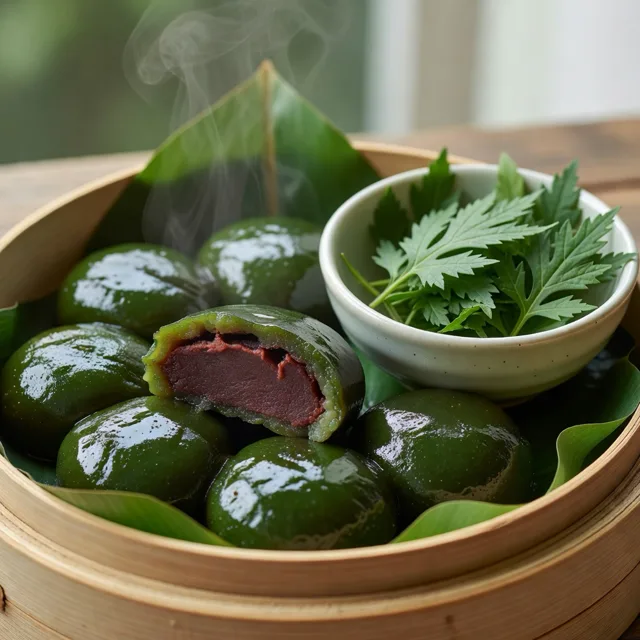
There is one food that announces the Qingming season the way cherry blossoms announce spring in Japan — and it is a small, impossibly green, slightly sticky ball of glutinous rice. 青团 (qīngtuán) — mugwort rice cakes — are eaten on 寒食节 (hánshí jié, Cold Food Day, April 4 this year) and 清明 (qīngmíng, April 5), and their season lasts barely three weeks before the mugwort grows too bitter for this use.
The vivid emerald color comes from 艾草 (àicǎo) — mugwort — one of TCM's most treasured herbs. Blended into glutinous rice dough and wrapped around a sweet red bean or savory filling, qingtuan combine ritual, flavor, and seasonal medicine in a single bite. If you have never made them, this is the year to try. If you have, this guide adds the TCM digestion angle you may have been missing.
Fair warning: these are deeply satisfying to make, and your kitchen will smell like a spring meadow for hours afterward.
Table of Contents
What Is Qingtuan
Qingtuan are small, round cakes made from glutinous rice flour mixed with a green plant paste — traditionally mugwort — then filled and steamed. They originated in the Jiangnan region (the Yangtze River Delta area around Shanghai, Suzhou, and Hangzhou) and are inseparable from the Qingming festival.
The connection to 寒食 (Cold Food Day) is direct: on a day when cooking was traditionally forbidden, cold qingtuan — prepared the day before — were the ready-made meal. They were also placed on ancestral altars as offerings. Today, the ritual dimension has softened for most families, but the food itself remains one of the most seasonal things you can eat in April.
In the US, qingtuan have become increasingly available at Chinese bakeries in major cities during Qingming season. If you would rather buy than make, look for them at Chinese and Taiwanese bakeries from late March through mid-April. Frozen versions from Asian grocery stores work as well — steam them for 8 minutes to revive the texture.
The Green: Mugwort vs Barley Grass
The two most common sources of qingtuan's signature color each bring different qualities.
| Property | Mugwort (艾草 Aicao) | Barley Grass (麦青汁) |
|---|---|---|
| Flavor | Distinctly herbal, slightly bitter, aromatic. The "real" qingtuan taste. | Milder, grassy, sweeter. More approachable for first-timers. |
| Color | Deep olive-green. Slightly muted after steaming. | Bright emerald green. Holds color well after steaming. |
| TCM Nature | Warm. Bitter and pungent. Enters Liver, Spleen, and Kidney channels. Disperses cold, warms the channels, stops pain. | Cool. Sweet. Milder action — clears heat gently. |
| Where to Find | Asian markets (fresh in spring, frozen or dried year-round). Some farmers markets carry it. | Barley grass powder is widely available online and in health food stores. Mix with water to form the juice. |
| Best For | Traditional flavor. People who enjoy herbal, slightly bitter notes. | Kids, guests new to qingtuan, or when fresh mugwort is unavailable. |
TCM Nature of the Ingredients
| Ingredient | TCM Nature | Role in the Recipe |
|---|---|---|
| Mugwort (艾草) | Warm, bitter, aromatic | Classically warms the channels and disperses cold and dampness. In spring, mugwort's warmth is said to counterbalance the coldness of glutinous rice. The fragrance moves qi. |
| Glutinous Rice Flour (糯米粉 nuòmǐ fěn) | Warm, sweet | Tonifies the Spleen and warms the Stomach. Heavy and sticky — which is why portions matter. The Spleen must work harder to transform glutinous rice. |
| Red Bean Paste (红豆沙) | Neutral, sweet | Nourishes the Heart and Blood, gently drains dampness. The most traditional filling and a good partner for the heavy rice wrapper. |
| Lard or Oil (猪油) | Neutral | A small amount mixed into the dough prevents cracking and keeps the texture soft after cooling. Vegetable oil works as a substitute. |
Master Recipe
Ingredients (makes 12-14 pieces)
- 200 g glutinous rice flour (糯米粉)
- 30 g rice flour (粘米粉, for structure — prevents the dough from being too sticky)
- 150 g mugwort paste (from about 100 g fresh mugwort, blanched and pureed) OR 2 tablespoons barley grass powder mixed with 3 tablespoons water
- 40 g sugar
- 1 tablespoon vegetable oil or melted lard
- 120-150 ml warm water (adjust as needed)
- About 300 g filling (red bean paste or savory — see below)
| Step | Method | Notes |
|---|---|---|
| 1. Mix dry | Combine glutinous rice flour, rice flour, and sugar in a large bowl. | The rice flour ratio matters. Too much glutinous flour = overly sticky. The 30 g of regular rice flour gives structure. |
| 2. Add green | Mix mugwort paste (or barley grass liquid) and oil into the dry ingredients. Add warm water gradually while stirring until a soft dough forms. | The dough should be smooth and pliable — like soft Play-Doh. Add water slowly; too much makes it impossible to shape. |
| 3. Knead | Knead for 5 minutes until the dough is smooth and the green color is uniform. Rest 10 minutes covered. | If using fresh mugwort, the dough will have visible flecks of herb. This is normal and traditional. |
| 4. Portion & fill | Divide dough into 12-14 equal pieces (about 30 g each). Flatten each into a disc, place 20-25 g of filling in the center, gather the edges, and seal into a smooth ball. | Oil your hands lightly to prevent sticking. Seal thoroughly — any gap will burst during steaming. |
| 5. Steam | Place each ball on a small square of parchment paper or a lightly oiled banana leaf. Steam over high heat for 10-12 minutes. | The parchment prevents the sticky dough from bonding with the steamer. Space them 2 inches apart — they expand slightly. |
| 6. Cool | Remove from steamer. Brush the surface lightly with oil to prevent a skin from forming. Cool on a rack for 10 minutes. | Best eaten warm or at room temperature the same day. The texture stiffens as it cools — see storage notes below. |
Fillings: Sweet & Savory
| Filling | Preparation | TCM Angle |
|---|---|---|
| Red Bean Paste (红豆沙) | Use store-bought or homemade. If homemade, cook adzuki beans until very soft, mash, and stir-fry with sugar and oil until thick. Roll into 25 g balls and chill before wrapping. | The classic. Red bean gently drains dampness and nourishes the Heart — a good complement to the heavy rice. |
| Black Sesame (黑芝麻) | Toast black sesame seeds, grind to a powder, mix with melted butter or lard and sugar. Chill until firm, then portion into balls. | Nourishes Kidney and Liver. Rich and warming — a luxurious variation. Like the tangyuan filling, it flows when bitten. |
| Salted Egg Yolk & Pork Floss | Crumble salted egg yolk, mix with pork floss (肉松) and a touch of mayonnaise. A modern Shanghai favorite. | Savory and rich. The salty flavor enters the Kidney channel in TCM's five-flavor system. Best as an occasional indulgence. |
| Savory: Bamboo Shoot & Pork | Finely dice spring bamboo shoots and pork. Stir-fry with soy sauce, sesame oil, and a pinch of sugar. Cool before wrapping. | Bamboo shoot is cool in TCM nature — a nice contrast to the warm mugwort dough. Light and seasonal. |
Eating Smart: Portions & Pairing
Glutinous rice is warming and nourishing, but it is also heavy. In TCM terms, the Spleen must work hard to transform sticky, dense food. Eat too many qingtuan in one sitting, and you may feel bloated, heavy, and sluggish the next morning.
Guidelines
- Adults: 2-3 pieces per sitting is a comfortable amount. Eat slowly.
- Children: 1 piece, cut in half. The sticky texture is a choking concern for very young children — supervise closely, and avoid serving to children under 3.
- Weak digestion: If you tend toward bloating, loose stools, or feel heavy after meals, start with 1 piece and see how your body responds. Pair with warm tea.
- Elderly: 1-2 pieces. Glutinous rice can be hard to digest for older adults with weaker Spleen qi. Warm tea alongside is essential.
What to Drink Alongside
- Pu-erh tea: Fermented, warming, and classically used to cut through heavy, sticky foods. The best pairing.
- Ginger tea: A few slices of fresh ginger in hot water. Warms the Stomach and helps the Spleen process the dense dough.
- Hawthorn tea (山楂水): The traditional digestive. Boil dried hawthorn slices with a little rock sugar. Drink warm after eating.
Storage & Make-Ahead Plan
Qingtuan are best the day they are made, but with Cold Food Day on Sunday April 4 and 清明 on Monday April 5, you may want to make a batch on Saturday April 3 and have them ready for both days.
| Method | How | Duration |
|---|---|---|
| Room temperature | Keep in an airtight container, wrapped individually in plastic wrap. The texture stiffens but remains edible. | Up to 1 day |
| Refrigerator | Wrap each piece individually. The dough will harden. Re-steam for 4-5 minutes before eating to restore softness. | 2-3 days |
| Freezer | Freeze unsteamed, shaped qingtuan on a parchment-lined tray first (so they don't stick together), then transfer to a freezer bag. Steam from frozen for 15 minutes. | Up to 1 month |
⚠️ Disclaimer: Qingtuan are a traditional food associated with the Qingming season. TCM properties of mugwort and glutinous rice are traditional classifications from Chinese dietary therapy. Mugwort should be sourced from a food-safe supplier — do not forage roadside mugwort, which may be contaminated. If you have plant allergies (particularly to the Asteraceae/daisy family), exercise caution with mugwort. Consult your healthcare provider if you have digestive conditions or dietary restrictions.
Eat for Your Season
Qingtuan are one thread in the fabric of spring food therapy. Your personal Five Element balance determines which seasonal foods serve you best — a BaZi consultation maps your dietary constitution.
Book a Consultation