农历: 丙午年 二月十二 (Fire Horse Year, 2nd Lunar Month Day 12)
宜 (Auspicious): 祈福 (Pray for Blessings) · 出行 (Travel) · 栽种 (Plant) · 开光 (Consecrate)
忌 (Avoid): 安葬 (Burial) · 动土 (Break Ground) · 伐木 (Cut Trees)
Modern psychology increasingly validates what feng shui practitioners have known for millennia: your physical environment profoundly impacts your mental state. Environmental psychology studies show that clutter raises cortisol (stress hormone), natural light reduces depression, and spatial organization improves cognitive function.
Feng shui provides a structured framework for creating environments that support mental wellness — not as a replacement for professional mental health care, but as a powerful complementary practice.
Feng shui is a complementary practice, not a substitute for professional mental health treatment. If you're experiencing clinical depression, severe anxiety, or other mental health conditions, please seek help from a qualified mental health professional. The suggestions below are environmental optimizations that can support — not replace — proper care.
Table of Contents
Clutter & the Mind: The Proven Connection
A 2011 study from Princeton Neuroscience Institute found that physical clutter in your visual field reduces your ability to focus and process information. Your brain's visual cortex is overwhelmed by irrelevant stimuli, leaving fewer cognitive resources for the task at hand.
In feng shui terms: clutter generates si chi (stagnant energy) that weighs on your psychological well-being like an invisible fog.
How Clutter Affects Different Areas:
- Cluttered bedroom: Restless sleep, increased anxiety, relationship tension
- Cluttered office: Reduced productivity, decision fatigue, procrastination
- Cluttered entry: Coming home feels oppressive instead of welcoming, resistance to returning home
- Cluttered closets: "Out of sight, out of mind" is a myth — your subconscious knows it's there. Creates background anxiety.
- Digital clutter: 10,000 unread emails, chaotic desktop files, notification overload — digital versions of physical clutter with similar stress effects
The Decluttering Protocol for Mental Health:
- Start with the bedroom: This is where you spend 30% of your life. Clearing this space yields the fastest improvement in sleep and anxiety.
- One drawer per day: Don't tackle the whole house at once — that creates more stress. One drawer, one shelf, one category at a time.
- The 12-Month Rule: If you haven't used, worn, or looked at something in 12 months, it goes. Exception: seasonal items and truly sentimental pieces (limit to one box).
- Don't just reorganize — remove: Buying organizing containers for clutter is like putting lipstick on a pig. The quantity must decrease, not just get rearranged.
Feng Shui for Anxiety
Anxiety is excessive yang energy — hyperactivity, racing thoughts, an inability to settle. The environmental prescription is to increase yin energy and create grounding.
Environmental Changes:
- Colors: Switch to cool, yin colors — soft blue, sage green, lavender, muted earth tones. Remove bright reds, oranges, and neon colors from the bedroom and living spaces.
- Lighting: Use warm, dim lighting in the evenings (2200K-2700K). Eliminate harsh fluorescent or cool white lights. Use dimmer switches.
- Sound: Add gentle, consistent sounds — a small water fountain, wind chimes, soft background nature sounds. These ground anxious chi.
- Weight/grounding: Use heavy, substantial furniture and decor. Thick rugs, weighted blankets, stone or ceramic accessories. Anxiety needs Earth element grounding.
- Crystals: Amethyst (calming), smoky quartz (grounding), lepidolite (anxiety-specific), blue lace agate (throat chakra — helps express rather than suppress anxiety).
- Plants: Lavender (scent calms nervous system), peace lily (air-purifying), snake plant (releases oxygen at night for better sleep).
Furniture Placement for Anxiety:
- Always sit/sleep in the Command Position — back to wall, facing the door. This eliminates the primal "something might come from behind" anxiety.
- Ensure your bed has a solid headboard against a solid wall — no windows or open space behind your head.
- Remove any furniture with sharp corners pointing at your sitting/sleeping area — these create subconscious threat signals.
Feng Shui for Depression
Depression is excessive yin energy — heaviness, darkness, stagnation, withdrawal. The prescription is to gently increase yang energy and movement.
Environmental Changes:
- Light is your #1 medicine: Open all curtains during daylight hours. Maximize natural light. Add full-spectrum daylight bulbs (5000K-6500K) to dark rooms. Light is literal Fire element — it activates stagnant chi.
- Colors: Introduce warm, uplifting colors in small doses — sunny yellow accents, warm peach, coral, soft orange. Don't go aggressively bright (that shifts to anxiety territory).
- Movement: Add moving elements to break stagnation — a tabletop fountain, a mobile, a clock with movement, wind chimes by an open window. Movement = yang = life.
- Living things: At least one live plant per room. Plants breathe, grow, and generate life energy. Taking care of something alive gives you purpose and routine.
- Remove heavy, dark objects: Dark curtains, heavy dark furniture, black decor — these amplify yin energy. Lighten the palette.
- Music/sound: Unlike anxiety (needs calming sound), depression needs uplifting sound — cheerful music, bird songs, lively wind chimes.
Key Room Changes:
- Make the bedroom brighter during the day and dark only for sleep
- Clear any path to the front door — an obstructed entry symbolizes blocked connection to the outside world
- Create an inviting chair by a window — somewhere to sit and receive natural light and an outside view during the day
Feng Shui for Chronic Stress
Chronic stress usually involves a combination of imbalances. The feng shui approach is to create a home that actively counteracts the stress you accumulate outside.
- Entry ritual space: Create a small area inside your front door where you can "shed" the day's stress — a coat hook, a place for keys, a small tray for emptying pockets. This physical ritual marks the transition from stressful outside to calm inside.
- No work in the bedroom: This is the most important boundary. Laptops, work files, and business calls in the bedroom prevent the nervous system from ever fully downshifting.
- Scent: Use calming essential oils — lavender in the bedroom, eucalyptus in the bathroom, citrus in the kitchen. Scent bypasses the cognitive brain and directly affects the limbic system.
- Temperature: Keep the home slightly cool (65-70°F / 18-21°C). Overheated spaces increase agitation. The bedroom should be the coolest room.
- Order: Visual order creates mental order. Simple, uncluttered surfaces reduce the cognitive load on a stressed brain. Every item should have a designated home.
Sleep Environment Optimization
Sleep is where mental health repair happens. The bedroom's feng shui directly impacts sleep quality:
| Factor | Optimal Setting | Feng Shui Reasoning |
|---|---|---|
| Light | Complete darkness | Maximum yin for sleep. Blackout curtains. |
| Temperature | 60-67°F (15-19°C) | Cool = yin = rest. The body needs to drop temp to sleep. |
| Sound | Quiet or consistent white noise | Unpredictable sounds activate yang alertness. |
| EMF | Phone across the room or off | EMF disturbs the body's energy field during vulnerable sleep state. |
| Colors | Soft blues, greens, neutrals | Yin colors slow neural activity. Red/orange stimulate it. |
| Bed position | Command position, solid headboard | Security = deep sleep. Insecurity = light, anxious sleep. |
| Under bed | Empty or near-empty | Stored items beneath create stagnant chi that interferes with sleep. |
Colors & Their Psychological Effects
| Color | Psychological Effect | Use For | Avoid In |
|---|---|---|---|
| Blue | Calming, lowers heart rate | Bedrooms, bathrooms | Dining rooms (suppresses appetite) |
| Green | Balancing, restorative | Any room — most versatile | — |
| Yellow | Uplifting, energizing | Kitchens, hallways | Bedrooms (too stimulating) |
| Red | Activating, passionate | Dining rooms (stimulates appetite), accents | Bedrooms, offices (anxiety) |
| White | Clarity, freshness | Offices, bathrooms | Entire home (sterile, cold) |
| Earth tones | Grounding, stable | Living rooms, bedrooms | — |
Nature Connection: Biophilic Design
Feng shui and biophilic design share a core principle: human beings thrive when connected to nature. Research shows that just looking at plants reduces stress by up to 60%.
- One plant per room minimum — non-negotiable for mental wellness
- Natural materials — wood, stone, cotton, linen — over synthetic materials
- Nature views from windows — if you don't have one, hang landscape photographs or nature art
- Natural light — maximize it. Even on cloudy days, natural light carries a full spectrum that artificial lights can't replicate.
- Water element presence — a small fountain's sound triggers the parasympathetic nervous system (rest and digest mode)
- Fresh air — open windows daily, even in winter. Indoor air is often 2-5x more polluted than outdoor air.
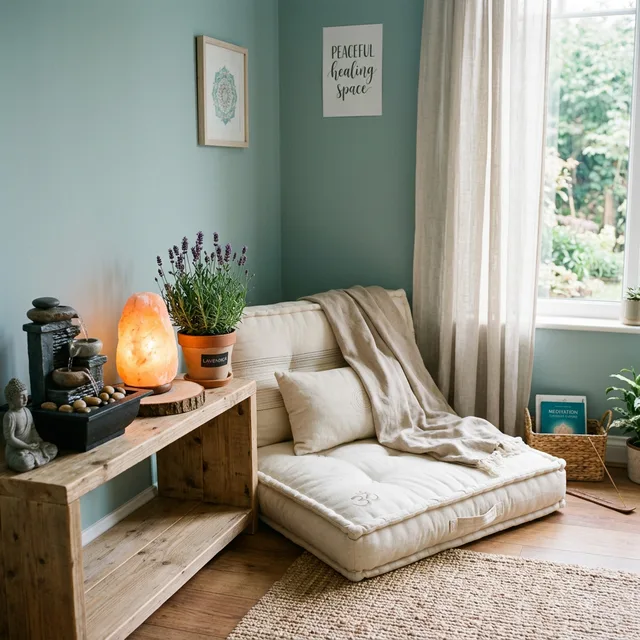
Creating Your Personal Sanctuary
Designate one spot in your home as your personal sanctuary — a place specifically designed for mental recovery:
- A comfortable chair or cushion
- Near natural light but not in direct view of others
- Calming colors and soft textures
- Personal crystals (amethyst, lepidolite, smoky quartz)
- A small plant or flower
- A candle (scented with lavender or chamomile)
- NO screens — this is a phone-free, screen-free zone
- A journal or quality book
Spend 10-15 minutes here daily — morning or evening. This simple practice of consistent retreat to a curated space creates measurable stress reduction over time.
Need a Wellness-Focused Consultation?
I offer consultations specifically focused on mental wellness feng shui — analyzing your home for anxiety triggers, depression-amplifying patterns, and stress contributors, with a customized optimization plan.
Book Wellness Consultation