农历: 丙午年 二月初三 (Fire Horse Year, 2nd Lunar Month Day 3)
宜 (Auspicious): 祈福 (Pray for Blessings) · 出行 (Travel) · 栽种 (Plant) · 开光 (Consecrate)
忌 (Avoid): 安葬 (Burial) · 动土 (Break Ground) · 伐木 (Cut Trees)
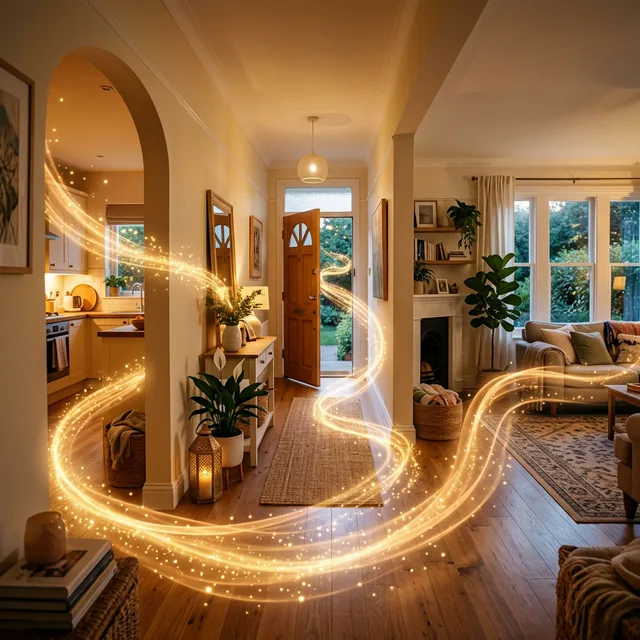
Everything you've ever read about feng shui — the Bagua map, the Five Elements, crystal placement, colors — all of it serves a single purpose: to optimize the flow of chi (气) through your living space.
Chi is the invisible life force energy that permeates everything. It flows through your home like water through pipes. When it flows smoothly, life feels easy — money comes, health improves, relationships flourish. When it's blocked, stagnant, or rushing too fast, problems stack up in ways that feel random but are actually traceable to your environment.
This article teaches you to see chi like a feng shui master does — not with mystical vision, but with practical, spatial awareness.
Table of Contents
What Is Chi, Really?
In Chinese philosophy, chi (气) is the fundamental substance of the universe. The character 气 originally depicted steam rising from cooking rice — something invisible but real, life-sustaining, ever-moving.
In practical terms for your home, chi is the quality of the air, light, sound, and spatial feeling of a room. When you walk into a cathedral and feel uplifted, or enter a cramped basement and feel oppressed — that's chi difference. You've been sensing chi your entire life; you just didn't have a name for it.
Chi exists in two fundamental states:
- Yang Chi (阳气): Active, bright, warm, moving energy. Found in sunlit rooms, near running water, in open spaces, with living plants. Yang chi promotes productivity, social interaction, and forward momentum.
- Yin Chi (阴气): Passive, dark, cool, still energy. Found in shaded areas, quiet corners, closed spaces, near still water. Yin chi promotes rest, reflection, and recovery.
Neither is good or bad — you need both. The bedroom needs more yin; the office needs more yang. Problems arise when the balance is wrong for the room's purpose.
The Three Types of Chi in Your Home
| Type | Chinese | Character | Effect |
|---|---|---|---|
| Sheng Chi | 生气 | Vital, life-generating | ✅ What you want. Fresh, vibrant, nourishing energy. Found in well-lit, clean, ventilated spaces with living things. |
| Sha Chi | 煞气 | Attacking, harmful | ❌ Sharp, aggressive energy. Created by sharp corners, long straight hallways, poison arrows, cluttered angles. Causes accidents, arguments, illness. |
| Si Chi | 死气 | Dead, stagnant | ❌ Still, decaying energy. Found in dark corners, under clutter, in unused rooms, around dead plants. Causes depression, lethargy, stuck patterns. |
Your feng shui goal is simple: Maximize sheng chi, neutralize sha chi, and prevent si chi. Every feng shui technique in existence serves one of these three purposes.
How Chi Enters Your Home
Chi primarily enters through the front door — called the "Mouth of Chi" (纳气口). This is why front door feng shui is the most impactful single adjustment you can make.
What Helps Chi Enter:
- Clear, unobstructed path from the street to the door (the "Ming Tang" or bright hall)
- Working doorbell and visible house numbers — chi (and opportunities) need to find you
- Good lighting at the entry — dark entrances repel chi
- Clean door that opens fully (not blocked by shoes, boxes, or a coat rack)
- Welcome mat in good condition — not torn, faded, or dirty
What Blocks Chi Entry:
- Dead potted plants flanking the door
- Pile of shoes or Amazon boxes inside the entry
- A door that squeaks, sticks, or won't open fully (blocked by furniture behind it)
- A tree, pole, or column directly in front of the door (poison arrow)
- Dark, unlit pathway approaching the house
Stand outside your front door. What's the first thing you see and feel in the first 3 seconds? That's the first impression chi makes when it enters your home. If it's clutter, darkness, or a wall — chi (and luck) will hesitate to enter. If it's light, space, and a pleasant view — chi flows in eagerly.
How Chi Circulates (or Gets Stuck)
Once inside, chi behaves like water flowing through a gentle stream. It follows paths of least resistance, pools in open areas, and gets trapped in dead-end corners.
The Ideal Chi Path:
Chi should meander through your home in gentle curves, touching every room without rushing through any single one. Think of it like a dinner party guest — they should explore the whole house at a comfortable pace, spending quality time in each room.
Where Chi Gets Stuck (Si Chi Zones):
- Corners — especially where walls meet at 90° angles. Chi pools here and stagnates. Fix: round-leaved plants, soft lighting, or a small crystal.
- Behind doors — the triangle of dead space behind an open door is one of the most common si chi zones. Don't store anything here.
- Under beds — whatever you store under the bed sits in stagnant energy all night, 8 hours a day. Ideally, keep this space empty.
- Closets and storage rooms — closed, dark, packed spaces generate si chi. Air them out regularly and don't let them overflow.
- Unused rooms — a guest room that's never opened generates dead energy that slowly affects the entire home. Open the door and window for at least 30 minutes weekly.
Where Chi Moves Too Fast (Sha Chi Zones):
- Long, straight hallways — chi accelerates like water in a narrow channel, becoming aggressive. Fix: hang pictures on alternating sides to create a zigzag pattern, or place a runner rug with a pattern.
- Staircases facing the front door — chi rushes upstairs before reaching the ground floor rooms. Fix: use a round table, plant, or crystal between the door and stairs.
- Aligned doors — when 3+ doors line up in a row, chi shoots through like a bullet. Fix: offset the sight line with furniture or a room divider.
- Sharp corners of furniture pointing at sitting areas — these create "poison arrows" that direct sha chi at anyone sitting there. Fix: reposition or soften with a draped fabric.
How Chi Exits (and Takes Your Luck With It)
Chi exits through:
- Drains — every toilet, sink, and shower drain is a chi exit point. This is why bathrooms are problematic — they're essentially chi vacuum cleaners.
- Windows — chi slowly leaks through open windows. This is normal and healthy (fresh chi in, stale chi out), but problematic when a window directly faces the front door (chi enters and immediately exits).
- Back doors — especially when aligned with the front door (穿堂煞, the Through-Hall Evil).
- Garage doors — an attached garage with a direct connection to the living space creates a massive chi exit. Keep the interior door to the garage closed.
Count the number of drains visible from your front door. Each one is a potential wealth exit. If you can see a toilet, sink, or floor drain from the entry, that's a priority fix. Solution: close bathroom doors, use drain covers, and place plants between the entry and visible drains.
Chi Speed: The Goldilocks Principle
Like Goldilocks' porridge, chi flow needs to be just right — not too fast, not too slow.
| Chi Speed | Symptoms | Where It Happens | Fix |
|---|---|---|---|
| Too Fast | Anxiety, arguments, money comes and goes quickly, accidents | Long hallways, aligned doors, staircase to front door | Wind chimes, crystals, rugs, plants to slow it down |
| Just Right | Calm productivity, steady income, good health, harmonious relationships | Curved pathways, well-lit open rooms with some furniture | Maintain what's working! |
| Too Slow | Depression, lethargy, feeling "stuck," weight gain, stalled career | Cluttered corners, dark rooms, unused spaces, heavy furniture | Declutter, add light, introduce movement (fans, fountains, mobiles) |
Self-Diagnosis: Walk Your Home Like a Master
Here's a professional feng shui technique you can do yourself right now:
- Start at your front door. Stand outside, take a breath, and open it as if you're entering for the first time.
- Walk slowly through every room in the order you naturally move through them. Don't force a path — follow the route that feels natural.
- In each room, notice:
- Does it feel bright or dark?
- Does the air feel fresh or stale?
- Does the space feel open or cramped?
- Do you naturally want to stay, or do you want to move on quickly?
- Are there corners where your eyes feel "heavy" — where you avoid looking?
- Pay attention to transitions between rooms. Do you flow naturally from one to the next, or are there awkward doorways, dark hallways, or blocked paths?
- End at the farthest point from the front door. Did chi make it all the way here? Does this room feel alive or forgotten?
If you find yourself reluctant to enter certain rooms, if the air in some areas feels "thick," if corners feel dark despite adequate lighting, or if certain spots make you inexplicably uneasy — you've found your chi problem areas. These are where your feng shui work should focus first.
10 Universal Chi Flow Fixes
These work in virtually every home, regardless of layout or compass direction:
- Open all windows for 15 minutes daily — the most basic and powerful chi refresh. Fresh air = fresh chi. Do this even in winter.
- Fix everything that's broken — dripping faucets, stuck drawers, squeaky hinges, cracked windows. Broken items generate si chi and symbolize stagnation.
- Clear clutter from the entry — your home's chi starts at the door. A clean entry = clean chi intake. Remove shoes to a closed cabinet.
- Add one living plant to every room — plants are nature's chi generators. They convert si chi to sheng chi. Choose round-leaved varieties over spiky ones.
- Use flowing water somewhere — a tabletop fountain in the living room (North or East sector) keeps chi active and attracts wealth. The sound of moving water energizes stagnant spaces.
- Hang a faceted crystal ball in a window — it disperses light (and chi) into rainbow patterns throughout the room. A 40mm crystal creates remarkable chi distribution.
- Use mirrors strategically — mirrors double the energy of whatever they reflect. Place them to reflect beautiful views, gardens, or dining tables (doubles abundance). NEVER let them reflect clutter, toilets, or the bed.
- Alternate light levels — use dimmer switches or multiple light sources instead of single overhead lights. Chi responds to layered lighting the way streams respond to varied terrain — it becomes more alive.
- Create gentle curves — place furniture at slight angles rather than perfectly parallel to walls. Round tables instead of rectangular. Curved pathways instead of straight lines. Curves slow chi to a nourishing speed.
- Use sound — wind chimes near windows, a clock with a gentle tick, soft background music. Sound moves chi through stagnant areas better than almost any other cure.
Want a Professional Chi Flow Analysis?
I'll walk through your home (in-person or via video tour) and map your chi flow — identifying every blockage, acceleration point, and stagnation zone. You'll receive a prioritized fix list that typically takes one weekend to implement.
Book Chi Flow Analysis