Here is a question that confuses almost everyone learning TCM food therapy: if 酸 (suān) — the sour flavor — belongs to the Liver, and spring is Liver season, shouldn't you eat more sour food in spring? The answer, counterintuitively, is less, not more. The classical spring diet rule is 省酸增甘 (shěng suān zēng gān) — ease off sour and add mildly sweet, neutral foods.
This is not a ban on vinegar. It is not a rule against citrus or pickles. It is a principle of proportion that makes elegant sense once you see the logic — and it changes how you build every meal from now through May.
Today we unpack the paradox, explain the mechanism in plain language, and give you practical guidance on vinegar, plums, hawthorn, and the sweet-neutral foods that should anchor your spring plate.
Table of Contents
The Paradox Explained
In the Five Element system, each organ has an associated flavor. The 肝 (gān) — Liver — is paired with sour. In moderate amounts, sour nourishes the Liver. This is true all year round.
But spring changes the equation. In spring, the Liver is already at its strongest. Wood element qi surges upward and outward — this is the natural rising energy of the season. The Liver does not need extra fuel. It is running hot.
Now consider the Five Element control cycle: Wood controls Earth. In the body, the Liver (Wood) restrains the 脾 (pí) — Spleen (Earth). When the Liver is at peak strength, it can over-restrain the Spleen, weakening digestion. Adding excess sour — the Liver's own flavor — is like pouring gasoline on a fire that is already crowding the room next door.
The solution is 增甘 — add mildly sweet foods. Sweet is the Spleen's flavor. By gently supporting the Spleen, you prevent the Liver from dominating the digestive system. Balance is restored.
The Five Element Logic
| Element | Organ | Flavor | Spring Status |
|---|---|---|---|
| 🌳 Wood | Liver (肝) | Sour (酸) | At peak strength. Needs moderating, not fueling. Excess sour amplifies an already-strong Liver. |
| 🔥 Fire | Heart (心) | Bitter (苦) | Not yet dominant. Wood generates Fire — Heart energy will build as spring progresses toward summer. |
| 🌍 Earth | Spleen (脾) | Sweet (甘) | Under pressure from the surging Liver. Needs gentle support. Mildly sweet, neutral foods protect it. |
| ⚪ Metal | Lung (肺) | Pungent (辛) | Receding from its autumn peak. A small amount of pungent (scallion, ginger) still helps disperse wind. |
| 💧 Water | Kidney (肾) | Salty (咸) | Resting after winter's peak. Moderate salt is fine; the emphasis shifts away from Kidney-focused eating. |
The takeaway: spring eating is about restraining Wood and supporting Earth. Less sour, more mild-sweet. Not zero sour — just not a sour-dominant plate.
How to Use Sour Foods Right
Sour is not your enemy in spring. It simply steps from lead role to supporting actor. Here is how three common sour foods fit into a balanced spring kitchen.
Black vinegar (黑醋 / 香醋)
A splash of 镇江香醋 (Zhènjiāng xiāngcù) — Chinkiang black vinegar — on sauteed greens or as a dipping sauce is perfectly appropriate. The quantity is small, and the vinegar aids fat digestion. What to avoid: vinegar-heavy cold noodle dishes as your daily lunch, or drinking apple cider vinegar shots on an empty stomach in the morning. The dose makes the difference.
Hawthorn (山楂 shānzhā)
Dried hawthorn slices steeped in hot water make an excellent after-meal tea, especially after a heavy or greasy meal. In TCM, hawthorn is traditionally used to help digest meat and move food stagnation. A few slices in your afternoon tea is a digestive aid, not a Liver overstimulant. What to avoid: eating hawthorn candy by the handful or drinking strong hawthorn tea on an empty stomach — too much sour on an empty Spleen.
Preserved plums (话梅 huà méi)
One or two preserved plums after a meal can help settle the stomach and produce fluids. They are an occasional digestive treat, not a daily snack. The sugar-salt-sour combination in preserved plums is complex, and eating too many can aggravate both the Liver and the Spleen.
| Sour Food | Spring-Appropriate Use | What to Avoid |
|---|---|---|
| Black vinegar | Splash on cooked greens, dipping sauce, dressing component | Vinegar shots, vinegar-heavy cold noodles daily |
| Hawthorn (山楂) | 2–3 slices in hot water after a heavy meal | Strong hawthorn tea on empty stomach, hawthorn candy in quantity |
| Preserved plums | 1–2 after a meal as a digestive | Eating them like candy throughout the day |
| Citrus (lemons, oranges) | Lemon in warm water, orange segments as snack | Large glasses of cold lemon juice, especially before breakfast |
| Pickles / kimchi | Small side dish with a balanced meal | Pickle-heavy meals with no sweet-neutral anchor |
The Sweet-Neutral Anchor Foods
These are the foods that should form the backbone of your March plate. In TCM, they are classified as sweet in flavor and neutral to slightly warm in nature — meaning they nourish without overheating or overcooling. They support the Spleen, which is under extra pressure from the surging Liver this season.
| Food | TCM Nature | How to Use |
|---|---|---|
| 🥕 Chinese yam (山药 shānyào) | Neutral, sweet | Stir-fried, in soup, steamed as a side. The top Spleen-nourishing root in TCM. |
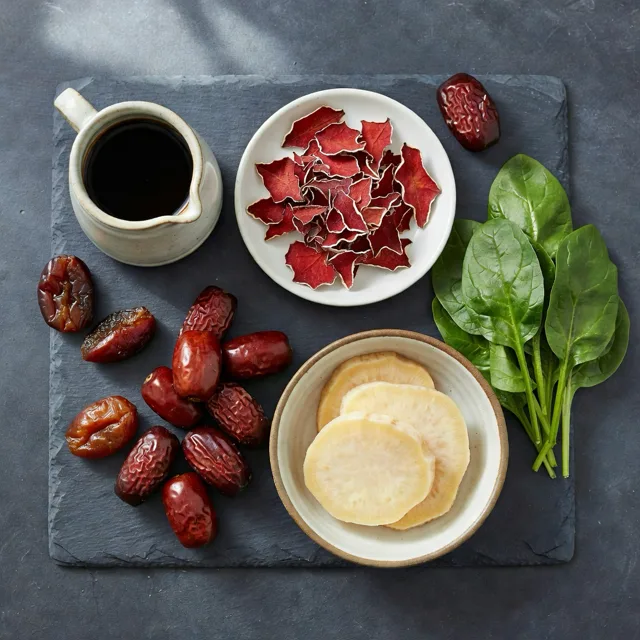
| 🔴 Red dates (红枣 hóngzǎo) | Warm, sweet | In tea (3–4 per cup), in congee, in soups. Boosts qi and nourishes Blood. |
| 🍚 White rice / millet | Neutral, sweet | The daily grain anchor. Congee or steamed rice. Easy on the Spleen. |
| 🥕 Carrots | Neutral, sweet | Cooked in soups, stir-fried, braised. Supports Spleen and benefits eyesight (Liver opens to the eyes). |
| 🍠 Sweet potato | Neutral, sweet | Baked, steamed, in congee. Comforting and Spleen-friendly. Not too heavy for spring. |
| 🫘 Lotus seeds (莲子 liánzǐ) | Neutral, sweet, astringent | In sweet soups, congee, or dessert broths. Calms the Heart and supports the Spleen. |
Who Should Adjust and How
The 省酸增甘 rule applies broadly, but your body constitution fine-tunes the ratio. Here is how different types should calibrate.
| Constitution | Spring Tendency | Sour-Sweet Adjustment |
|---|---|---|
| 🔥 Liver-Heat / Irritable Type | Easily frustrated, red eyes, bitter taste, headaches | Strictly ease off sour. A small amount of naturally sour fruit (like kiwi) is fine, but avoid vinegar-heavy and spicy foods. Focus on cooling sweet foods: pear, cucumber, mung bean. |
| 😰 Spleen-Qi Deficient | Bloating, loose stools, fatigue after eating, poor appetite | This is the type most vulnerable when the Liver surges. Minimize all sour. Maximize cooked sweet-neutral foods: yam, congee, jujube, millet. Avoid raw cold food entirely. |
| 🧊 Cold / Yang-Deficient | Still cold in spring, slow to warm up, low energy | Moderate sour is acceptable because your Liver is not overheating. Add warming aromatics (ginger, cinnamon) to your sweet-neutral foods. Warm everything. |
| ⚖️ Balanced / Neutral | Feels generally well, energy is good | Follow the standard rule: sour as a condiment, sweet-neutral as the foundation. You have the widest flexibility. |
A Week of Balanced Spring Plates
Here is how 省酸增甘 looks across three meals a day. Notice the pattern: sweet-neutral foods form the base of every meal, sour appears as a small accent once or twice a day at most, and the balance consistently favors the Spleen.
| Day | Breakfast (Sweet-Neutral) | Lunch | Dinner |
|---|---|---|---|
| Mon | Millet congee with jujube and goji | Rice, stir-fried yam with pork, blanched bok choy | Tofu-mushroom soup with rice. Sour accent: none |
| Tue | Oatmeal with sweet potato and walnuts | Stir-fried carrots and pork, rice. Accent: splash of black vinegar | Spinach-goji soup, steamed bun |
| Wed | Rice congee with carrot and egg | Rice, steamed sweet potato, blanched greens. Accent: lemon wedge | Tofu-tomato egg-drop soup with noodles |
| Thu | Steamed bun, warm soy milk, boiled egg | Yam and chicken stew over rice | Clear fish soup with greens. Accent: 2 hawthorn slices in post-meal tea |
| Fri | Chrysanthemum-goji tea, millet congee | Stir-fried greens with garlic, rice, braised tofu | Lotus-seed sweet soup, steamed bun |
| Sat | Pumpkin congee with red dates | Pork rib and yam soup with rice | Noodle soup with bok choy and egg. Accent: 1 preserved plum as digestive |
| Sun | Rice congee with yam and goji | Steamed fish, stir-fried watercress, rice | Congee with leftover soup broth and greens — a light, Spleen-friendly close |
Spring pantry staples to stock now
Buy these once at the start of March and you have the backbone of every meal above. Most are shelf-stable for weeks or months.
- Grains: White rice, millet, rolled oats — the sweet-neutral base of every breakfast and dinner.
- Roots: Chinese yam (山药), sweet potato, carrots, pumpkin — the 增甘 anchors.
- TCM pantry: Red dates, goji berries, dried lotus seeds, rock sugar — tea and congee additions.
- Greens: Spinach, bok choy, watercress — buy fresh twice a week. The Liver's color is green; these soothe without overheating.
- Protein: Tofu (silken and firm), eggs, chicken or pork for soups. Light proteins that do not burden the Spleen.
- Sour condiments (small quantities): One bottle of Chinkiang black vinegar, a bag of dried hawthorn slices, a packet of preserved plums. These last for months because you use them sparingly.
⚠️ Disclaimer: The 省酸增甘 principle is a traditional Chinese dietary guideline from classical TCM texts, not a medical prescription. TCM organ references (Liver, Spleen) describe traditional functional systems, not the biomedical organs. If you have diagnosed digestive conditions, acid reflux, or dietary restrictions, consult your healthcare provider before making significant changes to your diet.
Eat for Your Element
Your personal Five Element balance determines whether you need more Spleen support or more Liver calming this spring. A BaZi reading reveals your constitutional tendencies and the diet that serves you best.
Book a Consultation