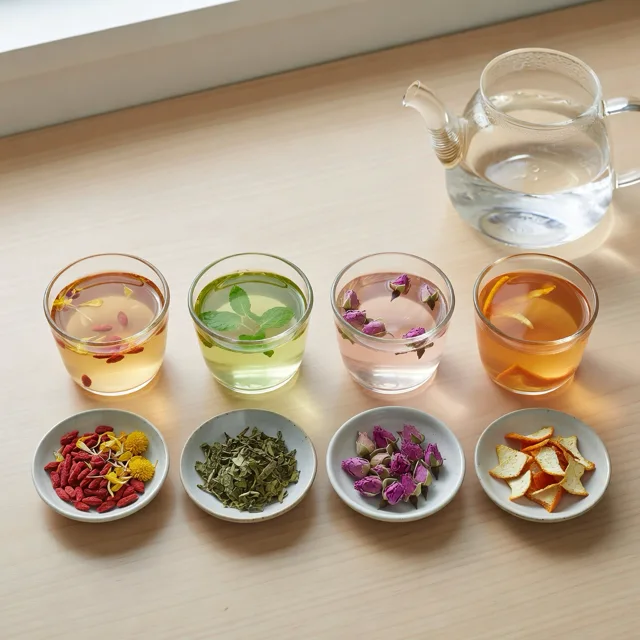
A week of feasting leaves traces. The heavy, greasy, sweet, and rich foods of the Spring Festival do not just burden the Spleen — they generate internal heat that rises and accumulates in the 肝 (gān) — the Liver system. Add the stress of family gatherings, broken sleep rhythms, and maybe a few too many toasts of 白酒, and the Liver is carrying a load it was not designed for.
Spring is the Liver's season. In TCM, the Liver governs the free flow of qi throughout the body. When it is overloaded with heat and stagnation, you feel it: irritability, headaches behind the eyes, a tight feeling in the ribcage, restless sleep, and that general sense of being wound too tight. The classical remedy is not a detox cleanse or a juice fast — it is a cup of the right tea at the right time.
These five herbal teas have been used in Chinese households for generations to soothe the Liver, clear accumulated heat, and ease the body from festival mode back into daily life. They are not medicine. They are the gentle daily practice that keeps your internal weather mild. For a broader look at tea and element theory, see our tea and Five Elements guide.
Table of Contents
Tea 1: Goji & Chrysanthemum (枸杞菊花茶)
枸杞菊花茶 (gǒuqǐ júhuā chá) is arguably the most classic Liver tea in all of Chinese food therapy. The pairing is ancient and elegant: chrysanthemum clears heat and brightens the eyes while goji nourishes Liver yin and replenishes what the heat burns away. Together, they form a balanced formula — one clears, the other restores.
TCM Profile
- 菊花 Chrysanthemum (júhuā): Cool in nature, sweet and bitter in flavor. Enters the Lung and Liver channels. Classically used to clear Liver heat, calm Liver yang rising, and benefit the eyes. The small, yellow Hangzhou variety (杭白菊 háng bái jú) is preferred for daily drinking.
- 枸杞 Goji berry (gǒuqǐ): Neutral to slightly warm, sweet. Enters the Liver, Kidney, and Lung channels. Nourishes Liver and Kidney yin, benefits essence, brightens eyes. The combination of cooling chrysanthemum and nourishing goji prevents the tea from being too cold for daily use.
How to Brew
Place 5-6 dried chrysanthemum flowers and a small handful (about 10) of goji berries in a glass or ceramic cup. Pour water that is just off the boil — around 90-95 degrees Celsius (195-200 degrees Fahrenheit). Let it steep for 5 minutes. The chrysanthemum flowers will open, and the goji berries will plump and soften. Refill with hot water 2-3 times through the day. Eat the softened goji berries at the end — they are food, not just flavoring.
For a deeper look at goji berries, including their traditional uses across seasons, see our goji berry guide.
Tea 2: Mint Tea (薄荷茶)
薄荷 (bòhé) — mint — is one of TCM's most accessible Liver qi movers. Cool in nature and pungent in flavor, it enters the Liver and Lung channels. Its traditional actions include dispersing wind-heat, soothing the throat, and — most relevant here — moving stagnant Liver qi. When you feel tight, tense, and irritable after days of heavy socializing, mint is the herb that opens the release valve.
How to Brew
Use 6-8 fresh mint leaves (spearmint or peppermint) or 1 teaspoon of dried mint. Pour water at about 85 degrees Celsius (185 degrees Fahrenheit) — boiling water scorches mint and makes it bitter. Steep for 3-4 minutes. Remove the leaves; do not over-steep. A touch of honey softens the cooling effect if you tend to run cold.
Mint + Green Tea
For an afternoon pick-me-up that clears the head and supports focus, combine dried mint with a teaspoon of green tea. Green tea is also cool and enters the Liver channel, and the caffeine provides a gentle lift without the crash of coffee. This combination is particularly good for the afternoon drowsiness of spring fatigue.
Tea 3: Rose Bud Tea (玫瑰花茶)
玫瑰花 (méiguī huā) — rose buds — are the gentle diplomat of the Liver tea world. Where mint is direct and cooling, rose is warm and softening. In TCM, rose is classified as warm in nature, sweet and slightly bitter in flavor, entering the Liver and Spleen channels. Its primary action is to 疏肝理气 (shū gān lǐ qì) — soothe the Liver and regulate qi flow.
Rose tea is particularly well suited for people who carry their tension emotionally rather than physically — mood swings, sighing, a sense of tightness in the chest, or an urge to cry without a clear reason. These are classic signs of Liver qi stagnation affecting the emotions, and rose is one of the gentlest ways to ease it.
How to Brew
Use 5-6 dried rose buds (food-grade, unsprayed — sourced from a Chinese tea supplier or health food store). Pour water at 80-85 degrees Celsius (176-185 degrees Fahrenheit). Steep for 5 minutes. The tea will be a pale pink with a delicate floral fragrance. Add a small piece of rock sugar or a goji berry for sweetness. Refill 2-3 times.
Rose + Red Date
For a warming, Blood-nourishing version, add 2-3 pitted, halved red dates (红枣 hóngzǎo) to the brew. The combination of rose (qi-moving) and red date (Blood-nourishing) creates a formula that both moves stagnation and replenishes what the stagnation depletes. This variation is especially suitable for women and anyone who feels both tense and tired.
Tea 4: Tangerine Peel Tea (陈皮茶)
陈皮 (chénpí) — aged tangerine peel — is one of the most versatile ingredients in the Chinese medicine cabinet. Warm in nature, pungent and bitter in flavor, it enters the Spleen and Lung channels. Its primary traditional action is to regulate qi and dry dampness — making it the ideal post-feast tea when your middle feels bloated and sluggish.
While it is not technically a "Liver tea," chenpi earns its place here because the Liver and Spleen are intimately connected. When the Liver stagnates, it overacts on the Spleen (Wood overcontrolling Earth in Five Element theory). Supporting the Spleen with chenpi takes pressure off both systems.
How to Brew
Use one piece of dried tangerine peel (about the size of your thumb) — or two smaller pieces. Rinse it briefly with hot water to remove surface dust. Place in a cup and pour boiling water directly. Let it steep for 8-10 minutes — chenpi needs longer than flowers or leaves to release its oils. The tea will be amber-colored with a warm, citrusy aroma. Refill several times; the flavor deepens with each steep.
Chenpi + Pu-erh
The famous 陈皮普洱 (chénpí pǔ'ěr) combination is a standard after-meal tea in Cantonese culture. Pu-erh is warm and fermented, excellent for cutting grease. Chenpi adds its qi-regulating and dampness-drying properties. Together, they make the most effective post-feast digestive tea in the Chinese tea tradition. Brew them together in a small teapot, using a piece of chenpi and a teaspoon of loose pu-erh. For more on seasonal tea selection, see our autumn tea guide, which covers pu-erh in depth.
Tea 5: Roasted Barley Tea (大麦茶)
大麦茶 (dàmài chá) — roasted barley tea — is the least glamorous tea on this list and one of the most effective. Cool in nature, sweet in flavor, it enters the Spleen and Stomach channels. It is not technically a Liver tea, but its power lies in its ability to drain dampness and support digestion — which, when your Spleen is overwhelmed from feasting, indirectly frees the Liver to do its own work.
Barley tea is also caffeine-free, inexpensive, and universally palatable. In Japan (where it is called mugicha) and Korea (boricha), it is a year-round household staple served cold in summer and warm in winter.
How to Brew
Use 2 tablespoons of roasted barley kernels (available in Asian grocery stores, or buy raw barley and dry-roast it in a skillet until dark golden and fragrant). Bring 4 cups of water to a boil. Add the barley, reduce heat, and simmer for 10 minutes. Strain and drink warm. The flavor is toasty, malty, and comforting — like a grain-based coffee without the caffeine.
Master Brewing Table
| Tea | Amount | Water Temp | Steep Time | Refills |
|---|---|---|---|---|
| Goji + Chrysanthemum | 5-6 flowers + 10 goji | 90-95 C (195-200 F) | 5 min | 2-3 |
| Mint | 6-8 fresh leaves or 1 tsp dried | 85 C (185 F) | 3-4 min | 1-2 |
| Rose Buds | 5-6 buds | 80-85 C (176-185 F) | 5 min | 2-3 |
| Tangerine Peel | 1 thumb-sized piece | 100 C (212 F) | 8-10 min | 3-4 |
| Roasted Barley | 2 tbsp kernels | 100 C (boil & simmer) | 10 min simmer | 1-2 |
When to Drink Which Tea
| Time of Day | Best Choice | Why |
|---|---|---|
| Morning (before 10 AM) | Goji + Chrysanthemum or Rose | The Liver channel is most active in the early morning (1-3 AM was its peak, but the effects carry into morning). A Liver-soothing tea on waking supports the day's qi flow. |
| Mid-morning (10 AM - noon) | Mint or Mint + Green Tea | The Spleen channel is active (9-11 AM). Mint's clearing, rising action complements the Spleen's peak transforming time. |
| After lunch | Tangerine Peel or Chenpi + Pu-erh | Digestive support at the moment of greatest need. Helps the Spleen process the midday meal. |
| Afternoon (3-5 PM) | Barley Tea | Caffeine-free and dampness-draining. The afternoon is Bladder channel time — supporting water metabolism helps the body drain accumulated fluid. |
| Evening (after 6 PM) | Rose or Goji + Chrysanthemum | Both are caffeine-free and calming. Rose soothes the emotions before sleep. Goji + chrysanthemum nourishes yin for a restful night. |
Who Should Be Careful
| Situation | Guidance |
|---|---|
| Pregnancy | Avoid mint tea (traditionally contraindicated in pregnancy due to its strong qi-moving action). Rose is considered generally mild, but consult your practitioner. Goji + chrysanthemum and barley are typically considered safe in moderate amounts. |
| Cold constitution (yang deficiency) | If you tend to feel cold, have cold hands and feet, and prefer warm environments, go easy on chrysanthemum and mint — both are cooling. Favor rose (warm) and chenpi (warm) instead, and add ginger slices to barley tea. |
| Taking medications | Some herbal teas interact with medications. If you are on blood thinners, blood pressure medication, or hormone treatments, check with your doctor before adding herbal teas as a daily habit. |
| Allergies | Chrysanthemum is in the daisy (Asteraceae) family. If you are allergic to ragweed, daisies, or marigolds, use caution with chrysanthemum tea or skip it. |
| Children under 6 | Herbal teas are typically given in much smaller amounts to young children, if at all. Barley tea is the safest option for kids. Avoid mint for infants. |
⚠️ Disclaimer: The herbal teas described here are traditional Chinese food therapy beverages, not pharmaceutical treatments. Their properties are described according to classical TCM theory. If you have a diagnosed liver condition, are pregnant, or are taking prescription medications, consult a healthcare professional before incorporating herbal teas into your daily routine.
Your Tea, Your Constitution
Different body types thrive on different teas. A BaZi and constitution assessment reveals whether your system runs hot or cold, damp or dry — and which daily teas will support you best through spring.
Book Your Reading