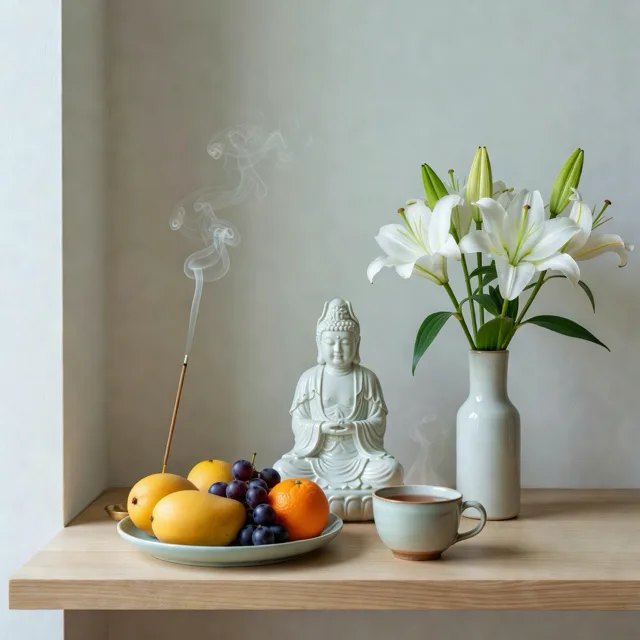
On Friday, March 26, 2027 — the 19th day of the second lunar month — millions of people across the Chinese-speaking world observe 观音诞 (Guānyīn Dàn), the birthday of 观世音菩萨 (Guānshìyīn Púsà), known in English as Guanyin, the Bodhisattva of Compassion. It is one of the most widely observed devotional days in Chinese culture, and it happens to coincide this year with Good Friday, the most solemn day in the Christian calendar.
Two traditions, one shared theme: compassion, mercy, and the pause that comes from looking beyond yourself. Whether you follow either tradition, both, or neither, there is something here worth borrowing for a single March day.
This is not a religious instruction article. It is a cultural guide — what this day means, how families have traditionally observed it, and how you can create a quiet, intentional space at home if the idea resonates with you.
Table of Contents
Who Is Guanyin
观世音 (Guānshìyīn) literally means "the one who perceives the sounds of the world" — specifically the cries of suffering. In Chinese devotional life, Guanyin is the figure people turn to in moments of fear, grief, illness, and childbirth. You will find Guanyin statues in Buddhist temples, Daoist shrines, family altars, and in many Chinese restaurants and businesses. The figure transcends any single religious tradition in Chinese culture.
Guanyin is most commonly depicted as a serene woman in white robes, holding a vase of pure water and a willow branch — symbols of purifying compassion. In some traditions, Guanyin holds a child, and families praying for children have historically directed their prayers to Guanyin.
What makes Guanyin unique in Chinese cultural life is the emphasis on unconditional compassion. The vow attributed to Guanyin is to hear all who call, without exception. That universality is why the figure appears across Buddhist, Daoist, and folk traditions alike — and why the birthday observance is one of the most widely practiced across East and Southeast Asia.
The Three Guanyin Days of the Year
The Chinese lunar calendar marks three Guanyin days, each tied to a different chapter of the traditional story:
| Lunar Date | Significance | 2027 Solar Date |
|---|---|---|
| 2nd month, 19th day | Guanyin's birthday (诞辰) | Friday, March 26, 2027 |
| 6th month, 19th day | Guanyin's enlightenment (成道日) | Varies by year |
| 9th month, 19th day | Guanyin's renunciation (出家日) | Varies by year |
Of the three, the birthday on 2/19 is the most widely observed. Temples hold special services, offer vegetarian feasts, and sometimes release captive animals (放生 fàngshēng) as a symbolic act of mercy. At home, the observance is simpler: a vegetarian meal, a moment of quiet, and an intention toward kindness.
The Good Friday Coincidence
In 2027, 观音诞 and Good Friday fall on the same day. This is a calendar coincidence, not a theological connection — but it is a remarkable one. Good Friday in Christian tradition commemorates sacrifice and mercy. Guanyin's birthday celebrates the embodiment of compassion.
For families that bridge Chinese and Western traditions — and many of this site's readers do — the overlap is a natural invitation to hold both with respect. You might attend a Good Friday service and prepare a vegetarian dinner afterward. You might light a candle at home and spend five minutes in silence, honoring whichever tradition speaks to you. The point is not to blend or compare, but to recognize that two of the world's great traditions chose the same day, in 2027, to remind us about mercy.
As we did with the Christmas Day piece, this guide treats both traditions with warmth and does not attempt to interpret either one's theology. The shared theme — compassion — needs no translation.
The Vegetarian Meal Custom
The most common home observance of Guanyin's birthday is eating 素 (sù) — a vegetarian meal — for the day. In Chinese Buddhist practice, vegetarian days are acts of 慈悲 (cíbēi, compassion) toward living beings. The meal does not need to be elaborate. It needs to be intentional.
A simple 观音诞 menu
| Dish | Notes |
|---|---|
| Stir-fried seasonal greens | Whatever is fresh at the market — bok choy, Chinese broccoli, spinach. Simple garlic and oil. |
| Braised tofu with mushrooms | A satisfying center dish. Shiitake or king oyster mushrooms add umami depth. |
| Clear vegetable soup | Napa cabbage, carrot, glass noodles. Light and warming for spring evenings. |
| Steamed rice | Plain white or brown rice. The grounding base. |
| Fresh fruit | Traditionally offered first, then shared as dessert. Oranges, apples, bananas. |
The traditional rule is no meat, no fish, no eggs, and no pungent alliums (garlic, onion, chives, leeks, green onion) — the 五荤 (wǔ hūn, five pungent vegetables) are traditionally avoided on devotional days. In practice, many modern families simply skip the meat and are not strict about alliums. Either approach is fine. The intention matters more than the strictness.
Setting a Quiet Home Altar or Shelf
Not every family keeps a home altar, and not every reader will want one. But if you find meaning in having a small, dedicated space for quiet reflection — whether or not it includes a Guanyin figure — here are the traditional placement guidelines.
Where to place it
- Elevated. A high shelf, a wall-mounted ledge, or the top of a tall bookcase. The space should be above waist height. Tradition holds that devotional items are placed high out of respect.
- Quiet area. A living room corner, a study, or a hallway alcove. Not in a high-traffic, noisy zone.
- Not in the bedroom. Traditional placement avoids sleeping areas. The bedroom is a yin, private space; an altar is a yang, communal one.
- Not facing a bathroom or kitchen stove. The bathroom is a drain point for qi. The kitchen stove is Fire energy that, in traditional thinking, conflicts with the serene Water energy associated with Guanyin. A shelf that faces a wall or a window is ideal.
- Clean and uncluttered. Nothing else should crowd the shelf — no stacks of mail, no random objects. A clear, dedicated surface.
What to place
- A Guanyin figure or image — ceramic, porcelain, or a framed print. Choose what feels right to you. There is no required size or material.
- A small cup of clean water. Changed daily. This represents Guanyin's vase of purifying water.
- Fresh flowers or a small plant. Nothing dried or artificial on the altar shelf.
- Fruit or tea as an offering. A few pieces of fresh fruit or a small cup of tea, placed in the morning.
- A candle or incense. Optional. If you use incense, keep it light — one stick, not a bundle. Good ventilation is essential.
The point of the space is not decoration. It is a physical anchor for a daily pause — a place where you stop, breathe, and reset your intention. The meditation guide covers longer practices. A Guanyin shelf invites something simpler: a moment of quiet each morning.
For readers who already have a feng shui symbols arrangement at home, a Guanyin figure fits naturally in the space. The key is sincerity, not display.
Compassion Practices for a Busy Week
You do not need a full day of silence to observe this. Here are five-minute practices that carry the spirit of the day into your week:
| Practice | How | Time |
|---|---|---|
| The morning pause | Before checking your phone, sit for 60 seconds and set one intention for how you want to treat people today. | 1 min |
| Release one grudge | Think of someone you are holding frustration toward. Consciously decide to let it go — not for them, for you. | 2 min |
| Compliment with specifics | Tell one person — a partner, coworker, barista — something specific you appreciate about them. | 30 sec |
| Eat one meal slowly | No phone, no TV. Taste each bite. Gratitude for the food is a form of compassion toward yourself. | 15 min |
| Evening water ritual | Pour a glass of clean water. Hold it. Think of one person who is struggling. Set the glass down. Drink it. | 2 min |
These are not religious acts. They are human ones. Guanyin's birthday, like many traditional observances, survives because the core message — pay attention to suffering, including your own, and respond with kindness — is universally needed.
As the Renri (People's Day) guide discussed, Chinese culture has many calendar anchors for self-reflection. 观音诞 is perhaps the gentlest of them all.
⚠️ Disclaimer: This article describes Guanyin and related customs as cultural practices observed across East and Southeast Asia. It is not religious instruction and does not endorse any particular spiritual practice. The home altar guidelines reflect traditional feng shui and cultural conventions. Observe what resonates with you and your family.
Find Your Quiet Center
A personalized BaZi reading can reveal which practices — meditation, movement, creativity, stillness — best support your elemental makeup this spring.
Book a Personal Reading