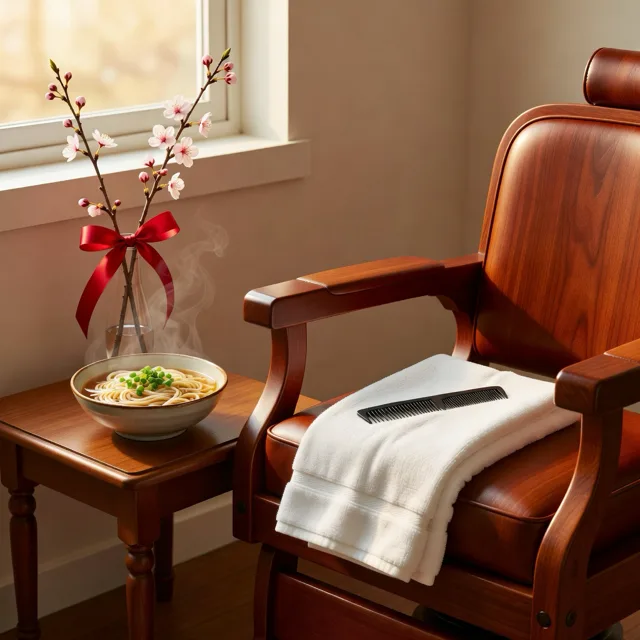
Every year on the second day of the second lunar month, the dragon lifts its head. 龙抬头 (lóng tái tóu) — literally "dragon raises its head" — marks the moment when the celestial Azure Dragon constellation begins to rise above the eastern horizon at dusk, signaling that spring has truly arrived and the earth is ready to wake up. In 2027, that day falls on Tuesday, March 9.
This is the day barber shops across China see their busiest traffic of the year. It is also the day kitchens fill with foods renamed after dragon body parts — noodles become dragon whiskers, dumplings become dragon ears, and spring pancakes become dragon scales. If the Lunar New Year launched the celebrations, 龙抬头 is the morning after the party when the real work begins.
For those of us living in the US, this festival is easy to observe and surprisingly fun. Here is what the day means, where the customs come from, and how to mark it with intention.
Table of Contents
Why the Dragon Raises Its Head
The name comes from astronomy. In the traditional Chinese sky, the eastern quadrant is mapped to the 苍龙 (cāng lóng) — the Azure Dragon, a constellation made up of seven lunar mansions (宿 xiù). During winter, the dragon lies below the horizon, hidden. By the second lunar month, the dragon's horn star (角宿 jiǎo xiù) begins to appear above the eastern horizon at dusk. The dragon is "raising its head."
In agricultural terms, this timing coincides with the awakening of insects (惊蛰 jīngzhé landed just three days ago on March 6), the return of spring rain, and the start of serious fieldwork. The dragon — always associated with water, rain, and imperial power in Chinese culture — was seen as the cosmic signal that the growing season had begun.
The day is also called 春龙节 (chūn lóng jié, Spring Dragon Festival) and, in some regions, 青龙节 (qīng lóng jié, Azure Dragon Festival). It was historically one of the year's most important agrarian markers — the day farmers committed to the fields.
The First Haircut of the Year
If you know one thing about 龙抬头, it is probably this: people line up for haircuts. But the custom only makes sense if you understand the month that preceded it.
There is a widely observed folk taboo against cutting hair during the first lunar month (正月 zhēngyuè). The saying goes: 正月剃头死舅舅 — "shaving your head in the first month will cause your uncle's death." The phrase sounds alarming, but linguistic historians trace it to a wordplay. The original expression was likely 正月剃头思旧 — "shaving in the first month means longing for the old." The word 思旧 (sī jiù, "missing the old ways") was gradually misheard as 死舅 (sǐ jiù, "uncle dies"). Over generations, the wordplay hardened into genuine superstition, and the taboo stuck.
Whatever its origin, the practical effect is clear: by lunar 2/2, a lot of people have gone over a month without a trim. 龙抬头 releases the taboo. Getting a haircut on this day is called 剃龙头 (tì lóng tóu) — "shaving the dragon's head" — and it symbolizes cutting away the old and inviting fresh, rising energy.
What it means for you
Even if you did not observe the first-month hair taboo, booking a haircut or trim on or around March 9 is a meaningful way to mark the day. Think of it as a physical renewal: shedding winter heaviness, aligning with the dragon's upward energy, and stepping into spring looking sharp.
For children, a first haircut on 龙抬头 is considered especially auspicious. It symbolizes the child "raising their head" — growing strong, healthy, and confident. Many Chinese families time a toddler's first real haircut to this date.
Dragon Foods: A Menu for March 9
On 龙抬头, nearly every food on the table gets renamed with a dragon body part. This is not random whimsy — it is sympathetic magic. By eating the dragon's body, you absorb its rising, powerful energy. Here are the main ones:
| Dragon Name | Actual Food | Symbolism |
|---|---|---|
| 龙须面 (lóng xū miàn) | Dragon-whisker noodles — thin, hand-pulled noodles | Long noodles = longevity, smooth fortune |
| 龙鳞 (lóng lín) | 春饼 (chūnbǐng) — spring pancakes, thin and round like scales | The dragon's armor; layers of protection for the year |
| 龙耳 (lóng ěr) | 饺子 (jiǎozi) — dumplings, ear-shaped when folded | The dragon listens to your wishes |
| 龙眼 (lóng yǎn) | 馄饨 (húntun) — wontons, round and plump like dragon eyes | Watchfulness, clarity of vision |
| 龙胆 (lóng dǎn) | 炸糕 (zhá gāo) — fried sweet rice cakes, golden and round | The dragon's courage; boldness for the year ahead |
| 龙子 (lóng zǐ) | 米饭 (mǐfàn) — steamed rice, each grain a "dragon's child" | Abundance, fertility |
The spring pancake spread
The centerpiece in many northern Chinese households is 春饼 — thin, soft wheat pancakes served with an array of fillings: shredded pork or chicken, scrambled eggs, bean sprouts, julienned scallions, sweet bean paste (甜面酱 tiánmiànjiàng), and crisp vegetables. You roll everything together and eat it by hand. It is the original wrap.
If you made spring rolls during 立春, the spring pancake is its gentler sibling — no frying, just a warm, soft wrapper holding the season's freshest ingredients. A batch of thin pancakes and a spread of fillings makes a casual, celebratory dinner that works beautifully for families.
Dragon-whisker noodles at home
True hand-pulled dragon-whisker noodles require serious skill — the dough is stretched and folded repeatedly until the strands are as fine as silk. Unless you are a practiced noodle puller, use the thinnest dried wheat noodles you can find (angel hair or capellini work in a pinch). Toss them in a simple sauce of soy sauce, sesame oil, minced garlic, and a splash of black vinegar. Top with a fried egg and chopped scallions.
The point is the symbolism: long, unbroken strands for a smooth, uninterrupted year.
Folk Customs: Ash Lines, Well Water & Waking the Earth
Beyond food and haircuts, 龙抬头 carries a set of folk practices that vary by region. Here are the most widely documented ones:
引龙 (yǐn lóng) — Leading the dragon home
In northern China, families traditionally drew a line of ash or lime powder from the nearest well or river to their front door and into the kitchen. This was called "leading the dragon" — inviting the water dragon to bring rain, prosperity, and good fortune into the home. Some families circled the ash line around water jars and grain stores, symbolically linking the dragon's water energy to the family's essential provisions.
Fetching morning water
On 龙抬头 morning, the first person to draw water from the village well was said to receive the "dragon's head water" — the most auspicious water of the year. Families would use this water to brew the day's first pot of tea or cook the morning meal. In modern terms, you might simply fill a fresh pitcher of water first thing in the morning with some intention behind it.
Sunning bedding and grain
The second day of the second month was a traditional day to air out bedding, quilts, and stored grain — shaking off the damp, stale energy of winter and exposing everything to the returning sun. If you have been meaning to wash heavy winter blankets or rotate stored provisions, this is the day the tradition supports it. The spring cleaning order we discussed earlier this week aligns well with this impulse.
Taboos of the Day
Like most Chinese festival days, 龙抬头 has its "don'ts." These are folk customs, not rigid rules — observe them if they resonate, and understand them culturally if they do not.
- Women traditionally did not sew or use needles — the fear was that needlework could "poke the dragon's eye," bringing misfortune. In practice, this gave women a day of rest from mending, one of the most labor-intensive daily tasks in historical households.
- Avoid grinding grain — turning the millstone was said to risk "crushing the dragon's head." Again, the practical effect was a day off from heavy labor.
- Do not wash clothes in some regional traditions — water use was reserved for the dragon's rituals. This one varies widely; many families simply avoid doing large loads of laundry.
- Speak carefully — as with many auspicious days in the Chinese calendar, harsh words, arguments, and complaints are discouraged. The dragon is listening.
A Modern Observance Plan
You do not need to draw ash lines or fetch well water to honor 龙抬头. Here is a simple, modern plan for Tuesday, March 9:
Morning
- Fresh water ritual: Fill a clean pitcher or kettle with fresh water first thing. Make your morning tea or coffee with it. Set a small intention for the season ahead — what do you want to grow?
- Air your bedding: Strip the bed and let the mattress breathe. If weather permits, hang quilts or comforters outside for an hour. This aligns with the tradition of sunning bedding on this day.
Midday
- Book a haircut: Walk-ins will be crowded at Chinese barbershops. Book ahead, or schedule one for this week. The symbolism extends a few days in either direction.
- Quick home walk-through: 龙抬头 is traditionally an awakening day — a good moment to open windows briefly, let fresh air circulate, and check corners that have been sealed since winter.
Evening
- Dragon-themed dinner: Make spring pancakes or noodles. If you have kids, let them help roll the pancakes or set the fillings — the "dragon" naming makes it a game. Serve dumplings as a side if you want to hit two dragon foods in one meal.
- Share the story: Tell someone at the table why the dragon raises its head. Cultural customs live when they are spoken, not just practiced.
A note on timing
龙抬头 sits three days after 惊蛰 (March 6) in 2027. The two festivals reinforce each other: 惊蛰 wakes the insects, and 龙抬头 wakes the dragon. Together, they are spring's alarm clock — the world is stirring, the growing season is real, and it is time to move. Our March kickoff maps the full month's rhythm.
Your Spring Awakening
龙抬头 marks the energy shift that sets your year's direction. A personalized BaZi reading can reveal which areas of your life are ready to "raise their head" this spring.
Book a Spring Reading