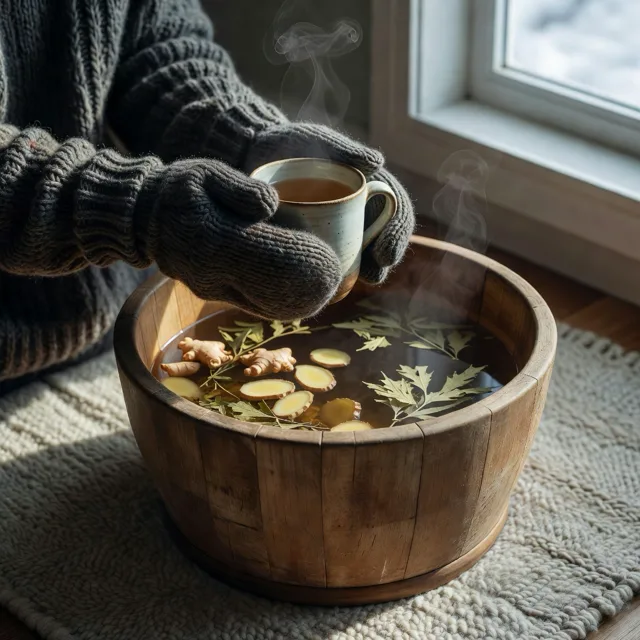
It is the middle of January. Your house is heated. You are wearing socks, slippers, and a sweater. And your hands are still cold. Your feet feel like blocks of ice under the blanket at night. Sound familiar?
In Western medicine, persistently cold extremities can relate to circulation, thyroid function, or conditions like Raynaud's phenomenon. In TCM, the picture is framed differently: cold hands and feet point to either 阳虚 (yáng xū) — yang deficiency — or 气滞 (qì zhì) — qi stagnation — or sometimes both. Yang is the body's warming, activating force. When it is depleted, heat cannot reach the periphery. When qi is stuck, warmth cannot flow even if it exists.
The good news: TCM has been addressing this for thousands of years, and many of the best strategies require nothing more than ginger, warm water, movement, and intention. Here is what actually helps.
Table of Contents
The TCM View: Why Your Extremities Go Cold
In TCM, the 肾 (shèn) — Kidney system — is the root of yang for the entire body. Winter is Kidney's season, and it is the time when yang naturally retreats inward to protect the core. Some degree of cooler hands and feet in winter is normal. But when your extremities are persistently icy — cold to the touch even in a warm room — that crosses into a pattern worth addressing.
| TCM Pattern | Signs | What Is Happening |
|---|---|---|
| 阳虚 (Yang Deficiency) | Cold hands/feet, cold lower back, fatigue, pale face, preference for warm drinks, loose stools | Kidney yang — the body's furnace — is too weak to push warmth to the extremities. The core hoards what little heat it has. |
| 气滞 (Qi Stagnation) | Cold fingers/toes with warm torso, mood swings, tight shoulders, sighing, alternating hot/cold | Yang exists but cannot circulate. Stress, inactivity, and emotional tension create roadblocks in the meridian pathways. |
| 血虚 (Blood Deficiency) | Cold hands especially, pale nails, dry skin, dizziness, light menstruation | Not enough blood volume to fill the vessels fully. The extremities — furthest from the heart — get shortchanged first. |
Ginger Foot Soak Protocol
The foot soak is the single most effective home remedy for cold feet in TCM. The feet contain the starting points of three yin meridians (Kidney, Liver, Spleen) and the endpoint of the Stomach meridian. Soaking them in warm, herb-infused water drives warmth upward through these channels.
Basic Ginger Soak
| Step | Details |
|---|---|
| 1. Prepare the ginger | Slice 30–50g of fresh ginger (about a thumb-sized piece). Crush the slices lightly with the flat of a knife to release the oils. |
| 2. Boil the ginger | Simmer the slices in a small pot of water for 10 minutes. The water should turn slightly yellow and smell strongly of ginger. |
| 3. Fill the basin | Pour the ginger water into a foot basin. Add plain warm water until it covers your ankles. Target temperature: comfortably hot but not scalding — around 40-42°C (104-108°F). |
| 4. Soak for 15–20 minutes | Add hot water as it cools. Stop when you feel a gentle warmth rising through your calves, or a light sweat on your forehead. That is the sign qi is moving. |
| 5. Dry and cover immediately | Pat feet dry thoroughly. Put on warm socks right away. Do not walk on cold floors with wet feet — that undoes everything. |
Moxibustion Points for Cold Extremities
Moxibustion (艾灸) uses the heat of burning mugwort to warm specific acupoints. For cold hands and feet, the following points are traditionally used. Remember: moxibustion is described here as a traditional practice. If you are new to it, start with the moxa stick method held 1–2 inches above the skin.
| Acupoint | Location | Traditional Use |
|---|---|---|
| 关元 (Guānyuán) | 3 inches below the navel on the midline | Tonifies Kidney yang at its source. Classically called "the gate of origin." The primary winter warming point. |
| 足三里 (Zúsānlǐ) | 3 inches below the kneecap, outer side of the shinbone | Strengthens overall qi and digestion. "Regular moxa on Zusanli keeps illness at bay" — a classical saying. |
| 涌泉 (Yǒngquán) | Center of the sole, in the depression when toes curl | The first point of the Kidney meridian. Warming here draws yang downward to the coldest extremity. |
| 命门 (Mìngmén) | On the spine, directly opposite the navel | "Gate of life." Directly fires up Kidney yang. For severe cold constitutions and chronic cold lower back. |
Qigong & Movement That Warms
Stagnation is a major contributor to cold extremities. Sitting all day — especially in a desk job — compresses the channels in the hips and legs, slowing qi and blood flow to the feet. Movement breaks the stagnation.
Three Quick Exercises
| Exercise | How | Time |
|---|---|---|
| Arm swinging (甩手功) | Stand with feet shoulder-width apart. Swing both arms forward and back in a relaxed, continuous rhythm. Let momentum do the work — do not force it. This is a classic qigong warm-up that opens the chest and drives blood to the fingertips. | 3–5 minutes |
| Toe clenching | While seated, clench all ten toes tightly for 5 seconds, then release fully. Repeat 20 times. This pumps blood through the foot's capillary network. | 2 minutes |
| Meridian stretching | The Kidney meridian stretch: sit with legs extended, flex feet toward you, and reach gently for your toes. Hold 30 seconds. Repeat 3 times. Opens the Water element channel along the inner leg. | 3 minutes |
What to Avoid
Certain habits worsen cold extremities in January. They are common enough that most people do at least one without realizing the connection:
- Sitting cross-legged for long stretches. Crossing your legs compresses the femoral artery and the meridians that run through the inner thigh. If you work at a desk, keep both feet flat on the floor or on a footrest.
- Skipping breakfast. The Spleen and Stomach generate post-digestive warmth (called 营气 yíng qì — nutritive qi). Without a warm morning meal, the body has no fuel to generate heat until lunch.
- Wearing tight shoes. Snug winter boots restrict blood flow to the toes. Choose boots with room for thick socks and natural foot expansion.
Warming Teas for Circulation
What you drink matters. Cold or iced beverages in January constrict the vessels and compound the problem. These warming teas are traditionally used to support yang and circulation:
| Tea | Ingredients | TCM Property |
|---|---|---|
| Ginger red date tea | 3 slices fresh ginger + 4 red dates + brown sugar | Warms the middle, tonifies blood, drives cold from the channels. The classic combination. |
| Cinnamon goji tea | 1 cinnamon stick + a handful of goji berries + hot water | Cinnamon (肉桂 ròuguì) is one of TCM's strongest warming herbs. Goji nourishes Kidney yin to prevent the heat from drying. |
| Longan walnut tea | 5 dried longan + 2 crushed walnuts + hot water | Longan tonifies Heart blood, walnut nourishes Kidney. Together, they warm from the center outward. |
Bedtime Warming Routine
The worst moment for cold-handed people is getting into bed. That shock of cold sheets against cold feet makes falling asleep miserable. Build a nightly routine:
| # | Step | Details |
|---|---|---|
| 1 | Foot soak at 8 PM | The ginger soak described above. Finish by 8:30 PM. |
| 2 | Warm socks on immediately | Loose, breathable cotton or wool socks. Not compression socks — you want free circulation. |
| 3 | Hot water bottle in the bed | Place a hot water bottle at the foot of the bed 30 minutes before you get in. Remove or push aside once you are warm. |
| 4 | Warming tea as a nightcap | A small cup of ginger red date tea. Sip slowly. |
| 5 | Sleep by 10:30 PM | In TCM, the Gallbladder meridian activates at 11 PM (子时). Falling asleep before this hour lets the body shift smoothly into yin (rest) without yang being artificially sustained. |
When to See a Doctor
TCM warming strategies work well for the common, seasonal cold-extremity pattern. But some conditions require medical evaluation. See a doctor if:
- Your fingers or toes turn white or blue when cold, then red and painful when warming — this pattern may indicate Raynaud's phenomenon, which has specific medical treatments.
- You have persistent fatigue, unexplained weight gain, and cold intolerance — thyroid function should be checked.
- Numbness or tingling accompanies the cold — this may point to nerve issues or circulation problems beyond what warming therapies address.
- One hand or foot is significantly colder than the other — asymmetric cold can indicate a vascular issue worth investigating.
These strategies complement medical care — they do not replace it. If you have been diagnosed with a circulatory condition, work with your healthcare provider and use these warming practices as supportive, not primary, treatment.
⚠️ Disclaimer: The TCM practices described — foot soaking, moxibustion, warming teas, and qigong — are traditional wellness approaches, not medical treatments. Cold extremities can have medical causes including Raynaud's phenomenon, hypothyroidism, anemia, and peripheral artery disease. If your symptoms are persistent, severe, or accompanied by color changes, numbness, or pain, consult a healthcare professional for proper evaluation.
Understand Your Constitution
Cold extremities often reflect a deeper constitutional pattern. A BaZi and TCM-informed consultation can identify whether yang deficiency, qi stagnation, or blood deficiency is your primary pattern — and tailor solutions to your specific body.
Book Your Consultation