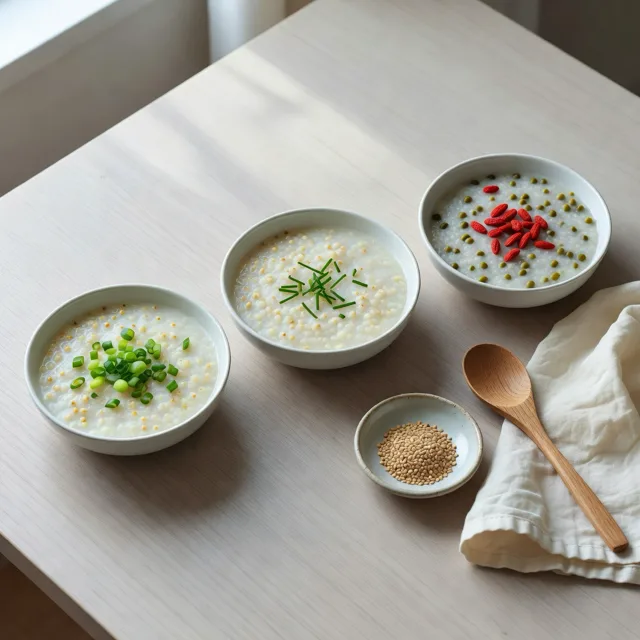
Your congee pot has carried you through winter. If you followed the black rice and red bean rotation in January, your mornings were anchored in deep Kidney nourishment — dark, warming, heavy. That was exactly right for the coldest month. But the season has turned. 立春 (lìchūn) passed on February 4, and 雨水 (yǔshuǐ) — Rain Water — arrived on February 19. Your body is shifting from Water season into Wood season, and your congee should shift with it.
In TCM, spring belongs to the 肝 (gān) — the Liver system. The Liver governs the smooth flow of qi throughout the body, and it responds best to lighter, upward-moving foods. Heavy, deeply warming porridges that sustained you through 大寒 (Major Cold) can now create stagnation: the qi wants to rise and spread, but a dense bowl of black rice keeps pulling it inward and downward.
The fix is not to abandon congee — it remains the gentlest, most digestible breakfast in the Chinese food therapy tradition. The fix is to change the grains, lighten the toppings, and tune each bowl to what spring asks of your body.
Table of Contents
The Seasonal Grain Shift
The principle is simple: as the weather warms and dampness increases, move from heavy, dark grains toward lighter, more neutral ones. This is not a hard cutover. Late February still has cold mornings. You blend, not switch.
| Winter Grain | Spring Replacement | Why the Change |
|---|---|---|
| Black rice (黑米) | Millet (小米) | Millet is gentler on the Spleen, less heavy. Yellow color supports the Earth element — the Spleen's home — which in turn supports the Liver's smooth flow. |
| Red bean (红豆) | Mung bean (绿豆) | Mung beans are slightly cooling and classically clear internal heat. Green color resonates with the Liver and the Wood element. |
| Glutinous rice (糯米) | Barley (薏仁) | Barley drains dampness — essential as 雨水 brings moisture back. Lighter and easier to digest than sticky rice. |
| Brown sugar / longan | Goji / fresh greens | Less warming sweetness, more upward-rising, pungent toppings. Goji supports the Liver and brightens the eyes. |
If you are still in a cold climate and February mornings feel like winter, mix half old and half new: millet blended with a small scoop of white rice, or barley cooked with a few red dates for warmth. Follow your body, not the calendar alone.
Four Spring Grains and Their TCM Roles
Millet (小米 xiǎo mǐ)
小米 (xiǎo mǐ) — millet — is the single most important grain in Chinese congee tradition. In TCM, it is classified as sweet and neutral to slightly cool, entering the Spleen, Stomach, and Kidney channels. It is gentle enough for convalescence and strong enough for daily nourishment. A bowl of plain millet congee is what Chinese hospitals still serve as the first meal after surgery or childbirth.
For spring, millet's Spleen-strengthening action matters most. The Five Element cycle teaches that Earth (Spleen) is the mother of Metal and the child of Fire — but more practically, a strong Spleen ensures the Liver's rising qi has a stable base. Without Spleen support, Liver qi can overshoot and create headaches, irritability, and digestive upset.
Barley (薏仁 yì rén)
薏仁 (yì rén) — Job's tears or pearl barley — is spring's dampness warrior. As 雨水 increases ambient moisture and the ground begins to thaw, your body mirrors the environment: bloating, heavy limbs, and a sticky-coated tongue are classical signs of internal dampness. Barley's mildly cool, sweet nature and its affinity for the Spleen and Lung channels make it the grain of choice for draining without depleting.
Mung Bean (绿豆 lǜ dòu)
绿豆 (lǜ dòu) — mung bean — is cooling, sweet, and enters the Heart and Stomach channels. Its green color aligns with Wood and the Liver. In small amounts added to a spring congee base, mung beans clear residual heat from winter's heavy eating without chilling the core. They also add protein and a subtle sweetness that makes the porridge more satisfying.
White Rice (白米 bái mǐ)
Plain white rice remains a perfectly good congee base in any season. Its neutral nature and easy digestibility make it a safe foundation when you want to let the toppings do the seasonal work. In spring, use white rice as the carrier grain and load it with green toppings — scallion, chives, pea shoots — rather than relying on the grain itself for therapeutic effect.
Wood Season Toppings
Spring congee is a two-part system: the grain base provides Spleen support, and the toppings deliver the Liver-soothing, qi-moving action. The toppings are where the seasonal medicine lives.
| Topping | TCM Nature | How to Use |
|---|---|---|
| Scallion (葱 cōng) | Warm, pungent. Releases the exterior, moves qi upward. | Slice thin and scatter on top of hot congee just before eating. Do not cook into the porridge — the pungent volatile oils dissipate with long heating. |
| Garlic chives (韭菜 jiǔ cài) | Warm, pungent. Warms the Kidney, benefits Liver yang. | Chop finely and stir into the congee during the last minute of cooking. A small amount — one or two tablespoons — is enough. Chives are warming, so use less if you tend toward heat. |
| Sesame (芝麻 zhī ma) | Neutral, sweet. Nourishes Liver and Kidney. Moistens the intestines. | Toast lightly and sprinkle on top. White sesame is mildly cooling; black sesame is more nourishing for the Kidney. Use white for spring. |
| Goji berries (枸杞 gǒu qǐ) | Neutral, sweet. Nourishes Liver and Kidney, brightens eyes. | Add a small handful in the last five minutes of cooking. They plump up and release a gentle sweetness. Especially good for anyone spending long hours at a screen — the Liver opens into the eyes. |
| Fresh ginger (生姜 shēng jiāng) | Warm, pungent. Disperses cold, warms the Stomach. | Two or three thin slices simmered with the grain. Essential on cold mornings when the body still needs warming support. Remove before serving or eat for extra warmth. |
The 7-Day Spring Congee Rotation
One base recipe anchors the week. Vary the grain and toppings daily to target different TCM needs as your body adjusts from winter to spring.
| Day | Base Grain | Toppings | TCM Focus |
|---|---|---|---|
| Monday | Millet | Goji berries + red dates (2-3) | Spleen strengthening, gentle Liver nourishment. A balanced start to the week. |
| Tuesday | White rice + barley (3:1) | Sliced scallion + white sesame | Dampness draining, qi moving. The scallion lifts stagnant morning energy. |
| Wednesday | Millet + mung bean (4:1) | Chopped chives + a drizzle of sesame oil | Liver soothing, mild heat clearing. The chives add warmth to balance the cooling mung bean. |
| Thursday | White rice | Poached egg + sliced scallion + soy sauce | Protein-rich savory bowl. The egg nourishes Blood and yin. A sustaining mid-week meal. |
| Friday | Barley + white rice (1:1) | Fresh ginger (2 slices) + goji berries | Dampness draining with warming support. Good for mornings that are still cold and damp. |
| Saturday | Millet | Pea shoots or baby spinach + toasted pine nuts | Maximum Wood energy. Fresh greens deliver the rising, spreading quality the Liver craves. |
| Sunday | White rice + sweet potato | A drizzle of honey + toasted white sesame | Spleen-nourishing, Lung-moistening. A sweet, grounding bowl to close the week before the next begins. |
The Rice-Cooker Method
The overnight rice-cooker approach that worked for winter congee works just as well for spring grains, with one adjustment: spring grains cook faster. Millet and white rice need less water than black rice did.
| Grain | Grain : Water Ratio | Soaking Needed? | Cook Time (Porridge Setting) |
|---|---|---|---|
| Millet | 1 : 8 | No (rinse only) | 60 minutes |
| White rice | 1 : 8 | No | 45-60 minutes |
| Barley (薏仁) | 1 : 10 | Yes, 2-4 hours or overnight | 75-90 minutes |
| Mung bean (add-in) | Use 2 tbsp per cup of main grain | Yes, 2 hours minimum | Cook with main grain |
Set your rice cooker timer the night before. Add goji berries, red dates, or ginger slices to the pot at the start. Add fresh toppings — scallion, chives, greens, sesame — only after the congee is done. Fresh pungent toppings lose their qi-moving effect if they simmer for hours.
Who Should Adjust
Not every spring congee suits every constitution. If you are unsure of your type, the constitution guide can help you identify your patterns.
| Constitution | Adjustment |
|---|---|
| Cold / yang deficient (always cold, pale, fatigued) | Keep ginger in every bowl. Use more millet than barley. Skip the mung bean days entirely until the weather warms. Add two or three red dates for warmth. You are still closer to winter than spring — honor that. |
| Damp / phlegm (heavy, bloated, foggy, thick tongue coat) | Lean into barley. Make it your primary grain three or four days a week. Add tangerine peel (陈皮 chénpí) — two or three dried strips simmered with the grain. Minimize sweeteners. The dampness guide has more strategies. |
| Heat / yin deficient (warm palms, dry mouth, flushed cheeks) | The mung bean days are your best friend. Skip the ginger and chives. Use white sesame instead of black. A few lily bulb pieces (百合) added during cooking moisten the Lung. Plain millet with goji is also ideal. |
| Liver qi stagnation (irritable, tight sides, frequent sighing) | Maximize the pungent toppings: scallion, chives, a drop of sesame oil. These move stuck qi. Rose tea alongside the congee is a beautiful pairing. The Liver qi stretches complement the dietary approach. |
What the research says
Modern nutritional interest in millet and barley centers on their fiber content and glycemic profiles. Millet is gluten-free and relatively rich in minerals. Barley is recognized for its beta-glucan content. These observations complement but do not replace the TCM framework used here — the traditional reasoning is based on flavor, thermal nature, and channel affinity, not macronutrient analysis.
⚠️ Disclaimer: Spring congee recipes are traditional Chinese food therapy preparations. TCM organ references (Liver, Spleen, Kidney) describe functional systems in traditional Chinese medicine, not the biomedical organs. Congee is food, not medicine. If you have specific health conditions, food allergies, or are pregnant, consult your healthcare provider before making significant dietary changes.
Eat for Your Season
Your spring congee rotation works best when it matches your personal Five Element balance. A BaZi consultation reveals which grains and toppings serve your constitution this season.
Book a Consultation