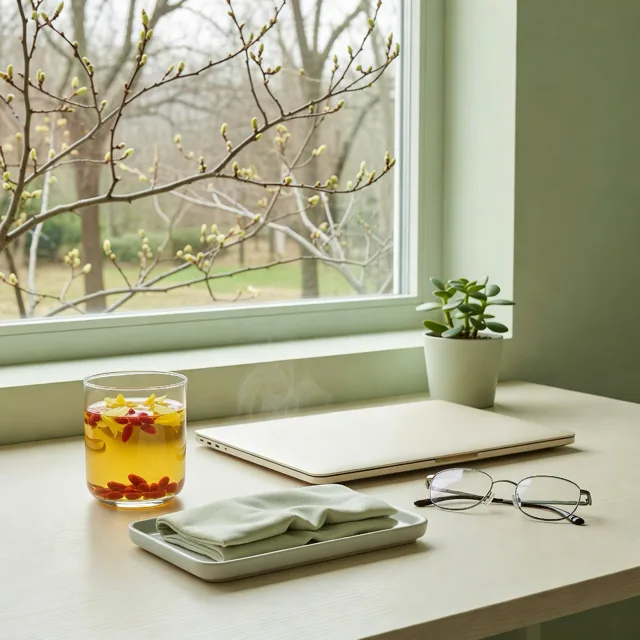
肝开窍于目 (gān kāi qiào yú mù) — "the Liver opens into the eyes." This is one of the most widely quoted principles in TCM, and in spring, it becomes intensely practical. The Liver is the Wood organ. Spring is the Wood season. When the Liver's qi flows well, your vision is clear, your eyes feel comfortable, and you can focus without strain. When Liver qi stagnates or Liver Blood runs thin — common in early spring after a winter of heavy eating and indoor living — the eyes are the first to complain.
Dry eyes, twitching eyelids, blurry vision at the end of a long workday, sensitivity to light, a gritty feeling that no amount of eye drops seems to fix. If you are spending eight or more hours a day looking at screens, spring amplifies every one of these symptoms. The TCM explanation is straightforward: screens consume Liver Blood. The Liver supplies Blood to the eyes to maintain vision and moisture. When that supply is depleted — by overwork, poor sleep, or seasonal stress — the eyes dry out and tire.
This is not about replacing your eye doctor. If your vision changes, get an exam. What follows is the traditional wellness layer: how to support your eyes by supporting your Liver, using food, simple habits, and a desk-side routine you can do without standing up.
Table of Contents
The Liver-Eye Connection in TCM
In TCM, the eyes are not isolated sensory organs — they are windows into the Liver's condition. The Liver stores Blood (肝藏血 gān cáng xuè) and sends it upward to nourish the eyes. When Liver Blood is sufficient, the eyes are moist, bright, and capable of sustained focus. When Liver Blood is deficient, the eyes become dry, fatigued, and prone to floaters and blurriness.
Spring adds a complicating factor: Liver qi rises strongly in its own season. If that rising qi brings adequate Blood with it, the eyes benefit. If the qi rises but the Blood is depleted from winter — too many late nights, too much heavy food, too little rest — the qi arrives at the eyes without enough nourishment. The result is a paradox: more energy reaching the eyes, but less substance to sustain them. This is why spring eye twitching (眼皮跳 yǎnpí tiào) is so common. In TCM, it is often read as Liver wind stirring from Blood deficiency.
| Eye Symptom | TCM Reading |
|---|---|
| Dry, gritty eyes | Liver Blood or Liver Yin not reaching the eyes. The eyes lack moisture. |
| Twitching eyelid | Liver Wind stirring, often from Blood deficiency or Liver qi stagnation. |
| Blurry vision after screen work | Liver Blood consumed by prolonged focus. The "fuel" runs out. |
| Red, irritated eyes | Liver Fire rising — often from frustration, stress, or Liver qi stagnation turning to heat. |
| Light sensitivity | Liver Yin deficiency — not enough cooling, moistening substance to buffer the eyes. |
Goji & Chrysanthemum: The Classic Eye Tea
枸杞菊花茶 (gǒu qǐ jú huā chá) is perhaps the most famous eye-care formula in the Chinese tradition. It pairs two ingredients with complementary actions: goji berries nourish Liver Blood and Kidney essence (the deep root supply for the eyes), while chrysanthemum clears heat and brightens the eyes from the surface. Together, they address both the nourishment deficit and the heat excess that screen work creates.
How to Brew
- Place 8-10 goji berries and 5-6 dried chrysanthemum flowers in a mug or glass teapot.
- Pour water that has cooled slightly from a full boil — around 90 degrees Celsius (195 degrees Fahrenheit). Boiling water can make the chrysanthemum taste bitter.
- Steep for 5 minutes. The goji berries will plump and soften. Eat them after drinking the tea for maximum benefit.
- Refill with hot water two or three times throughout the day. The flavor mellows but the benefits continue.
Drink this tea mid-morning, between the end of breakfast digestion and the start of the afternoon energy dip. This timing aligns with the spring liver tea recommendations. Avoid drinking it on an empty stomach if you have a cold constitution — the chrysanthemum is cooling, and an empty stomach amplifies that effect.
Palming: Rest for Tired Eyes
Palming is one of the oldest eye-rest techniques, used in both Chinese and Western traditions. It gives the optic nerve a complete break from light and allows the eye muscles to relax fully.
How to Do It
- Rub your palms together vigorously for 10-15 seconds until they feel warm.
- Close your eyes. Cup your warm palms over your closed eyes — fingers overlapping across your forehead, the heels of your hands resting on your cheekbones. Do not press on the eyeballs. Your palms should create a dome of darkness without touching the eyelids.
- Rest in total darkness for 30 seconds to one minute. Breathe slowly. Let your eye muscles completely release.
- Remove your hands. Keep your eyes closed for another moment, then open them slowly.
In TCM terms, the warmth from your palms carries your personal qi directly to the eyes. The Laogong point (劳宫 láogōng) at the center of each palm is a Pericardium channel point — using it to warm the eyes connects the Heart system (which governs blood circulation) to the Liver system (which governs the eyes). The darkness gives the Liver a brief moment to stop "working" and simply rest.
Far-Gazing: The Antidote to Screen Distance
When you stare at a screen 18 inches from your face for hours, the ciliary muscles that control your lens focus lock into a fixed near-focus position. In TCM terms, the Liver qi that governs smooth movement becomes "stuck" in one pattern — another form of stagnation, but localized to the eye.
The simplest fix is far-gazing: deliberately looking at something distant. The technique is ancient, but the reasoning is universal — your eyes need to shift focal distances regularly to stay flexible and comfortable.
How to Practice
- Every 20-30 minutes, look away from your screen at something at least 20 feet away — through a window, across the room, or out a hallway.
- Hold your gaze on the distant object for at least 20 seconds. Let your focus soften. Do not squint.
- If you can, look at something green: trees, a far-off lawn, a hillside. Green is Wood's color and is considered soothing to the Liver and eyes in TCM.
- Blink slowly and deliberately five or six times before returning to the screen.
The rhythm — every 20-30 minutes, look 20 feet away, for 20 seconds — is easy to remember and builds naturally into your work flow. Set a timer if you tend to lose track of time. After a week, it becomes automatic.
The Warm Compress
A warm, moist compress over closed eyes is one of the most immediately soothing things you can do for eye fatigue. In TCM, warmth promotes circulation and helps Liver Blood reach the surface of the eyes. Moisture counteracts the drying effect of heated indoor air and screen glare.
How to Make One
- Soak a clean washcloth in comfortably warm water — not hot enough to scald, just pleasantly warm.
- Wring out the excess water. The cloth should be damp, not dripping.
- Fold it and place it over your closed eyes. Lie down if possible, or lean back in your chair.
- Rest for 3-5 minutes. Replace with a freshly warmed cloth if it cools down.
For an enhanced version, brew a strong cup of chrysanthemum tea, let it cool to a comfortable warmth, and use it to soak the washcloth. The chrysanthemum compounds contact the eye area directly through the warm moisture.
A Screen Rhythm That Works
The single most impactful change for screen-heavy eye fatigue is not a tea or a compress — it is interrupting the screen. The digital feng shui approach to screen time applies here: your relationship with screens is an energy exchange, and it needs boundaries.
| Habit | What to Do | Why It Matters |
|---|---|---|
| Distance breaks | Every 20-30 minutes, look 20+ feet away for 20 seconds | Releases the ciliary muscle and shifts Liver qi from a fixed state |
| Blink consciously | When focusing on a screen, blink rate drops dramatically. Deliberately blink 5-6 times during each far-gaze break | Blinking spreads the tear film and moistens the eye surface |
| Evening cutoff | Stop screens by 9 PM, or at minimum switch to a warm-toned, dimmed display | Blue light after dark suppresses melatonin and overstimulates the Liver at the time when it should be winding down for its 1-3 AM restorative cycle |
| Morning light first | Before looking at your phone, spend 5 minutes looking at natural light — even through a window | Natural morning light calibrates the visual system and supports the circadian reset that spring demands |
The 5-Minute Desk-Side Routine
You can do this entire sequence without leaving your chair. It takes five minutes and addresses eye fatigue from multiple angles.
| Step | Action | Time |
|---|---|---|
| 1 | Palming — rub palms warm, cup over closed eyes | 1 minute |
| 2 | Far-gazing — look out the nearest window or across the room | 30 seconds |
| 3 | Gentle eye circles — close eyes, slowly roll eyeballs clockwise 5 times, then counterclockwise 5 times | 1 minute |
| 4 | Temple massage — use your fingertips to make small circles on the temples (太阳穴 tàiyáng xué) for 30 seconds, then press gently on the inner corners of the eyebrows (攒竹 cuán zhú) for 10 seconds | 1 minute |
| 5 | Deliberate blinks — 10 slow, full blinks, holding each closed for a full second | 30 seconds |
| 6 | Sip your goji-chrysanthemum tea | 1 minute |
Do this routine twice a day — once mid-morning and once mid-afternoon. If you only have time for one element, do the palming. It delivers the most relief per minute.
⚠️ Disclaimer: The eye care practices described are traditional TCM wellness habits, not treatments for eye disease. "The Liver opens into the eyes" is a TCM concept describing a functional relationship, not a biomedical claim. If you experience sudden vision changes, persistent eye pain, flashing lights, or new floaters, see an eye care professional immediately. Regular eye exams are essential regardless of traditional care practices.
See More Clearly
Your Liver's capacity to nourish your eyes is shaped by your constitutional element balance. A BaZi reading reveals how much Liver support your chart needs and which seasonal practices serve you best.
Book a Consultation