Friday, February 12, 2027 — 初七 (chū qī) — is 人日 (rén rì), the Day of Humankind. According to Chinese creation mythology, the goddess 女娲 (Nǚwā) created the world in seven days. On the first day she made chickens. On the second, dogs. Third, pigs. Fourth, sheep. Fifth, cattle. Sixth, horses. And on the seventh day, she shaped human beings from clay.
That makes today everyone's birthday. Not your individual birthday — the shared birthday of the entire human species. It is a day to celebrate being alive, to treat people (and yourself) with extra kindness, and to eat foods that honor life and longevity. No punishment is administered on this day. No quarreling. The traditional theme is simple: humanity deserves a good day.
It is also a day of food traditions that are more gentle and green than the heavy feasts of the past week — a welcome shift for a body that has been processing celebrations since 除夕. For a look at the full 15-day cycle, see our CNY customs and taboos overview.
Table of Contents
The Seven-Day Creation Story
The creation sequence attributed to 女娲 assigns an animal to each of the first six days and humankind to the seventh. Each day of the New Year was traditionally associated with the creature born on that day, and people observed customs connected to those animals:
| Day | Creature | Traditional Observation |
|---|---|---|
| 初一 | 鸡 Chicken | Do not kill chickens. A good-weather Day One predicts a good year for poultry. |
| 初二 | 狗 Dog | Be kind to dogs. Feed strays. |
| 初三 | 猪 Pig | Do not kill pigs. Rest day (赤口). |
| 初四 | 羊 Sheep/Goat | Welcome the Kitchen God back. Be gentle with livestock. |
| 初五 | 牛 Cattle | 破五 — taboos break, God of Wealth welcomed. |
| 初六 | 马 Horse | Shops fully reopen. Travel resumes. |
| 初七 | 人 Humankind | 人日 — everyone's birthday. Eat seven-vegetable soup. No punishments. Be kind. |
The creation story is myth, not doctrine. Different regions tell slightly different versions. What matters is the sentiment: on this day, every human being is honored simply for existing. It is one of the oldest expressions of universal human dignity in Chinese culture.
七宝羹 Seven-Treasure Soup
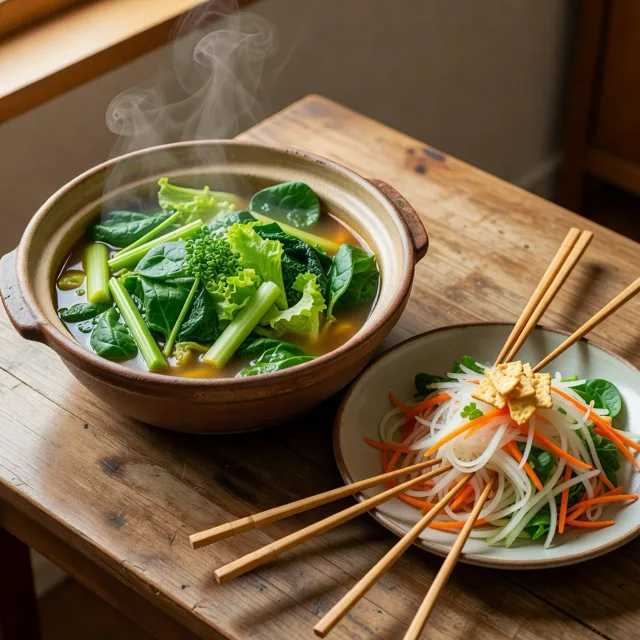
The signature dish of 人日 is 七宝羹 (qī bǎo gēng) or 七菜羹 (qī cài gēng) — a soup or congee made with seven vegetables or herbs. The number seven mirrors the seven days of creation, and the green, living ingredients represent growth, renewal, and the preciousness of life.
Regional variations are wide. In Guangdong, the seven typically include celery, garlic chives, scallions, cilantro, lettuce, shepherd's purse, and leeks — many of which have punning meanings:
| Vegetable | Chinese | Pun / Symbolism |
|---|---|---|
| Celery | 芹菜 (qíncài) | Sounds like 勤 (qín, diligent) — wishing for hard work and success |
| Garlic chives | 韭菜 (jiǔcài) | Sounds like 久 (jiǔ, long-lasting) — longevity and endurance |
| Scallion | 葱 (cōng) | Sounds like 聪 (cōng, clever) — wishing for intelligence |
| Cilantro | 芫荽 (yánsuī) | Represents harmony and adaptability |
| Lettuce | 生菜 (shēngcài) | Sounds like 生财 (shēngcái, generating wealth) |
| Garlic | 蒜 (suàn) | Sounds like 算 (suàn, to calculate) — financial acumen |
| Leek / Spring onion | 蒜苗 / 葱 variant | Represents spring growth and upward energy |
In Fujian and other regions, the soup may include mustard greens, watercress, spinach, Chinese cabbage, or shepherd's purse (荠菜 jìcài). There is no single canonical recipe — the rule is seven greens, chosen for availability, meaning, and what your family has always used.
Seven Greens for a Western Kitchen
If you do not have access to a Chinese grocery — or even if you do and want to adapt — here are seven greens that are widely available in American supermarkets and carry appropriate symbolism:
| # | Green | TCM Nature | Why It Works |
|---|---|---|---|
| 1 | Spinach | Cool, sweet | Nourishes Blood, moistens dryness. Widely available year-round. |
| 2 | Celery | Cool, sweet-bitter | Same pun as the traditional version (勤). Calms the Liver in TCM. |
| 3 | Scallions | Warm, pungent | Same pun (聪). Releases the exterior, warms the middle. |
| 4 | Cilantro | Warm, pungent | Traditional inclusion. Helps move qi outward. Skip if you have the gene that makes it taste like soap. |
| 5 | Romaine or butter lettuce | Cool, sweet-bitter | Replaces 生菜 in the wealth pun. Cook lightly rather than serving raw in February. |
| 6 | Pea shoots or snow pea tips | Cool, sweet | A rising, sprouting green that embodies spring energy. Increasingly available in good grocery stores. |
| 7 | Kale or Swiss chard | Slightly warm, sweet-bitter | Sturdy winter green that adds body to the soup. Represents resilience. |
Simple Seven-Green Soup
- Bring a pot of chicken or vegetable broth (about 6 cups) to a gentle boil.
- Add the hardier greens first (kale, celery, chopped romaine) and simmer for 3 minutes.
- Add the tender greens (spinach, pea shoots, cilantro) and cook for 1 more minute.
- Stir in sliced scallions at the very end — they should wilt but not lose their color.
- Season with salt, a splash of sesame oil, and white pepper.
- Serve hot. Count your greens out loud if you like — naming each one is part of the tradition.
The soup is light, cleansing, and exactly what your body needs after a week of festive richness. In TCM terms, you are giving the Spleen a break while the pungent greens help move stagnant Liver qi. For more on incorporating winter greens into your cooking, see our guide.
捞鱼生 Yusheng: The Prosperity Toss
In Singapore, Malaysia, and Southeast Asian Chinese communities, 人日 is celebrated with 捞鱼生 (lāo yú shēng) — the prosperity toss, also called 捞起 (lāo qǐ) or simply 鱼生 (yú shēng). This is one of the most joyful and exuberant food rituals in the Chinese New Year calendar.
Yusheng is a raw fish salad assembled from colorful ingredients, each with its own auspicious meaning. The climax is the toss: everyone at the table stands up, takes chopsticks, and tosses the salad ingredients high into the air while shouting blessings. The higher you toss, the greater the prosperity. The messier the table, the more abundant the year.
Traditional Yusheng Ingredients and Phrases
| Ingredient | What You Say | Meaning |
|---|---|---|
| Raw fish (salmon or similar) | 年年有余 (nián nián yǒu yú) | Surplus year after year |
| Shredded radish and carrot | 好运当头 (hǎo yùn dāngtóu) | Good luck descends |
| Pomelo or lime | 大吉大利 (dà jí dà lì) | Great luck and great profit |
| Pepper and cinnamon | 招财进宝 (zhāo cái jìn bǎo) | Attracting wealth and treasures |
| Oil | 财源广进 (cáiyuán guǎngjìn) | Wealth flowing in from all directions |
| Crushed peanuts | 金银满屋 (jīn yín mǎn wū) | House full of gold and silver |
| Sesame seeds | 生意兴隆 (shēngyì xīnglóng) | Business thriving |
| Plum sauce | 甜甜蜜蜜 (tiántián mìmì) | Sweet and harmonious life |
| The Toss | 捞起!捞起!(lāo qǐ!) | "Toss it up!" — the higher, the more prosperous |
If you are not in Southeast Asia, you can make a simplified version at home with smoked salmon, shredded carrots and daikon, sesame seeds, crushed peanuts, lime juice, plum sauce, and sesame oil. The ritual matters more than perfection — toss it high, shout your wishes, and laugh at the mess.
Longevity Noodles: Long Life for Everyone
Because 人日 is everyone's birthday, many families serve 长寿面 (chángshòu miàn) — longevity noodles. The rules are the same as any birthday noodle dish: the noodles must be long and unbroken. Never cut them before serving. Slurp them in — the longer the strand you eat without breaking it, the longer and more fortunate your life.
A simple preparation works best: thin wheat noodles in a clear broth with a poached egg on top, garnished with scallion and a few drops of sesame oil. The poached egg represents wholeness and completion. The broth is light — by Day Seven, light is exactly what is needed.
The Spirit of Renri: What the Day Asks of Us
Beyond the food, 人日 carries a quieter message. The traditional customs for this day include:
- No punishment: Employers, teachers, and parents traditionally refrain from scolding or disciplining anyone on 人日. If something went wrong, it can wait until tomorrow.
- No executions: In imperial China, capital punishment was suspended on 人日. The day honored the sanctity of every human life.
- Kindness to strangers: The spirit of 人日 extends beyond your family. Be generous with tips, patient with service workers, and warm to people you do not know. Everyone is a year older today.
- Self-care: It is your birthday too. Do something that makes you feel good — not productive, not dutiful, simply good. Read, walk, cook something you love, rest.
- Reflection: 人日 is a natural point for a quiet internal check-in, one week into the new year. How do you feel? What has the first week revealed? What do you need going forward?
A TCM Note on the Day's Food
After nearly a week of heavy feasting, the shift to greens on 人日 is not just symbolic — it is therapeutic. In TCM terms, the seven-vegetable soup is a gentle Spleen reset. Pungent greens like scallion and cilantro help move stagnant qi. Mildly bitter greens like mustard and watercress drain accumulated damp-heat. Sweet greens like lettuce and spinach nourish the Spleen without overloading it. The combination is light, warm, and easy to digest — the exact opposite of the feasts that preceded it.
If your digestion is still sluggish from the week's celebrations, make the seven-green soup your main meal today. Add a small portion of rice or noodles for substance, and skip the rich leftovers. Your Spleen needs a day off, and 人日 gives you the cultural permission to take one.
Renri Weather Lore
In older Chinese almanac traditions, the weather on 人日 was considered a forecast for the year's human affairs. A clear, sunny Day Seven predicted a peaceful and prosperous year for people. A cloudy or rainy Day Seven suggested challenges ahead. While no one takes weather divination literally today, there is something pleasing about stepping outside on 人日 morning, looking at the sky, and making a quiet wish for all of humanity. It costs nothing and hurts no one.
In a culture where New Year celebrations are large, loud, and family-centric, 人日 stands apart as something gentler: a day that asks you to look outward with compassion and inward with honesty. We are all, according to the myth, shaped from the same clay by the same hands. That is worth a bowl of soup and a moment of gratitude.
A Year of Good Days
Your BaZi chart reveals the days and months that carry the strongest energy for you personally. A reading helps you plan the year ahead — when to push, when to rest, and when to celebrate.
Book Your Reading