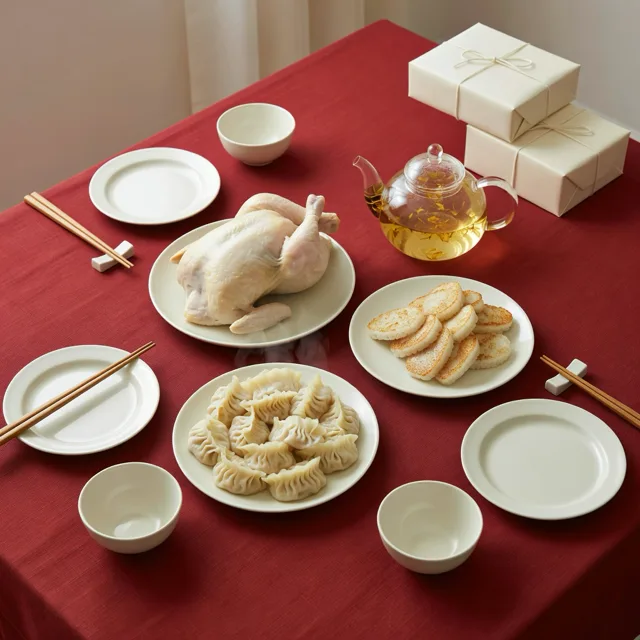
初二 (chū'èr) — Day Two of the Chinese New Year — falls on Sunday, February 7, 2027. This is the day of 回娘家 (huí niáng jiā): married daughters return to their parents' home for a visit, bringing their spouse and children along. It's one of the warmest, most food-heavy days of the entire New Year period — and after last night's reunion dinner and today's Day One feast, your stomach is already working overtime.
The 初二 meal is a second major feast. Dumplings often reappear (because every day of New Year is a good day for dumplings), a whole chicken takes the table, 年糕 (niángāo) rice cake shows up again, and often another fish. If you're the host — the parents welcoming their daughter home — the table must be generous. If you're the guest, you arrive with gifts.
This article covers the customs, the foods and their symbolism, what to bring when you visit, and — critically — how to pace two big feasts in two days without wrecking your digestion for the rest of the week.
Table of Contents
The 回娘家 Tradition
回娘家 (huí niáng jiā) literally means "return to the mother's home." In traditional Chinese family structure, after marriage a woman becomes part of her husband's household. 除夕 and 初一 are spent with the husband's family. 初二 is her day to go home.
Today the tradition carries a different emotional weight — it's less about obligation and more about reunion across both sides of the family. For many families in the US, where geography makes daily visits impossible, 初二 is the one day that honors the maternal side of the family tree. Even if you can't visit in person, a long phone call or video chat on this day carries the tradition forward.
The Customs
- Arrive before noon. The visit traditionally happens during the daytime — arriving in the morning and staying for lunch. Leaving before dark was once customary, though modern families often extend the visit.
- The husband comes too. This is a family visit, not a solo trip. The son-in-law's presence is a sign of respect to the wife's parents.
- Children are the highlight. Grandparents on the maternal side often wait all year for this day. Bring the kids. Let them be loud.
What to Bring: Gifts in Pairs
Arriving empty-handed on 初二 is a serious breach of etiquette. The gifts don't need to be expensive, but they must follow one rule: everything in pairs. Even numbers symbolize completeness and good fortune. Odd numbers are associated with funerals and separation.
| Gift | Quantity | Symbolism |
|---|---|---|
| 🍊 Tangerines or oranges | 6 or 8 | 橘 (jú) sounds like 吉 (jí, luck); 橙 (chéng) sounds like 成 (chéng, success) |
| 🍬 Candy or cookies | 2 boxes | Sweetness and prosperity. Homemade CNY cookies are especially appreciated. |
| 🫖 Tea | 2 tins or boxes | Warmth and respect for elders. Premium oolong or pu'er are classic choices. |
| 🧧 Red envelopes | As needed | For the parents and for any younger relatives present. Even-numbered amounts inside. |
| 🍶 Rice wine or spirits | 2 bottles | For the father-in-law specifically. Always in pairs. |
The Day Two Feast
The 初二 lunch is the parents' way of welcoming their daughter and her family. It's a generous table — not as elaborate as the reunion dinner, but substantial. Here are the common dishes and what they represent:
Dumplings (饺子)
If the reunion dinner is the fish's night, 初二 often belongs to the dumpling. Shaped like 元宝 (yuánbǎo) — gold ingots — dumplings symbolize wrapping up wealth and good fortune. They're also practical: they can be made ahead in large batches and boiled quickly when guests arrive.
Whole Chicken (鸡)
A whole chicken — head, feet, and all — symbolizes completeness and family unity. 鸡 (jī) sounds like 吉 (jí, good fortune). The chicken is served whole to represent an unbroken family, then carved at the table. The head traditionally goes to the eldest.
Rice Cake (年糕)
年糕 (niángāo) appears again. It's a New Year staple that shows up on every table for the first several days. Fried, steamed, or in soup — the form changes, the meaning stays: 年年高升 (nián nián gāo shēng), rising higher every year.
Fish (鱼)
Yes, another fish. The symbolism of 年年有余 (surplus year after year) is so important that it bears repeating across multiple meals. If you're tired of fish, a different preparation helps — steamed on 除夕, braised on 初二, for instance.
Stir-Fried Vegetables
A mix of greens — lettuce (生菜, shēngcài, sounds like "generating wealth"), celery (芹菜, qíncài, sounds like "diligence"), and garlic chives — balances the richness of the meat dishes and gives the Spleen some much-needed fiber.
A Note on Portion and Variety
The 初二 table does not need to rival the reunion dinner in scale. The reunion dinner is the year's grand statement; the 初二 lunch is a warm welcome home. Five to six dishes is plenty. Quality over quantity. If the parents are elderly and cooking is a burden, the visiting daughter often brings prepared dishes — and in many modern families, the son-in-law does much of the cooking. The tradition is about gathering, not about who stands at the stove.
What matters is that the table feels full and generous. A bowl of fruit, a pot of tea, and a plate of snacks on the side fill the visual gaps even if you only cook three or four main dishes. The symbolism of abundance doesn't require abundance in labor.
Dish Symbolism at a Glance
| Dish | Chinese | Symbolism |
|---|---|---|
| Dumplings | 饺子 (jiǎozi) | Wealth (shaped like gold ingots) |
| Whole chicken | 鸡 (jī) | Good fortune, family completeness |
| Rice cake | 年糕 (niángāo) | Rising higher year after year |
| Whole fish | 鱼 (yú) | Surplus and abundance |
| Lettuce | 生菜 (shēngcài) | Generating wealth |
| Spring rolls | 春卷 (chūnjuǎn) | Wealth (shaped like gold bars) |
Pacing Two Feasts in Two Days
Here's the reality: by Sunday afternoon, you will have eaten three major meals in roughly 48 hours — the reunion dinner (Friday), Day One's feast (Saturday), and today's 初二 lunch. Your 脾 (pí) — Spleen system — is under siege. In TCM, the Spleen governs digestion and the transformation of food into qi. Overload it, and you get what classical texts call 食积 (shíjī) — food stagnation: bloating, heaviness, poor sleep, and a fuzzy head.
Here's how to get through it without crashing:
| Strategy | What to Do | TCM Reasoning |
|---|---|---|
| 🫖 Warm tea between dishes | Sip warm pu'er, barley tea, or plain warm water between every course. Never iced drinks. | Warm liquid keeps the Spleen's digestive fire active. Cold drinks extinguish it. |
| 🍽️ Smaller portions | Take one dumpling, not five. One slice of rice cake, not three. Taste everything; finish nothing. | The Spleen processes small loads efficiently but stalls on large ones. |
| 🫐 山楂 hawthorn after the meal | A few slices of dried hawthorn (山楂, shānzhā) or a cup of hawthorn tea after the feast. | Classically, 山楂 is the go-to remedy for food stagnation, especially from meat and greasy foods. |
| 🚶 Walk after eating | A gentle 15–20 minute walk after the meal. Not a power walk — just movement. | Movement aids the Spleen's transportation function. Sitting or lying down after a big meal promotes stagnation. |
| 🌙 Light dinner | After a big 初二 lunch, make dinner simple: plain congee, a light soup, or just warm tea with fruit. | Giving the Spleen a rest in the evening lets it recover overnight. |
What the research says
The idea of "digestive fire" is a TCM concept, not a biochemical one. However, the practical advice — smaller portions, warm liquids, gentle walking after meals, and lighter evening eating — aligns with general digestive wellness principles. If you experience persistent bloating or discomfort after holiday eating, consult a healthcare provider.
The Bring-a-Dish List
If you're the guest visiting your parents' home and want to contribute to the meal — or if you're attending a friend's 初二 gathering — here are easy, symbolic dishes to bring:
- A plate of homemade dumplings — pre-shaped, ready to boil. The host cooks them fresh, and nothing says effort like homemade wrappers. Our dumplings guide has the method.
- A braised dish that reheats well — red-braised pork belly (红烧肉, hóngshāo ròu) or braised tofu. Rich, auspicious (red color = good fortune), and it improves overnight.
- A dessert — tangyuan (sweet rice balls), red bean soup, or steamed 年糕 with brown sugar. Something sweet to close the meal.
- A large fruit platter — tangerines, apples (苹果, píngguǒ, sounds like "peace"), grapes, and dragon fruit. Arranged on a red plate if you have one.
- A pot of good tea — oolong or pu'er, with enough for the whole family. Bring your own teapot for bonus points.
For more on keeping your gut health balanced during festival season, follow the link — the principles apply well beyond New Year.
⚠️ Disclaimer: The TCM dietary principles in this article reflect traditional Chinese food therapy concepts. They are general wellness suggestions, not medical advice. If you have digestive conditions, food allergies, or specific health concerns, consult your doctor or a registered dietitian.
Your Year-Round Diet Blueprint
New Year feasting is temporary, but your body constitution is year-round. A personalized BaZi and wellness consultation maps your elemental needs and helps you eat in harmony with your specific constitution — not just the season.
Book a Wellness Consultation