农历: 丙午年 二月十九 · 观音菩萨诞辰 (Birthday of Guanyin, Bodhisattva of Compassion)
宜 (Auspicious): 祈福 (Pray) · 求嗣 (Seek Children) · 解除 (Remove Obstacles) · 修造 (Build) · 安床 (Place Bed)
忌 (Avoid): 动土 (Break Ground) · 安葬 (Burial)
🙏 Today marks the birthday of Guanyin — the embodiment of compassion and "making the most of what you have." The perfect day to bring feng shui harmony to even the smallest spaces.
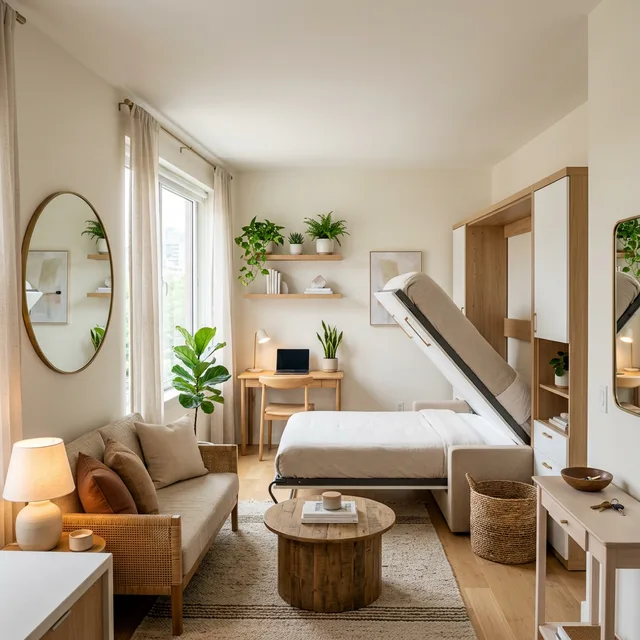
Let's be honest: most feng shui advice assumes you live in a spacious house with separate rooms for every function. But 44 million Americans rent apartments, and millions more live in studios, tiny homes, or compact condos. Does that mean good feng shui is out of reach?
Absolutely not. In fact, small spaces can have better chi than large ones — because chi doesn't need to travel far to circulate, and every item in a small space matters more. The key is intentionality over square footage.
Table of Contents
- The 5 Golden Rules for Small Space Feng Shui
- Creating Zones Without Walls
- Studio Apartment Layouts
- Renter-Friendly Cures (No Holes, No Paint)
- The Mirror Strategy
- Lighting Tricks for Small Spaces
- Vertical Space Activation
- Multi-Purpose Furniture Rules
- Feng Shui with Roommates
- Top 10 Small-Space Mistakes
- Small Space Feng Shui Essentials Kit
- The 20-Point Small Space Checklist
The 5 Golden Rules for Small Space Feng Shui
- Every object earns its place. In a small space, every item either supports your energy or drains it. There's no room for "maybe I'll use it someday" items. If it doesn't serve a function or spark genuine joy, it goes.
- Clear floor = clear mind. Visible floor space makes a room feel larger and allows chi to circulate. Elevate furniture on legs (no floor-skimming sofas). Use wall-mounted storage. If you can see the floor, the chi can flow.
- Light is your best friend. Small spaces tend toward yin (dark, heavy). Counter this with maximum light — sheer curtains (never heavy drapes), light-colored walls, mirrors strategically placed to bounce light, and multiple lighting sources.
- Multi-functional is essential. A dining table that doubles as a desk, a sofa bed, storage ottomans — multi-use items prevent clutter while maintaining functionality. In feng shui terms, versatile furniture demonstrates the adaptability of Water energy.
- Define zones energetically. Even without walls, you need clear boundaries between sleeping, working, cooking, and relaxing areas. Zone with rugs, lighting, furniture arrangement, and color shifts — not physical barriers.
Creating Zones Without Walls
In larger homes, walls naturally create different energy zones. In a studio or 1-bedroom, you need to create these zones yourself:
| Zone | Energy Needed | Zoning Technique |
|---|---|---|
| 🛏️ Sleep Zone | Yin — dark, quiet, restful | A bookshelf room divider, curtain, or screen between bed and living area. Lower lighting. Rug defines the boundary. |
| 💼 Work Zone | Yang — focused, active, bright | Desk near a window for natural light. A small area rug delineates the space. Task lighting (separate from ambient room lights). |
| 🛋️ Living Zone | Balanced — social, warm | Sofa facing the entry (Command Position). Coffee table acts as zone anchor. Different lighting from sleep/work zones. |
| 🍳 Kitchen Zone | Fire — active, nourishing | A kitchen cart or island creates a physical boundary. Distinct lighting. Keep this zone clean and active. |
Rugs are the most effective small-space zone dividers. Use different rugs for different zones — a soft rug under the bed, a flat-weave under the desk, and a plush rug in the living area. The texture change underfoot subconsciously signals a zone transition, and chi responds to these boundaries just as it would to walls.
Studio Apartment Layouts
Here are three feng shui-optimized studio layouts depending on your unit's shape:
Layout A: Rectangular Studio (most common)
- Entry → Living → Sleep → Window: Place the living area nearest the door (yang/social), sleep area furthest from the door (yin/private), near the window.
- A bookshelf or curtain between living and sleeping areas
- Desk along one long wall, between zones, facing the room's entry
- Kitchen along the entry wall (already there in most studios)
Layout B: Square Studio
- Divide into quadrants: Entry/kitchen in one quadrant, living opposite, sleep in the far corner (diagonally opposite from the door), desk in the fourth quadrant
- The center of the room should be kept as clear as possible — this is the Tai Chi point (health center)
- A round rug in the center anchors the energy
Layout C: L-Shaped Studio
- Use the L to your advantage: The "hidden" portion of the L is perfect for the bedroom zone — naturally screened from the entry.
- Living/work in the main portion, sleep in the L extension
- Place a mirror where the L turns to prevent chi from getting "stuck" in the corner
Renter-Friendly Cures (No Holes, No Paint, No Problem)
Not allowed to remodel your layout? Good news: every cure below works without any permanent modifications — no nails, no paint, no landlord approval required.
| Problem | Renter-Friendly Cure |
|---|---|
| No wealth corner visible | Place a green plant + citrine crystal in the SE corner — on a shelf or tabletop |
| Bathroom drains wealth | Keep the toilet lid closed, the door shut, and add a small plant like pothos |
| Can't paint walls | Use removable wallpaper, tapestries, large art prints, or colored curtains |
| Need to hang a mirror | Lean a floor mirror against the wall — actually preferred in modern feng shui |
| Dining area missing | Use a small round table (round = unity) with a cloth in earth tones |
| Kitchen visible from door | Hang a beaded curtain or use a tall plant to block the direct sight line |
| Low ceiling | Use vertical stripes, uplighting, and tall narrow plants to lift the energy |
| Ugly view from window | Hang a crystal ball in the window to refract light, plus beautiful curtains |
| No natural light | Full-spectrum LED bulbs + a mirror reflecting the light source + white/cream touches |
The Mirror Strategy
Mirrors are the single most powerful feng shui tool for small spaces. They represent the Water element, expand visual space, bounce light, and redirect chi. But placement is everything:
✅ Where to Place Mirrors:
- Opposite a window: Doubles the natural light and brings the outdoor view "inside." This is the #1 small-space mirror trick.
- In the dining area: A mirror reflecting the dining table symbolically doubles your food — a wealth and abundance symbol.
- In narrow hallways: Open up tight corridors and prevent chi from stagnating.
- Above a console near the entry: Creates depth and a sense of spaciousness immediately upon entering.
- Full-length mirrors: Choose one that shows your entire body with space above your head — a "cut off" head in the reflection symbolically limits your thinking.
❌ Where NOT to Place Mirrors:
- Directly facing the bed: Disrupts sleep and can create restless energy (the "third person" effect).
- Directly facing the front door: Bounces chi right back out before it enters.
- Reflecting clutter: A mirror doubles whatever it sees. If it sees mess, it doubles the mess. Always ensure mirrors reflect something beautiful.
- Facing another mirror: Creates infinite reflections = infinite energy bouncing = chaos. One mirror per wall in small spaces.
- Broken or distorted mirrors: They fragment whatever energy they reflect. Replace them immediately.
Lighting Tricks for Small Spaces
Mirrors can only bounce the light you give them — so build layers of it:
- Layer your lighting: Overhead + table lamp + accent light. Three layers create a depth and dimension that a single ceiling fixture never will.
- Warm bulbs (2700K–3000K): Warm white light creates a welcoming, expansive feeling; cold blue-white light makes small rooms feel clinical.
- Candles: Living Fire element. Use them in the South and Southwest sectors to activate fame and love energy.
Vertical Space Activation
When you can't expand horizontally, go vertical. Feng shui recognizes three energy layers in any room:
- Ground level (Earth): Flooring, rugs, low furniture. Grounding, stable energy.
- Middle level (Human): Where you sit, work, and interact. Eye-level art and shelving.
- Upper level (Heaven): Ceiling, high shelves, tall plants. Aspirational, uplifting energy.
Vertical Feng Shui Tips:
- Floating shelves: Keep the floor clear while displaying meaningful objects at the Human and Heaven levels.
- Tall plants: A fiddle leaf fig or bamboo palm draws the eye upward, making ceilings feel higher.
- Hang curtains high: Mount curtain rods as close to the ceiling as possible, not at the window frame. This illusion makes windows (and rooms) appear taller.
- Pendant lights: Replace table lamps (which consume floor/surface space) with hanging pendants or wall sconces.
- Upward-facing lights: Floor lamps that direct light upward towards the ceiling create an expansive, airy feeling.
- Over-door organizers: The backs of doors are free vertical real estate for shoes, accessories, and cleaning supplies.
- The "one in, one out" rule: In a small space, every new item must replace an old one — it stops clutter at the source.
Multi-Purpose Furniture Rules
Golden Rule #4 says multi-functional furniture is essential — but each dual-use piece comes with its own energy protocol:
- Dining table = desk: Acceptable only if you clear it completely between uses. Never eat at a messy desk.
- Sofa bed: Fold the bed away every morning — this "transforms" the space from yin back to yang.
- Storage ottoman: Seating plus hidden storage keeps surfaces clear without sacrificing function.
- Murphy bed: The ultimate small-space solution. When closed, the bedroom "disappears" and living energy takes over.
In small spaces, a daily reset is non-negotiable. Every morning: make the bed (or fold the sofa), clear the desk, open a window for 10 minutes, and light incense or a candle. This 5-minute ritual signals to the chi: "New day, new energy."
Feng Shui with Roommates
Sharing a small space adds one more challenge: you can only control part of it. Draw your energetic boundaries accordingly:
- Your bedroom is YOUR sanctuary. Whatever happens in shared areas, keep your room clean, organized, and personalized.
- Don't feng shui someone else's room. Their energy is their responsibility — focus on your own space.
- Shared kitchen: Keep your section of the fridge organized and clean your dishes immediately.
- Shared bathroom: Use a caddy or bag to keep your toiletries contained — your energy stays with you.
- Main entrance: Place a small personal item (a crystal, a plant) near the entry as your "energetic stake" in the shared space.
Top 10 Small-Space Feng Shui Mistakes
| # | Mistake | Fix |
|---|---|---|
| 1 | Pushing all furniture against walls | Float some pieces — a sofa 6 inches from the wall lets chi circulate behind it |
| 2 | Oversized furniture | Choose appropriately sized pieces. A king bed in a 400 sq ft studio is an energy disaster |
| 3 | Storing things under the bed | Under-bed storage blocks chi from circulating around you while you sleep. Clear it or use only soft items (linens) |
| 4 | No defined entry zone | Even a small tray for keys + a hook for coats creates a Mouth of Chi boundary |
| 5 | Working in bed | Work energy (yang) contaminates sleep energy (yin). Separate the zones even by 3 feet |
| 6 | Heavy, dark curtains | Light, sheer fabrics maximize daylight and prevent claustrophobic feeling |
| 7 | Too many strong colors | Use 80% neutrals, 20% accent color. Walls should be light to expand the space visually |
| 8 | Ignoring the center of the room | The center (Tai Chi) represents health. Keep it as open as possible — no heavy furniture |
| 9 | No plants because "there's no room" | Even one small pothos on a shelf brings vital Wood energy. Hang plants if floor space is limited |
| 10 | Ignoring the bathroom door | Always keep the bathroom door closed. In small spaces, bathroom drain energy affects the entire unit |
Small Space Feng Shui Essentials Kit
If you live in a small apartment, these 8 items will make the biggest feng shui impact:
- One large, round mirror — placed to double natural light
- Two area rugs — to define sleep and living zones
- One healthy medium plant — Wood energy and air purification
- A small tabletop fountain — Water energy for career and wealth (place in North sector)
- Sheer white curtains — maximize light while maintaining privacy
- A bookshelf room divider — creates zones without blocking light or air
- A quality doormat — defines the entry and protects the Mouth of Chi
- 3 small crystals (clear quartz) — place in windows to refract and distribute chi throughout the space
The 20-Point Small Space Checklist
Kit assembled? Now walk through your apartment and score yourself:
- ☐ Front door opens fully without obstruction
- ☐ No shoes/clutter visible at entrance
- ☐ Bed is NOT visible from the front door
- ☐ Bed has a solid headboard against a wall
- ☐ Under-bed area is clean or clear
- ☐ Desk faces the door (Command Position)
- ☐ At least one living plant in the space
- ☐ No dead or dying plants
- ☐ All lights work (no burnt-out bulbs)
- ☐ Mirror reflects something beautiful
- ☐ No mirrors facing the bed
- ☐ Toilet lid stays closed
- ☐ Bathroom door stays closed
- ☐ No clutter on the floor
- ☐ Closet is organized (not overflowing)
- ☐ Kitchen stove is clean
- ☐ Trash has a closed lid
- ☐ Windows are clean and curtains let light in
- ☐ At least one Earth element item (crystal, ceramic)
- ☐ Space smells good (not musty, stale, or chemical)
Score 16–20 = Excellent small space feng shui
12–15 = Good, but room for improvement
Below 12 = Time for a weekend reset!
Small Space, Big Energy Potential
I specialize in apartment consultations — virtual walk-throughs where we optimize your floor plan, furniture placement, and element balance using your space's exact layout and compass orientation.
Book Apartment Consultation