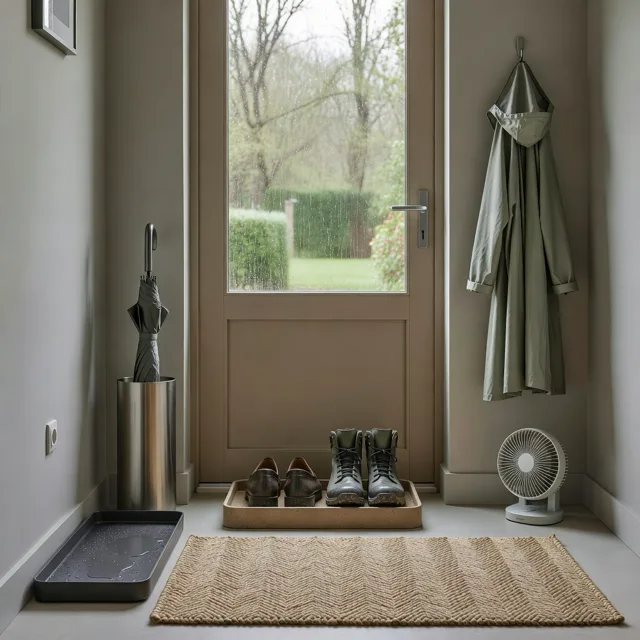
March rains are good for the garden but brutal on your entryway. Wet umbrellas propped against the wall, muddy boots pooling water on the mat, damp coats tossed over the door handle. Within a day or two, the whole front zone starts to smell like a locker room. In feng shui, that zone has a name: 气口 (qìkǒu) — the Mouth of Qi. It is the single most important threshold in your home, where fresh energy enters and circulates through every room.
When the Mouth of Qi is wet, cluttered, and stagnant, the energy that enters your home carries that quality. In TCM terms, 湿 (shī) — dampness — is one of the six climatic evils. It is heavy, sticky, and notoriously difficult to clear once it settles in, whether in the body or in a home. The 雨水 (Yǔshuǐ) solar term we passed in February marked the start of the rainy stretch, and by late March the moisture is relentless.
The fix is not about buying expensive mudroom furniture. It is about systems — small habits that keep moisture moving out instead of settling in. Here is how to protect your entry through the wettest weeks of spring.
Table of Contents
Why the Entry Matters More in Spring
Your front door is not just where people walk in. In feng shui, it is where 气 (qì) — life energy — flows into the entire home. A bright, clean, unobstructed entry invites fresh, vibrant qi. A dark, damp, cluttered one invites stagnation. Our entryway feng shui guide covers the year-round principles. This article is about the seasonal problem that March creates.
Spring rain introduces three specific challenges at the door:
- Standing water. Puddles from shoes and umbrellas create literal stagnant Water energy in the entry. In feng shui, moving water is auspicious; still, dirty water is the opposite.
- Damp objects blocking flow. Wet coats, bags, and gear piled by the door physically and energetically narrow the pathway qi uses to enter.
- Smell. Mildew and that unmistakable wet-shoe odor lower the quality of the qi at the threshold. If you can smell it, the energy is already compromised.
In TCM, external dampness that enters through doors and ground-level openings mirrors the way 湿邪 (shī xié, dampness evil) enters the body through the feet and lower limbs. The parallel is instructive: just as you protect your body from damp by keeping feet dry and warm, you protect your home by keeping the entry dry and moving.
The Umbrella System
The single biggest source of entry-zone dampness in March is the umbrella pile. Three family members come home on a rainy evening, and suddenly there are three soaking umbrellas dripping onto the floor, leaning against the wall, breeding mildew behind them.
The fix
- Use an umbrella stand with a drip tray. This sounds obvious, but the key detail is the tray. A stand without drainage just collects a pool underneath. Choose one with a removable tray you can empty and wipe daily during rainy stretches.
- Place the stand outside the front door or just inside on a waterproof surface. Not on carpet, not on wood floors. A stone or tile entry is ideal. If your entry is carpeted, put the stand on a boot tray.
- Open umbrellas to dry. When the rain stops, open each umbrella in a ventilated spot (a covered porch, the garage, a bathtub) for a few hours before closing and storing. A closed wet umbrella is a mold incubator.
- Limit the count. One umbrella per person at the door, plus one spare. Extras go to a closet shelf. A forest of umbrellas cluttering the entry signals chaotic, scattered energy.
Mat Rotation & Drying
Your doormat is the first line of defense. In the CNY entryway refresh, we talked about choosing the right mat for the new year. Now, in rainy season, the rule changes: you need two mats, and you rotate them.
The two-mat system
- Outside mat — a coarse, weather-resistant coir or rubber scraper mat. Its job is to catch the worst of the mud and water before feet cross the threshold. This mat gets soaked. That is its purpose.
- Inside mat — an absorbent microfiber or cotton mat just inside the door. Its job is to soak up whatever the outside mat missed. This is the one that needs rotation.
Every two to three days during a rainy stretch, swap the inside mat for a dry one and hang the wet one to dry completely — over a railing, on a drying rack, or in the dryer if it is machine-safe. A saturated mat cannot absorb anything. It just sits there, damp, smelling, and radiating stagnant energy right at the Mouth of Qi.
Shoe Protocol for Rainy Weeks
Wet shoes left on the floor create a micro-swamp at your front door. The soles hold moisture, mud, and whatever the sidewalk carried that day. In feng shui, shoes already carry the energy of everywhere they have been — adding water and dirt compounds the problem.
A simple rainy-day protocol
- Boot tray. A shallow tray or pan at the door catches drips and keeps moisture off the floor. Empty and wipe it when you see standing water.
- Stuff wet shoes with newspaper or a shoe dryer insert. Newspaper wicks moisture from inside the shoe overnight. Remove it in the morning and let shoes air-dry.
- Rotate pairs. Do not wear the same shoes two rainy days in a row. Let each pair dry completely before the next outing. This is especially important for leather shoes, which can develop mold inside.
- Cap the count at the door. One pair per person on the boot tray. The rest go to the closet. A row of six muddy pairs blocking the entry is a feng shui problem no amount of decluttering advice can fix if it happens every rainy day.
For families with children, this takes some training. A hook at kid-height for a raincoat and a clearly labeled spot on the boot tray make it easier for small people to participate without a battle.
The Coat Zone: No Piling
The single worst habit in a rainy entry: draping wet coats over the door handle, over the banister, over each other on a single hook. Wet fabric touching wet fabric does not dry — it breeds mildew and traps dampness in layers. In feng shui terms, you are literally wrapping your door's energy in heavy, stagnant Water.
What works
- One coat per hook, spaced apart. If your entry has a coat rack, use every other hook during rainy weeks so air circulates around each coat.
- Shake and hang immediately. When you come in, shake the coat outdoors (or in the entry with the door open), then hang it on its own hook. Do not fold it, do not pile it on a chair.
- Dry within 24 hours. If a coat is still damp the next morning, move it to a warmer, drier room or hang it near (not on) a heat register. Coats that stay damp for days develop odors that persist even after washing.
- Wet raincoats and ponchos go on a separate hook. These are designed to shed water, which means they drip. Keep them away from wool, cotton, and fabric coats. A dedicated hook over a drip-catching surface (a boot tray works) is the right setup.
Airflow & Ventilation at the Door
Dampness lingers where air does not move. The entry zone, especially in homes without a dedicated mudroom, is often a dead-air pocket — a small space between the front door and the first room, with no window and no fan.
Practical solutions
- Crack a nearby window for 15 minutes after everyone is home. Cross-ventilation is the fastest way to pull moisture out of the entry. Even a slightly open window in the next room creates a draft that moves damp air out.
- Use a small fan on rainy days. A compact clip fan or a small desk fan aimed at the shoe/coat zone accelerates drying. Run it for an hour or two in the evening. This single habit prevents most mildew problems.
- Dehumidifier for enclosed mudrooms. If your entry is a closed mudroom with poor ventilation, a small dehumidifier running on rainy days keeps humidity below the mold threshold. Empty the tank daily.
In the broader feng shui picture, ventilation at the entry is about keeping qi fresh and flowing. Our dampness elimination guide covers the whole-home approach. At the entry, the priority is simple: do not let wet things sit without airflow.
Wet-Weather Entry Checklist
Print this or save it in your phone. Run through it every evening during a rainy week.
| Task | Frequency | Why It Matters |
|---|---|---|
| Empty umbrella stand drip tray | Daily | Prevents standing water at the Mouth of Qi |
| Swap inside mat for a dry one | Every 2-3 days | Saturated mats can't absorb and breed odor |
| Empty and wipe boot tray | Daily | Mud and dirty water stagnate entry energy |
| Stuff wet shoes with newspaper | Same evening | Prevents internal mold and speeds drying |
| Space coats on hooks (no piling) | Every arrival | Fabric-on-fabric traps dampness and mildew |
| Run fan or crack window for 15 min | Each evening | Moves damp air out, keeps qi fresh |
| Check for mildew spots on walls and baseboards | Weekly | Early catch prevents permanent damage |
| Refresh doormat (shake, wash, or replace) | Monthly | The first thing qi touches should be clean |
A note on the TCM connection
In TCM, dampness in the environment mirrors dampness in the body. If you have been feeling heavy, sluggish, bloated, or foggy-headed this month, check your entry zone first. It is not magic — it is practical. A damp entry means you breathe damp air every time you walk in. It means your shoes carry moisture to every room. And in classical feng shui theory, a compromised Mouth of Qi affects the quality of energy throughout the entire home.
The Rain Water solar term guide covered the broader seasonal shift toward moisture. Now, as we approach 清明 (Qīngmíng) in early April, the rains intensify in many parts of the country. Getting your entry system in order this week saves you from chasing dampness problems all spring.
Is Dampness Holding Your Home Back?
A personalized feng shui consultation can identify where stagnant energy is hiding in your home — and how your BaZi chart interacts with the season's dampness. Let's get your space flowing again.
Book Your Consultation