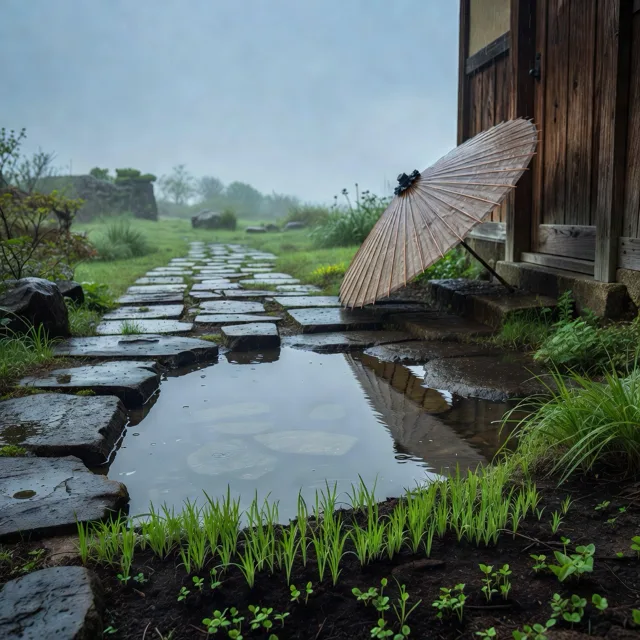
雨水 (Yǔshuǐ) — Rain Water — arrives on Friday, February 19, 2027. It is the second solar term of spring, following 立春 (Start of Spring) by exactly 15 days. The name describes a simple, observable shift: snow turns to rain, ice turns to water, and the air begins to carry moisture again.
For the home and body, 雨水 marks a turning point. Winter's challenge was dryness and cold. Spring's challenge, starting now, is 湿 (shī) — dampness. As melting snow and increasing rainfall raise outdoor humidity, and as indoor temperature differences create condensation, damp energy enters your living space and your body. The organ most vulnerable to dampness is the 脾 (pí) — the Spleen system — which governs digestion, energy production, and the body's ability to transform and transport fluids.
This guide covers the 15 days from 雨水 (February 19) to 惊蛰 (Awakening of Insects, March 6) — the window when dampness becomes the primary concern and Spleen support becomes essential.
Table of Contents
The Three Pentads of 雨水
Like all 24 solar terms, 雨水 is traditionally divided into three 候 (hòu) — five-day pentads. These are classical phenological observations describing what nature traditionally does during each period.
| Pentad | Dates (2027) | Traditional Observation | Meaning |
|---|---|---|---|
| 一候 | Feb 19-23 | 獭祭鱼 — The otter offers fish | Otters begin catching fish from newly thawed waters and lay them on the riverbank. The ancients saw this as an "offering" — nature's first harvest of the year, a sign of abundance returning. |
| 二候 | Feb 24-28 | 鸿雁来 — Wild geese arrive from the south | Migratory birds, sensing the shift in light and temperature, begin their northward journey. Movement returns to the sky. Yang energy is gaining strength. |
| 三候 | Mar 1-5 | 草木萌动 — Plants and trees begin to sprout | The first visible green appears. Buds swell. Grass pushes through softening soil. Wood energy is now unmistakable — spring has committed. |
The pentads trace a clear arc: water moves (thaw), birds move (migration), and plants move (sprouting). Everything is beginning to flow again after winter's stillness. Your body and home need to flow too — and dampness is what gets in the way.
雨水 Diet: Spleen-Supporting & Damp-Draining
The Spleen system in TCM is described as "disliking dampness" (脾恶湿). When damp energy enters the body — through diet, environment, or weather — the Spleen's ability to transform food into qi weakens. You feel heavy, bloated, foggy, and tired. The tongue develops a thick, greasy coating. Appetite drops or becomes erratic.
During 雨水, the dietary goal is twofold: strengthen the Spleen to resist incoming dampness, and gently drain dampness that has already accumulated from the festival season.
| Food Category | Best Choices | TCM Rationale |
|---|---|---|
| Spleen Tonics | Chinese yam (山药), millet, lotus seed, jujube dates, sweet potato | These neutral-to-warm, sweet foods directly nourish Spleen qi. They are gentle, easy to digest, and form the foundation of 雨水 eating. |
| Damp-Draining Grains | Barley (薏仁 yìrén), red bean (赤小豆), corn, aduki bean | These gently promote urination and help the body clear accumulated fluids. Barley and red bean congee is the classic dampness-clearing combination. |
| Aromatic Damp-Fighters | Fresh ginger, tangerine peel (陈皮), cardamom, perilla leaf (紫苏) | Aromatic foods and herbs "transform dampness" by activating the Spleen's transport function. Tangerine peel in congee or tea is a daily classic. |
| Warming Proteins | Chicken, freshwater fish, tofu, eggs | Lighter than winter's lamb and bone broth, but still warming. The transition from heavy winter proteins to lighter spring proteins begins now. |
| Leafy Greens | Chinese cabbage, spinach, celery, mustard greens | Lightly cooked greens support Liver qi flow (Wood season) and add fiber that helps the Spleen transport efficiently. |
Home Feng Shui for a Damp Season
Dampness is not only a TCM body concept — it is a literal environmental reality during 雨水. As outdoor humidity rises and temperature differentials create condensation on cold surfaces, your home needs attention in specific areas.
| Focus Area | Action | Why |
|---|---|---|
| Bathroom | Run the exhaust fan for 20 minutes after every shower. Squeegee glass surfaces. Check for mold in grout and silicone seals. Keep the bathroom door closed when not in use. | The bathroom is the dampest room in the home. In feng shui, bathroom moisture left to spread pulls Water energy into adjacent rooms, weakening Earth (Spleen) sectors. |
| North sector | Check for condensation on north-facing windows. Wipe down sills. If the North holds the #5 star this year (it does in 2027), ensure metal cures are not sitting in puddles of condensation. | The North is Water's home direction. During 雨水, it is the sector most prone to dampness accumulation. Excess moisture here amplifies the already-afflicted Five Yellow star. |
| Entryway | Place a shoe tray near the door to collect wet shoes. Add a dry mat. Do not let wet umbrellas drip onto entryway floors — hang them to dry or use a stand. | The entry is where outdoor dampness literally walks into your home. A wet, muddy entry carries damp qi into the entire living space. A dry entry = a clean qi threshold. |
| Closets and storage | Open closet doors for an hour on dry days to ventilate. Place moisture-absorbing packets or a small dehumidifier in closets near exterior walls. | Enclosed, unventilated spaces grow stale and damp during 雨水. Clothing stored in damp conditions develops a musty smell — and in feng shui, musty qi clings to what you wear. |
| Ventilation | On dry, sunny days, open opposite windows for 15 minutes to create a cross-breeze. Air the bedding (hang quilts over a balcony railing or in front of an open window). | Cross-ventilation is the fastest way to flush damp, stagnant qi. Sun-dried bedding carries warmth and yang energy back into the bedroom. |
Body Protocol
| Area | What to Do | TCM Reasoning |
|---|---|---|
| Abdomen | Keep the belly warm. Do not wear cropped tops or leave the lower abdomen exposed in February air. A wool undershirt tucked in protects the 中脘 (zhōngwǎn) area. | The Spleen and Stomach occupy the middle burner (中焦). Cold to the abdomen directly weakens their function — and weak Spleen qi means more dampness accumulates. |
| Joints | Protect knees, ankles, and wrists from damp wind. Don't switch to spring clothing too early. The old saying: 春捂秋冻 — "cover up in spring, endure cold in autumn." | Damp cold enters joints easily. In TCM, this creates 痹证 (bì zhèng) — painful obstruction. People with existing joint stiffness should dress warmly until March temperatures stabilize. |
| Movement | Increase activity level slightly from winter's minimum. Brisk walking, gentle yoga, tai chi. Work up a light sweat 3-4 times per week. | Movement activates Spleen qi and helps the body transport and transform dampness. A light sweat expels damp through the pores. But don't overdo it — drenching sweat depletes yang. |
| Emotions | The Spleen is weakened by overthinking and worry (思 sī). If you feel heavy or stuck, journal, take a walk, or talk to someone. Don't let worry spiral during the damp weeks. | "忧思伤脾" — worry and overthinking injure the Spleen. During 雨水, when the Spleen is already under dampness pressure, rumination hits harder. |
15-Day Plan: 雨水 to 惊蛰
| Days | Focus | Key Actions |
|---|---|---|
| Feb 19-23 | Damp-proof the home | Check bathrooms, north-facing windows, and closets for dampness. Set up shoe trays and dry mats at entries. Begin millet-tangerine peel congee for breakfast. Swap heavy winter bedding for a lighter quilt if the bedroom is warm enough. |
| Feb 24-28 | Spleen support week | Daily warm breakfast (congee, oatmeal with dates, or soup). Reduce dairy, sugar, and cold drinks. Cook with ginger and tangerine peel. Cross-ventilate the home on dry days. Begin 3-4x weekly brisk walks or tai chi. |
| Mar 1-5 | Prepare for 惊蛰 | Air sun-dry all bedding on a clear day. Deep-clean the kitchen (dampness accumulates around the sink and under appliances). Check outdoor drains — clear any debris before spring rains intensify. Begin shifting to slightly more pungent and sprouting foods as 惊蛰 approaches. |
雨水 Don'ts
| Avoid | Why |
|---|---|
| Switching to light spring clothing too early | 雨水 air is damp and cold — the worst combination for joints and the Spleen. Keep warm layers on until temperatures stabilize above 60F consistently. |
| Eating cold, raw, or greasy food | Cold and greasy foods generate dampness directly. The Spleen, already under pressure, cannot transform heavy food efficiently during 雨水. |
| Leaving wet laundry drying indoors | Indoor drying adds significant moisture to the air. Use a dryer or hang laundry outside or in a well-ventilated area. Damp laundry in the bedroom is particularly problematic. |
| Sitting still all day | Stillness allows dampness to settle. Even 15 minutes of movement helps the Spleen transport fluids and breaks up damp stagnation in the body. |
| Sleeping with wet hair | Damp hair on a pillow creates a damp micro-environment around the head for 7-8 hours. In TCM, this invites wind-damp into the neck and head — headaches and stiffness follow. |
⚠️ Disclaimer: Solar term health practices are traditional guidelines from Chinese agrarian culture and classical TCM texts. The three pentads are historical phenological observations. TCM organ references (Spleen, Liver) describe traditional functional systems, not biomedical organs. These guidelines are wellness suggestions, not medical advice. If you have chronic joint pain, persistent digestive issues, or conditions affected by humidity, consult your healthcare provider.
Your Dampness Tendency
Some people accumulate dampness easily; others hardly notice 雨水 at all. Your birth chart's Earth and Water balance determines your constitutional tendency. A BaZi reading reveals where dampness hits you hardest — and what to do about it.
Book a Spring Reading