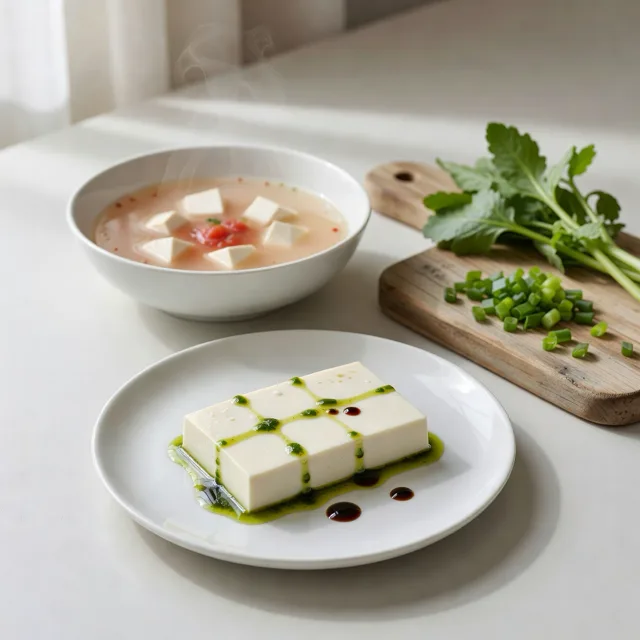
豆腐 (dòufu) — tofu — is one of the most versatile ingredients in Chinese cooking. It is also one of the most misunderstood in the West, where it is often treated as a bland meat substitute rather than a food with its own distinct character. In TCM food therapy, tofu has a specific nature and a specific season where it shines. That season is spring.
Classically, tofu is described as cool in nature, sweet in flavor, and moistening in action. It enters the Spleen, Stomach, and Large Intestine channels. In practical terms: it gently clears heat, generates body fluids, and supports digestion without burdening it. When the 肝 (gān) — Liver — is running hot in Wood season, tofu provides exactly the kind of quiet, cooling nourishment the body asks for.
This is not a "how to cook tofu for the first time" article. This is about using tofu strategically in March — paired with the right aromatics and vegetables so every constitution can enjoy it, even if you tend to run cold.
Table of Contents
Tofu's TCM Profile
| Property | Detail |
|---|---|
| Nature | Cool (凉 liáng) |
| Flavor | Sweet (甘 gān) |
| Channels entered | Spleen, Stomach, Large Intestine |
| Classical actions | Clears heat, generates fluids, moistens dryness, harmonizes the middle (中焦 zhōng jiāo) |
| Best season | Spring and summer, when internal heat tends to rise |
| Caution | Cool nature can burden a cold, deficient Spleen if eaten raw or in large quantities without warming companions |
The key takeaway: tofu is not neutral. It has a cooling direction. In March, when many people experience rising Liver heat (irritability, flushing, headaches, red eyes), that cooling direction is therapeutic. But if you are someone who runs cold — cold hands, loose stools, fatigue — you need to pair tofu with warming ingredients rather than eating it cold and plain. More on that at the end.
For a deeper look at the warming-cooling spectrum, see our warming and cooling foods guide.
Buying Tofu: Types That Matter
Not all tofu works for every dish. Here is a quick guide for US grocery stores.
| Type | Texture | Best For |
|---|---|---|
| Silken (嫩豆腐 nèn dòufu) | Custard-like, very soft | Cold dishes, soups, steaming. Do not stir-fry. |
| Medium-firm | Holds shape but still soft | Braising, mapo tofu, soup cubes |
| Firm (老豆腐 lǎo dòufu) | Dense, sliceable | Stir-frying, pan-frying, grilling |
| Extra-firm / pressed | Very dense, almost chewy | Dry-frying, cubing for salads, replacing meat in stir-fries |
Storage tips
- Use tofu within 3-5 days of opening. Once the package is open, store in a container of water in the fridge, changing the water daily.
- Unopened, sealed tofu keeps until the package date. Check for a sour smell before using — that is the sign it has turned.
- Freezing changes tofu's texture to spongy and chewy. This is intentional in some recipes (冻豆腐 dòng dòufu, frozen tofu, is used in hot pot), but not what you want for these spring dishes.
Dish 1: Silken Tofu with Scallion Oil
葱油豆腐 (cōng yóu dòufu) — the simplest tofu dish and one of the most satisfying. This is a cold or room-temperature appetizer that takes five minutes.
Method
- Carefully unmold a block of silken tofu onto a plate. Slice into generous squares or simply leave whole.
- Finely chop 3-4 scallions (green and white parts). Heat 2 tablespoons of a neutral oil in a small pan until shimmering. Pour the hot oil over the scallions — they should sizzle and release their aroma.
- Drizzle the scallion oil over the tofu. Add a splash of light soy sauce and a pinch of white pepper.
- Optional: a few drops of sesame oil and a scattering of toasted sesame seeds.
TCM note: The hot scallion oil provides a warming counterpoint to the cool tofu. Scallion is classified as warm and pungent in TCM, making this a well-balanced dish even for people who tend to run cool.
Dish 2: Tofu-Tomato-Egg Soup
番茄豆腐蛋花汤 (fānqié dòufu dànhuā tāng) — a home-cooking classic. Light, savory, done in 15 minutes. This appeared in our spring soups piece; here is the full method.
Method
- Cut 2 medium tomatoes into wedges. Cube half a block of medium-firm tofu into bite-size pieces. Beat 1-2 eggs in a bowl.
- Heat a small amount of oil. Stir-fry the tomatoes until they soften and release juice (about 3 minutes).
- Add 3-4 cups of water or light stock. Bring to a boil. Add the tofu cubes and simmer for 5 minutes.
- Season with salt and a pinch of white pepper. Slowly pour in the beaten egg in a thin stream while stirring gently to create egg-drop ribbons.
- Finish with a few drops of sesame oil and chopped scallion.
TCM note: Tomato is classified as slightly cool and sweet — it clears heat and generates fluids. Paired with tofu, this soup is gently cooling without being cold. The egg adds protein and a neutral, warming balance. An ideal lunch soup for March.
Dish 3: Mapo-Style with Less Chili
Spring Mapo Tofu — the classic Sichuan dish, dialed down for Wood season. Traditional mapo tofu is loaded with 花椒 (huājiāo, Sichuan pepper) and chili bean paste. In March, with Liver heat already rising, a gentler version keeps the flavor without adding fire.
Method
- Cube a block of medium-firm tofu. Blanch briefly in salted boiling water to firm it up, then drain.
- In a wok, heat oil and stir-fry 1 tablespoon of 豆瓣酱 (dòubàn jiàng, chili bean paste — use a mild variety or reduce to 2 teaspoons). Add minced ginger and garlic.
- Add a cup of stock or water. Slide in the tofu. Simmer gently for 5-7 minutes to absorb flavor.
- Thicken with a cornstarch slurry. Sprinkle a small amount of Sichuan pepper (or omit entirely) and chopped scallion.
TCM note: By reducing the chili and pepper, you keep the warming aromatics (ginger, garlic) that support digestion while avoiding the excess heat that aggravates Liver fire. This is not authentic Sichuan — it is a spring adaptation.
Dish 4: Braised Tofu with Mushrooms
蘑菇烧豆腐 (mógū shāo dòufu) — earthy, satisfying, and deeply flavored. Mushrooms and tofu together create a dish that is substantial without being heavy.
Method
- Slice firm tofu into rectangles about half an inch thick. Pan-fry in a thin layer of oil until golden on both sides. Remove and set aside.
- In the same pan, stir-fry sliced shiitake mushrooms (fresh or rehydrated dried) and king oyster mushroom slices until they release their liquid and begin to brown.
- Add a splash of soy sauce, a pinch of sugar, a cup of stock (or mushroom soaking liquid), and the fried tofu. Simmer for 8-10 minutes until the sauce reduces and the tofu absorbs flavor.
- Finish with a drizzle of sesame oil and a few leaves of fresh cilantro or scallion.
TCM note: Shiitake is classified as neutral to slightly warm, entering the Stomach channel — it tonifies qi and supports immunity. The neutral warmth of the mushroom balances the cool tofu, making this dish suitable for nearly everyone in March.
Dish 5: Tofu with Shepherd's Purse
荠菜豆腐 (jìcài dòufu) — a seasonal pairing that only works in March and early April, when shepherd's purse is available. If you read our wild spring greens guide, you know that 荠菜 (jìcài) is the quintessential spring green in the Chinese kitchen.
Method
- Wash and blanch a generous bunch of shepherd's purse (or frozen, if fresh is unavailable). Squeeze dry and chop roughly.
- Cube silken or medium-firm tofu.
- In a pot, bring light stock or water to a simmer. Add the tofu and simmer for 3 minutes.
- Add the chopped shepherd's purse. Season with salt and white pepper. Cook together for 2 more minutes.
- Serve as a soup or drain slightly and serve as a side dish.
TCM note: Shepherd's purse is classified as cool and sweet, with an affinity for the Liver channel. It is traditionally used to clear Liver heat and brighten the eyes. Combined with tofu, this is a deeply spring-appropriate dish — cooling, light, and nourishing.
Pairing Tips for Cold Constitutions
If you know from the body constitution guide that you run cold — or if you have symptoms like cold hands and feet, loose stools, fatigue, or a pale tongue — tofu's cool nature can feel heavy in your stomach. The solution is not to avoid tofu. It is to pair it correctly.
| Warming Companion | How to Use | TCM Logic |
|---|---|---|
| Fresh ginger (生姜 shēngjiāng) | Add minced ginger to any tofu stir-fry or braise | Warm nature counteracts tofu's coolness; supports Spleen |
| Garlic | Stir-fry garlic before adding tofu to the pan | Warm, pungent — moves qi and aids digestion |
| Scallion | Finish dishes with generous chopped scallion | Warm and dispersing — opens the surface and moves qi |
| Sesame oil | A finishing drizzle on soups and cold dishes | Warm nature, moistening — softens tofu's cooling effect |
| Black pepper or white pepper | A pinch in soups and braised dishes | Warm, pungent — warms the Stomach, dispels cold |
The principle is simple: cook tofu with warming aromatics, and eat it warm. A cold block of silken tofu straight from the fridge is not the right choice for someone with a cold constitution. The same tofu in a hot ginger-scallion braise is a different food entirely.
⚠️ Disclaimer: This article describes tofu within the traditional Chinese medicine food therapy framework. These are dietary perspectives, not medical prescriptions. If you have soy allergies or sensitivities, avoid tofu entirely. Consult your healthcare provider before making dietary changes for any health condition.
What Should You Eat This Spring?
Your BaZi chart reveals your elemental constitution — whether you run hot, cold, dry, or damp — and exactly which spring foods support your balance. Let's build your personalized spring diet.
Book a Food Therapy Consultation