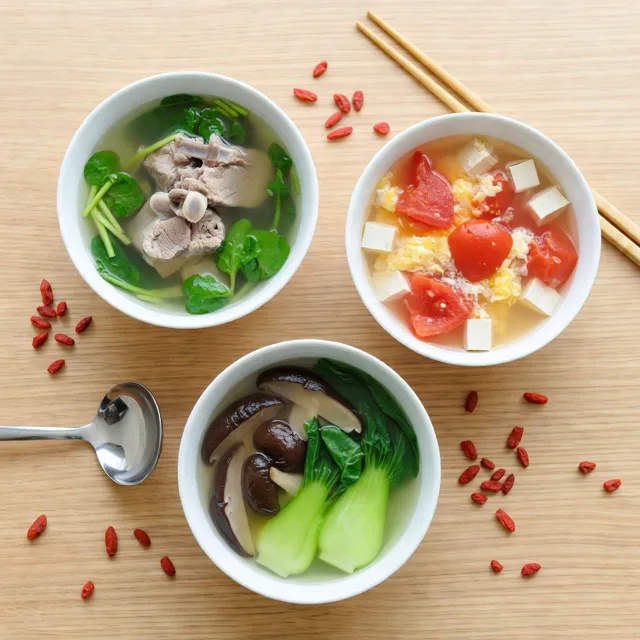
If your winter soup pot was all about depth — bone broth simmered for hours, rich lamb stews, thick congees with ginger and red dates — March asks for a different register. The Liver is peaking. The weather is warming. Heavy, warming soups that were essential in January now risk generating internal heat that has nowhere to go. The body is ready for lighter fare.
汤 (tāng) — soup — never leaves the Chinese table. It simply changes character with the season. Spring soups are thinner, clearer, and built around vegetables rather than bones. They gently clear heat, nourish 肝血 (gān xuè) — Liver Blood — and support the 脾 (pí) — Spleen system — so it can handle the seasonal shift without bogging down in dampness.
Here are five soups to anchor your March kitchen. Each one takes under 40 minutes, uses ingredients available in any US supermarket (with one or two additions from an Asian grocery), and follows a clear TCM logic. At the end, a 7-day table rotates them through the week.
Table of Contents
The Winter-to-Spring Soup Shift
In TCM food therapy, soups are classified by their thermal nature and their functional emphasis. Winter soups are warming and supplementing — they build yang, warm the interior, and fortify the Kidney. Spring soups shift toward cooling and regulating — they clear mild heat, move qi, and nourish Blood and yin without adding heaviness.
| Quality | Winter Soups | Spring Soups |
|---|---|---|
| Base | Bone broth, rich stock, slow-simmered | Light stock, clear broth, quick-cooked |
| Thermal nature | Warming to hot | Neutral to cool |
| Key ingredients | Lamb, ginger, astragalus, root vegetables | Leafy greens, tofu, goji, mushrooms, light pork |
| TCM organ focus | Kidney, Spleen | Liver, Spleen |
| Cook time | 1–4 hours | 20–40 minutes |
The transition does not need to be abrupt. If March still feels cold where you live, keep a bone broth in the rotation once or twice a week — just balance it with lighter soups on other days. Our herbal soups guide covers the bridge between heavy and light.
Soup 1: Watercress & Pork Rib (西洋菜排骨汤)
This is the quintessential Cantonese spring soup. 西洋菜 (xīyángcài) — watercress — is cool in TCM nature, sweet and slightly bitter, and enters the Lung and Stomach channels. It gently clears heat from the upper body without being aggressively cold. Paired with pork ribs, which are neutral and nourishing, you get a balanced soup that clears without depleting.
Method
- Blanch 400g pork spare ribs in boiling water for 3 minutes. Drain, rinse. This removes impurities and ensures a clear broth.
- In a fresh pot, combine the blanched ribs with 6 cups of water, 3 thin slices of ginger, and 2–3 honey dates (蜜枣 mìzǎo — available in Asian groceries; substitute regular jujubes if needed). Bring to a boil, then reduce to a gentle simmer for 30 minutes.
- Wash and roughly chop a large bunch of watercress (about 200g). Add to the pot. Simmer for another 10 minutes — no longer, or the watercress turns bitter and loses its bright color.
- Season with a pinch of salt. No soy sauce, no heavy seasoning. The sweetness of the pork and dates is the flavor.
TCM role
Clears mild heat from the Lung and Stomach, moistens without creating dampness, and gives the Liver a light, clean broth to work with. Ideal for days when you feel a slight sore throat, dry mouth, or restless warmth.
Soup 2: Tofu-Tomato Egg Drop (番茄豆腐蛋花汤)
This is comfort food that doubles as medicine. Tomatoes are slightly cool and sweet, entering the Stomach and Liver channels. Tofu is cool, sweet, and moistening — it clears heat and generates fluids. Eggs add protein and nourish Blood. Together in a soup, they create one of the lightest, fastest, most satisfying meals in the Chinese kitchen.
Method
- Dice 2 medium tomatoes. In a pot with a teaspoon of oil, cook the tomatoes over medium heat until they break down and release their juices — about 5 minutes.
- Add 4 cups of water or light stock. Bring to a boil.
- Cut half a block of soft tofu into small cubes. Add to the pot. Simmer 5 minutes.
- Beat 1 egg in a bowl. With the soup at a gentle boil, pour the egg in a thin stream while stirring slowly in one direction. The egg forms ribbons.
- Season with salt and a dash of white pepper. Finish with chopped scallions and a few drops of sesame oil.
TCM role
Nourishes Stomach yin, gently clears heat, and supports Blood. This is the soup for a busy weeknight when you need something nourishing in 15 minutes. It suits nearly every constitution.
Soup 3: Goji-Leaf or Spinach-Goji (枸杞叶汤 / 菠菜枸杞汤)
枸杞叶 (gǒuqǐ yè) — goji leaves — are a Cantonese spring staple. If you can find them fresh at an Asian market, they make a superb soup. If not, spinach is an excellent substitute, and dried goji berries provide the goji element.
Method (Spinach-Goji version)
- Soak a handful of dried goji berries (about 2 tablespoons) in warm water for 10 minutes.
- Bring 4 cups of light chicken stock or water to a boil. Add 2 slices of ginger and the soaked goji berries.
- Simmer 10 minutes.
- Wash 150g fresh spinach. Add to the pot whole (do not chop — the leaves wilt beautifully). Cook 2 minutes until just wilted.
- Season lightly with salt. Serve immediately — spinach darkens if it sits.
Method (Goji-Leaf version)
Substitute fresh goji leaves for the spinach. Strip the leaves from the stems, wash thoroughly, and add to the broth. Cook 3–4 minutes. Add 100g sliced lean pork if desired — drop the pork slices into the simmering broth before the leaves, cook 5 minutes, then add the leaves.
TCM role
Both goji berries and spinach nourish Liver Blood and benefit the eyes — the Liver's sense organ. This soup is classically recommended for people who spend long hours at screens, experience dry or tired eyes in spring, or show signs of Blood deficiency (pale complexion, light-headedness, thin nails).
Soup 4: Shiitake & Bok Choy Clear Broth (香菇小白菜清汤)
The simplest soup on this list and possibly the most useful as a daily staple. Shiitake mushrooms are neutral in thermal nature, sweet, and enter the Stomach and Liver channels. They are traditionally credited with strengthening the Spleen and boosting the body's defensive energy. Bok choy is cool and sweet — a gentle heat-clearing vegetable that keeps the broth light.
Method
- Slice 4–5 fresh shiitake mushrooms (or rehydrate 6 dried shiitakes in warm water for 20 minutes; save the soaking liquid).
- Bring 4 cups of water (plus mushroom soaking liquid if using dried) to a boil with 2 slices of ginger.
- Add the shiitakes. Simmer 10 minutes.
- Halve or quarter 3–4 baby bok choy. Add to the pot. Cook 3 minutes until the stems are tender-crisp.
- Season with a pinch of salt and a tiny splash of soy sauce. A few drops of sesame oil to finish.
TCM role
A neutral, balanced soup that supports the Spleen without adding heat or cold. This is the workhorse — the soup you make on days when nothing is wrong and you just want something clean and nourishing. It pairs with anything and suits all constitutions.
Soup 5: Vegetarian Kombu-Mushroom Base (昆布菌菇素高汤)
Not a finished soup but a base — a spring replacement for heavy bone broth as your default cooking stock. Kombu (kelp) and dried mushrooms together produce a deep umami without any animal product. In TCM terms, kelp is cold, salty, and enters the Kidney and Liver channels; it softens hardness and clears heat. Mushrooms balance it with their neutral sweetness.
Method
- Combine in a large pot: 1 sheet of kombu (about 15cm), 6 dried shiitakes, a handful of dried goji berries, 2 slices of ginger, 8 cups of cold water.
- Soak for 30 minutes (or overnight in the fridge for deeper flavor).
- Bring to a gentle simmer — do not boil hard, which makes kombu slimy. Simmer 20 minutes.
- Remove the kombu. Continue simmering the mushrooms and goji for another 10 minutes.
- Strain. The clear golden broth is your base for any of the soups above (replace water or stock with this), for cooking grains, or for sipping on its own with a pinch of salt.
This base keeps in the fridge for 4–5 days and freezes well. Making a batch on Sunday sets you up for the week. Our spring congee guide also works beautifully with this base as the liquid.
Lunch Soup vs Dinner Soup
In Chinese meal structure, soup often appears at two points: as a midday dish (especially in southern China, where a soup course is standard at lunch) and as a light dinner.
| Timing | Best Soups | Why |
|---|---|---|
| Lunch (11 AM – 1 PM) | Watercress pork rib; tofu-tomato egg drop | Midday is when the Stomach and Spleen are strongest. Slightly more substantial soups are well digested. |
| Dinner (6 – 7 PM) | Spinach-goji; shiitake-bok choy; clear broth | Evening digestion is weaker. Lighter, clearer soups avoid burdening the Stomach before sleep. |
7-Day Rotation
| Day | Soup | Notes |
|---|---|---|
| Monday | Watercress & pork rib | Start the week with the classic spring clear |
| Tuesday | Tofu-tomato egg drop | Fast and easy; good for busy evenings |
| Wednesday | Spinach-goji | Liver Blood nourishment mid-week |
| Thursday | Shiitake & bok choy clear broth | The neutral reset day |
| Friday | Tofu-tomato egg drop (variation: add wild greens) | Familiar base with a seasonal addition |
| Saturday | Watercress & pork rib or your own creation using the vegetarian base | Weekend cooking — take your time |
| Sunday | Make a batch of kombu-mushroom base for the week; sip a bowl for dinner | Prep day |
Who Should Keep Warming Soups Longer
Not everyone is ready to go fully light in March. If you recognize yourself below, keep one or two warming soups in your weekly rotation through the end of the month:
- People with a cold Spleen constitution — chronic loose stools, bloating, cold hands and feet even in mild weather. Your Spleen still needs warmth. Add ginger to every soup, and keep the bone broth once or twice a week.
- People recovering from illness — a recent cold, flu, or surgery. Your defensive qi is low. Lighter soups are fine, but make them with chicken stock rather than plain water, and add warming aromatics (ginger, scallion white, a few slices of astragalus if available).
- Elderly or very thin individuals — less digestive fire overall. The tofu-tomato and spinach-goji soups are good choices (nourishing without being heavy), but avoid the coldest options (plain watercress broth without pork) until April.
- People in still-cold climates — if March where you live still means snow and below-freezing nights, follow the calendar by introducing lighter soups gradually, but do not force a full transition until your local weather confirms spring has arrived.
The principle is always the same: listen to your body first, the calendar second. If a warming soup still feels right on a cold March evening, trust that instinct.
⚠️ Disclaimer: These soups are based on traditional Chinese food therapy principles. They are intended as part of a balanced diet, not as treatment for any medical condition. If you have food allergies, dietary restrictions, or a chronic health condition, consult your healthcare provider before making significant changes to your diet.
Your Seasonal Kitchen
What your body needs from food changes with the season and your personal constitution. A wellness reading maps your elemental profile to a food strategy that works all year.
Book a Wellness Reading