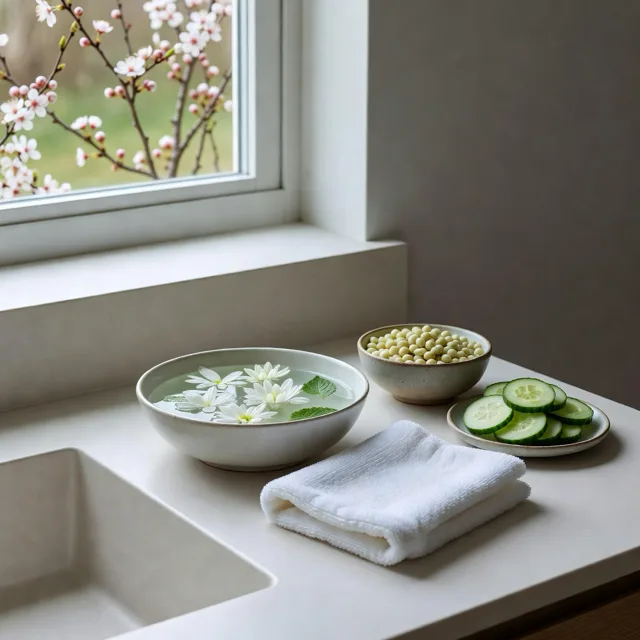
Your skin was fine all winter. Maybe a little dry, maybe a little tight, but manageable. Then March arrived — and suddenly your cheeks are red, your neck is itchy, your eyes are puffy, and the skin around your nose feels like sandpaper. Sound familiar?
In TCM, this is not a surprise. Spring is 风 (fēng) — Wind — season. Wind is classified as the leading external pathogenic factor, the one that opens the door for others. And in Wood season, the 肝 (gān) — Liver — is at peak activity. When Liver qi rises unchecked, it generates internal heat. Add wind, pollen, fluctuating temperatures, and the remnants of winter dryness, and you have the perfect setup for reactive, irritable skin.
This guide covers what is happening from a classical perspective, what you can do at home with food and care, and — importantly — when what you are seeing on your skin is no longer a seasonal annoyance and needs a doctor.
Table of Contents
Why Skin Reacts in March
In TCM, the skin is governed by the 肺 (fèi) — Lung system — which controls the opening and closing of pores and the distribution of 卫气 (wèi qì, defensive qi) across the body's surface. But the Lung does not act alone. In Five Element theory, Wood (Liver) controls Earth (Spleen), and an overactive Liver in spring can suppress the Spleen's ability to transform dampness. Meanwhile, rising Liver heat can push upward and outward to the skin's surface.
Add external factors and the picture becomes clear:
| Factor | TCM View | What You Notice |
|---|---|---|
| Spring wind | Wind opens the pores and carries external pathogens inward | Sudden itching, hives that appear and disappear, dry patches on windward cheeks |
| Rising Liver heat | Excess Liver yang pushes heat upward and outward to the skin | Red, hot-feeling skin on the face, neck, and chest; flushing |
| Pollen and allergens | External wind-heat invasion | Puffy, swollen, weeping eyes; sneezing; itchy nose and throat |
| Temperature swings | Defensive qi cannot adjust quickly enough | Skin that is dry in the morning and oily by afternoon |
| Leftover winter dryness | Yin fluids depleted by months of heating and cold wind | Flaking, tightness, cracked corners of the mouth |
Our winter skin guide covered the dryness angle. This article picks up where that left off — the transition from dry to reactive.
Gentle Cleansing: Less Is More
The single biggest mistake people make with spring skin is overreacting. The redness appears, so they add a new serum. The itching starts, so they exfoliate harder. The puffiness arrives, so they switch to a "purifying" cleanser with alcohol. Each intervention strips more of the skin's protective barrier, making the problem worse.
The TCM approach: protect the barrier
- Cleanse gently, once or twice daily. A mild, fragrance-free cleanser. No scrubs, no brushes, no "deep clean" products during a reactive phase.
- Lukewarm water only. Hot water strips oils from the skin and opens pores wider to allergens. Cold water does not cleanse effectively. Lukewarm is the middle path.
- Pat dry, do not rub. A soft towel, pressed gently against the face. Rubbing inflamed skin creates micro-abrasions that worsen redness.
- Reduce products. If your skin is reacting, strip your routine to cleanser, moisturizer, and sunscreen. Nothing else until it calms down. Every additional product is a potential irritant during a reactive window.
- No new products in March. This is not the month to trial a new acid, retinol, or vitamin C serum. Introduce new actives in calm skin months, not reactive ones.
Cooling Foods for Itchy Weeks
In TCM, heat in the skin is often addressed from the inside. When the Liver is generating excess heat and wind is carrying it to the surface, cooling the interior helps calm the exterior. This is the classical logic behind the spring diet advice in our Liver tea guide — and it applies directly to skin.
Foods traditionally used to cool spring skin heat
- 绿豆 (lǜ dòu) — mung bean. Classically one of the most cooling foods in the Chinese kitchen. Mung bean soup (sweet or savory) is a traditional summer standby, but in a warm, windy March it serves the same purpose. A bowl every few days during an itchy stretch.
- 黄瓜 (huángguā) — cucumber. Cool nature, moistening. Eat it raw in salads or add to cold soups. Also works as a topical — fresh cucumber slices on irritated skin for 10 minutes provide gentle cooling.
- 梨 (lí) — pear. Moistening and mildly cooling. Good for the throat and skin alike. Raw or lightly steamed.
- 菊花茶 (júhuā chá) — chrysanthemum tea. The classic Liver-cooling, eye-soothing tea. Steep a handful of dried chrysanthemum flowers in hot water for five minutes. Drink 1-2 cups during itchy or red-eye days.
- 薏米 (yìmǐ) — Job's tears / coix seed. Traditionally used to drain dampness and support skin clarity. Add to congee or cook as a simple barley water.
- Leafy greens. Spinach, watercress, romaine lettuce — lightly cooked, not raw in large quantities (raw greens can be hard on a weak Spleen).
What to Avoid When Skin Is Hot
If your skin is already red, itchy, or inflamed, certain foods can add fuel to the fire in classical terms. This is not about permanent restriction — it is about temporary moderation during the reactive window.
| Category | Examples | TCM Reason |
|---|---|---|
| Alcohol | Wine, beer, spirits | Generates damp-heat, dilates blood vessels, worsens flushing |
| Lamb and venison | Any strongly warming red meat | Hot nature adds yang heat when you need cooling |
| Chili and hot spices | Dried chili, cayenne, Sichuan pepper | Disperses heat outward to the skin surface |
| Fried foods | Deep-fried snacks, crispy chicken | Generates internal damp-heat and burdens the Spleen |
| Excessive dairy | Full-fat cheese, cream, ice cream | Traditionally considered damp-producing, can worsen congestion |
These are traditional guidelines, not medical prescriptions. If you know from experience that a specific food triggers your skin, trust that knowledge regardless of what any system says.
Chrysanthemum Compress & Mint Mist
Two traditional external remedies described in classical texts for wind-heat skin irritation. These are gentle enough for home use but are not treatments for diagnosed skin conditions.
Chrysanthemum compress
- Steep a generous handful of dried 菊花 (júhuā, chrysanthemum flowers) in hot water for 10 minutes. Let cool to room temperature.
- Soak a clean, soft cloth in the tea. Wring lightly.
- Press against red, itchy areas of the face or neck for 5-10 minutes.
- Repeat once daily during reactive episodes.
Chrysanthemum is classified as cool and slightly bitter in TCM, with an affinity for the Liver and Lung channels. Traditionally, it is used to clear wind-heat from the head and eyes.
Mint mist
- Brew a strong cup of 薄荷 (bòhé, peppermint or field mint) tea. Let cool completely.
- Pour into a small spray bottle.
- Mist lightly on itchy, hot skin as needed throughout the day. Store in the refrigerator for extra cooling effect.
Mint is classified as cool and pungent — it disperses wind-heat at the surface. This is a folk remedy, not a clinical treatment. If your skin reacts to the mist, stop immediately.
What the research says
Chrysanthemum extracts and menthol (the active compound in mint) have been studied for their anti-inflammatory properties in preliminary research. While these studies are not conclusive, the traditional use of both plants for skin-surface cooling has a long empirical history in Chinese herbal practice.
Sleep, Stress & the Liver Connection
If you have been following this site through March, you know that the allergy piece covered the respiratory angle of spring reactivity. The skin angle has one additional dimension that deserves emphasis: stress and sleep.
In TCM, the Liver governs the smooth flow of qi and emotions. When you are stressed, anxious, or sleeping poorly, Liver qi stagnates and then flares — often as heat that surfaces on the skin. This is why many people notice their worst skin days coincide with their most stressful weeks, not their highest pollen days.
The skin-sleep protocol
- Aim for sleep before 11 PM. The Liver channel is most active from 1 to 3 AM. Being deeply asleep during this window allows the Liver to process and detoxify without disturbance.
- No screens for 30 minutes before bed. Blue light and the stress of social media stimulate Liver yang at exactly the wrong time.
- Cool the bedroom slightly. Spring nights warm up. A cooler room (around 65-68 degrees Fahrenheit) helps prevent the overheating that aggravates itchy skin at night.
- Manage stress actively. Movement, journaling, a five-minute breathing exercise, or a walk outdoors. The summer skincare guide will expand on this for warmer months.
When to See a Doctor
This guide describes traditional approaches to seasonal skin discomfort. There are clear lines where self-care stops and medical attention starts.
- Rashes that spread rapidly — especially if accompanied by fever, swelling, or difficulty breathing. This could indicate an allergic reaction that needs immediate attention.
- Hives that last more than a few days or keep returning. Persistent urticaria warrants medical evaluation.
- Weeping, crusting, or infected-looking skin — any sign of bacterial infection (increasing redness, warmth, pus, red streaks) needs a doctor, not a compress.
- Skin changes that do not match the season — new moles, asymmetric spots, or lesions that bleed without trauma. These are always a doctor visit, any time of year.
- Symptoms that interfere with daily life — itching that prevents sleep, redness that causes social anxiety, dryness that cracks and bleeds. Quality of life matters. Do not suffer through a month of misery when a dermatologist can help.
If you are on prescribed allergy medication or using a prescription skin treatment, continue using it. Nothing in this article is a substitute for medical care. TCM dietary and lifestyle practices can complement your treatment — they do not replace it.
⚠️ Disclaimer: This article describes traditional Chinese medicine perspectives on seasonal skin care. It is not medical advice. Rashes, persistent hives, infections, and new or changing skin lesions require evaluation by a qualified healthcare provider. Continue any prescribed medications and consult your doctor before making dietary changes for a skin condition.
Your Skin Tells a Seasonal Story
A BaZi reading reveals your constitutional tendencies — which elements run hot, which run dry — and how to adjust your routines for each season. Let's decode yours.
Book Your BaZi Reading