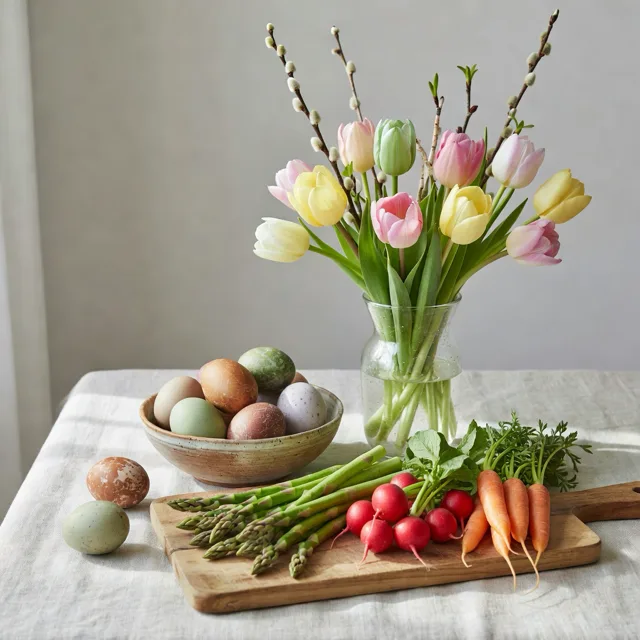
Easter Sunday, March 28, 2027. A week after the 春分 (Chūnfēn) spring equinox, two days after 观音诞 (Guanyin's Birthday). This is one of those rare stretches on the calendar where Western and Chinese traditions pile on top of each other, all saying the same thing in different languages: the world is renewing, and so can you.
If you celebrate Easter, this guide is for you. If you do not, but you live in a household that does, it is still for you — because the themes of this weekend (rebirth, gratitude, family, spring) are universal, and the Five Element lens gives you practical ways to honor them in your home.
In our Christmas Day piece, we explored how Chinese and Western holiday traditions share deeper resonances when you look past the surface. Easter and equinox season offer the same opportunity. No theology here. Just warmth, family, and a home that feels right for spring.
Table of Contents
Eggs as Renewal: East and West
The egg is one of the most universal symbols of new life. In the Easter tradition, decorated eggs represent resurrection and hope. In Chinese culture, eggs mark life transitions — dyed red eggs are given at a baby's one-month celebration (满月 mǎnyuè), and eggs play a central role in two spring customs.
The 春分 egg-standing custom
On the spring equinox (which we covered in the 春分 guide last week), there is a folk tradition of 竖蛋 (shù dàn) — standing a raw egg upright on a flat surface. The idea is that the equinox's perfect balance of day and night creates conditions where even an egg can find its center. It is a playful custom, not a physics lesson, but it delights children and connects the family to the season's theme of equilibrium.
The 立夏 egg games
Later in spring, on 立夏 (Lìxià, Start of Summer), children play egg-fighting games and wear eggs in woven nets around their necks. The egg appears again and again in Chinese seasonal customs — a thread running through the calendar, always connected to vitality and transition.
Bridging the traditions
On Easter Sunday, whether you are dyeing eggs, hunting for them, or simply cracking one into a pan, take a moment to notice the overlap. Two civilizations, thousands of miles apart, both chose the egg as their spring symbol. The fact that they arrived at the same image independently says something about the power of the symbol — and about what spring stirs in all of us.
Spring Lamb & TCM's Warm-Weather View
Lamb is a classic Easter centerpiece in Western tradition. In Chinese food therapy, 羊肉 (yáng ròu) — lamb/mutton — is classified as warm to hot in nature, with an affinity for the Spleen and Kidney channels. It is an excellent winter food: warming, nourishing, and tonifying for yang energy.
In late March, though, the season has shifted. Wood energy is strong, the Liver is active, and the body is beginning to shed winter's heaviness. A large, heavy lamb roast on top of a week of spring wind and rising Liver heat can, in classical terms, generate excess internal warmth — flushing, restless sleep, irritability.
The balanced approach
- Go lighter on the portion. A few slices of roasted lamb alongside generous spring vegetables, rather than a mountain of meat. The lamb is the accent, not the entire plate.
- Pair with cooling sides. A mint sauce (mint is cooling in TCM), a cucumber salad, steamed asparagus, or a watercress salad balances the heat of the lamb.
- Use rosemary and thyme generously. These aromatic herbs help the Spleen transform heavy protein, supporting digestion in a season where the Spleen is already under pressure from Wood energy.
- Skip seconds if you run warm. If your BaZi chart is Fire-heavy or you already feel warm, flushed, or restless this week, let the lamb be a taste, not a feast.
None of this means lamb is wrong at Easter. It means adjusting the proportion and pairing to match the season. That is the whole principle of Chinese food therapy: the same ingredient serves or strains, depending on when and how you use it.
A Five Element Easter Table
Whether your Easter table is formal or casual, you can use Five Element principles to make it feel complete. This is the same approach we used for the Christmas table, adapted for spring energy.
| Element | Spring Expression | Table Ideas |
|---|---|---|
| Wood | This is Wood's season — it should be present but not overwhelming | Fresh flowers in a small vase (not a towering arrangement). Green napkins or a green linen runner. A few sprigs of fresh herbs as garnish. |
| Fire | Joy, warmth, the heart of the gathering | Candles (even in daylight, a lit candle sets intention). Pink or pastel-red accents. The warm tones of a baked ham or roasted lamb. |
| Earth | Grounding, nourishment, the center | Ceramic or stoneware serving dishes. Root vegetables — roasted carrots, parsnips, potatoes. A bread basket as the anchoring center of the table. |
| Metal | Structure, clarity, refinement | Clean white plates. Silver or steel cutlery. A single white flower among the greens. Crystal glassware if you have it. |
| Water | Depth, reflection, connection | A bowl of water with floating flowers as a centerpiece. Blue or dark purple accents. Still water served in a glass pitcher. |
The key word for a spring table is lightness. The Christmas table was about abundance and warmth against the cold. The Easter table reflects the equinox: balanced, open, fresh. Less is more. Leave space on the table — crowded surfaces create cluttered energy.
A Home Blessing Walk-Through
Easter morning, before guests arrive or the egg hunt begins, take ten minutes for a simple home walk-through. This is not a ritual — it is a reset. The Christmas Eve piece described a similar pre-holiday preparation. Here is the spring version.
The ten-minute Easter walk-through
- Open the front door and one window on the opposite side of the house. Let cross-ventilation pull through for five minutes. Fresh spring air replaces stale indoor qi. This is the simplest, most powerful thing you can do for your home's energy.
- Walk the main rooms clockwise. Start at the front door, move through the living room, dining room, kitchen, and back. In each room, look for anything that feels wrong: a pile that formed overnight, a dead flower, a light bulb that needs replacing. Fix what you can in the moment.
- Set the dining table with intention. Place each item consciously. The table is where the family will gather — treat the setting as an act of hospitality, not a chore.
- Light one candle or place one fresh flower at the entry. This signals "welcome" to both guests and qi. A blooming branch in a simple vase is perfect for March.
- Take a breath at the threshold. Stand at your front door, face inward, and take three slow breaths. You are welcoming the day into your home.
This walk-through takes no equipment and no spiritual commitment. It is simply the practice of paying attention to your space before filling it with people. Homes that are prepared receive guests differently than homes that are scrambled into readiness at the last minute.
Family Rituals That Work for Everyone
The best family rituals are ones that everyone can participate in, regardless of age, belief, or cultural background. Here are a few that bridge traditions naturally.
The gratitude egg
Before the egg hunt, give each family member a blank egg (hard-boiled or craft) and a marker. Everyone writes one thing they are grateful for this spring. The eggs go into a bowl at the center of the table during dinner. After the meal, read them aloud. This is the same gratitude principle we explored at family harmony — made tangible, seasonal, and fun for children.
The spring table blessing
Before eating, each person at the table shares one word that describes how they want the next season to feel. One word. No speeches. Children love this because it is fast and they get to be heard. The words hang in the air over the meal — a collective intention for the household's spring.
The after-dinner walk
After Easter dinner, take a family walk around the block or through the garden. March evenings are long enough now to enjoy fading daylight. Walking together after a shared meal is a form of 踏青 (tàqīng) — the ancient spring custom of treading the green. It settles digestion, moves Liver qi, and gives the family a shared experience beyond the table.
The evening quiet
Before bed, turn off screens and sit together for five minutes. A child can describe their favorite part of the day. An adult can share a memory from past Easters or springs. Quiet endings to celebratory days prevent the "holiday crash" — that overstimulated, overtired feeling that comes from running all day without a pause.
⚠️ Disclaimer: This article uses Five Element philosophy as a complementary lens for enjoying Easter and spring celebrations. Easter is a Christian holiday — the feng shui framing is offered as a cultural perspective, not as religious commentary. Enjoy whichever traditions resonate with you and your family.
Make Spring Personal
Your BaZi chart reveals how you personally relate to spring's Wood energy — and whether this season calls for expansion, rest, or a specific focus. A reading makes the season feel like yours.
Book a Spring Reading