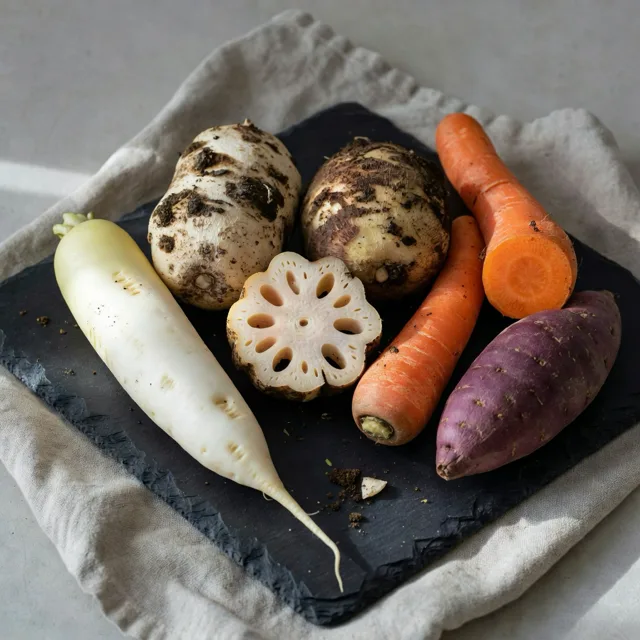
In the coldest weeks of the year, the smartest food grows underground. Root vegetables spend months pulling minerals and energy from the soil, storing everything below the surface while the world above freezes. In TCM, that matters: roots are grounding, warming, and nourishing — exactly what your body needs in January when the 肾 (shèn) — Kidney system — is working hardest to sustain warmth and vitality.
The Chinese saying captures it simply: "冬吃萝卜夏吃姜" (dōng chī luóbo xià chī jiāng) — eat radish in winter, eat ginger in summer. But radish is only one member of a deep winter root lineup. Each root has a distinct thermal nature (warming, cooling, or neutral), specific organ affinities, and a best cooking method that maximizes its benefit.
This article is your reference table. Pin it to the refrigerator, screenshot the chart, or just read it before your next grocery run. Three simple recipes at the bottom put the theory into your pot.
Table of Contents
Why Roots in Winter
In Five Element dietary theory, winter belongs to the Water element, governed by the Kidney. The Kidney stores 精 (jīng) — essence — and manages the body's foundational energy reserves. Winter eating should support this storage function: warm, slow-cooked, dense, and mineral-rich. Root vegetables fit every requirement.
| Why Roots Work in Winter | TCM Explanation |
|---|---|
| Grounding energy | Roots grow downward, anchoring. In TCM, downward-moving foods stabilize the lower body and nourish Kidney. This counteracts winter's tendency toward anxiety and ungroundedness. |
| Mineral density | Roots absorb minerals directly from the soil. In TCM, mineral-rich foods strengthen bones and marrow — both governed by Kidney. |
| Slow-release energy | Complex starches in roots break down gradually, providing sustained warmth. Unlike refined carbohydrates, they do not spike and crash — they burn like a slow fire in the Spleen's digestive furnace. |
| Affordable and available | Root vegetables are among the cheapest produce in any market during winter. They store well, transport easily, and last for weeks in a cool pantry. |
The Root Vegetable Reference Table
This is the core reference. Each root is classified by its TCM thermal nature, the organ systems it supports, and the best cooking method for January.
| Root | Chinese Name | Nature | Organ Affinity | Best Winter Method |
|---|---|---|---|---|
| Daikon / White radish | 白萝卜 (bái luóbo) | Cool | Lung, Stomach | Stewed in soup with lamb or bone broth. The cool nature of radish balances the warming lamb, preventing internal heat. |
| Chinese yam | 山药 (shānyào) | Neutral | Spleen, Lung, Kidney | Steamed, congee, or soup. Do not overcook — it becomes slimy. The gentlest tonic: safe for nearly everyone, including children and elderly. |
| Lotus root | 莲藕 (liánǒu) | Cool (raw) → Warm (cooked) | Spleen, Stomach, Heart | Slow-braised in soup or stir-fried. Cooking transforms its nature from cooling to warming — always cook it in winter. |
| Carrot | 胡萝卜 (hú luóbo) | Neutral | Spleen, Liver, Lung | Stir-fried with a little oil, or added to stews. Fat-soluble nutrients absorb better with oil. Good paired with ginger. |
| Taro | 芋头 (yùtou) | Neutral | Spleen, Stomach | Steamed, braised, or mashed into congee. Soft, starchy, easy to digest. Excellent for weak digestion or recovering from illness. |
| Burdock root | 牛蒡 (niúbàng) | Cool | Lung, Liver | Stir-fried kinpira-style (thin slices with soy sauce and sesame oil) or added to detox soups. Traditionally used for clearing and draining. |
| Sweet potato | 红薯 (hóngshǔ) | Neutral | Spleen, Kidney | Roasted whole or cubed into congee. Roasting intensifies sweetness and warming quality. The most satisfying winter snack. |
What the research says
The classification of foods as "warming" or "cooling" in TCM does not correspond directly to measurable temperature or calorie content. These categories reflect centuries of observed effects on the body's functional state and are best understood as a traditional framework rather than a biochemical claim.
Smart Pairings
In TCM food therapy, pairing a root with a complementary ingredient amplifies the benefit and prevents side effects. The classic principle: pair a cool-natured root with a warming ingredient to neutralize, and pair a neutral root with the organ-specific ingredient that targets your need.
| Root | Best Pairing | Why |
|---|---|---|
| White radish | Lamb | Radish (cool) + lamb (hot) = balanced. Radish cuts lamb's greasiness and prevents the internal heat that heavy lamb meals can create. |
| Chinese yam | Goji berries + red dates | Yam (neutral, Spleen) + goji (Kidney/Liver) + red dates (qi/blood) = a complete winter tonic trio targeting three organ systems. |
| Lotus root | Pork ribs | The classic 莲藕排骨汤. Lotus root (warming when cooked) + pork (neutral, moistening) = a deeply nourishing slow-cooked soup. |
| Carrot | Ginger + sesame oil | Quick stir-fry. Ginger warms the Stomach, sesame oil nourishes Kidney yin, and the oil helps your body absorb the carrot's fat-soluble nutrients. |
| Sweet potato | Millet | Sweet potato + millet congee is the ultimate Spleen-friendly breakfast. Both are gentle, warming, and easy to digest. |
| Taro | Coconut milk or brown sugar | Taro dessert soups pair the starchy root with gentle sweetness. Brown sugar warms the middle and moves blood. |
| Burdock | Carrot + sesame seeds | Japanese kinpira style. Burdock (cool, draining) + carrot (neutral) + sesame (warming, Kidney) balances the burdock's cool nature. |
Three Simple Recipes
1. Radish & Lamb Stew (萝卜炖羊肉)
| Component | Details |
|---|---|
| Ingredients | 500g lamb shoulder (cubed), 1 large daikon radish (chunked), 4 slices ginger, 2 scallions (knotted), 1 star anise, salt |
| Method | Blanch lamb in boiling water for 2 minutes to remove impurities. Drain. In a clay pot or Dutch oven, combine lamb, ginger, scallion, star anise, and enough water to cover. Bring to a boil, reduce to low heat, simmer 1 hour. Add radish chunks. Simmer another 30 minutes until radish is translucent. Season with salt. |
| TCM benefit | Warms Kidney yang, tonifies qi, balances with radish's digestive aid. The classic deep-winter warming meal. |
2. Yam & Red Date Congee (山药红枣粥)
| Component | Details |
|---|---|
| Ingredients | 1 cup white rice, 200g fresh Chinese yam (peeled, cubed), 8 red dates (pitted), a handful of goji berries, water |
| Method | Wash rice and soak 30 minutes. Combine rice and dates with 8 cups water in a pot. Bring to a boil, reduce to low, simmer 30 minutes stirring occasionally. Add yam cubes, simmer another 20 minutes until yam is soft and congee is thick. Add goji berries in the last 5 minutes. Sweeten with rock sugar if desired. |
| TCM benefit | Tonifies Spleen, nourishes Kidney, supplements qi and blood. Safe for all ages and constitutions. A gentle daily breakfast for January. |
3. Lotus Root & Pork Rib Soup (莲藕排骨汤)
| Component | Details |
|---|---|
| Ingredients | 500g pork spare ribs, 2 sections lotus root (peeled, sliced into 1cm rounds), 3 slices ginger, 1 scallion, salt, white pepper |
| Method | Blanch ribs in boiling water for 3 minutes, drain, rinse. Place ribs, ginger, and scallion in a pot with 8 cups water. Bring to boil, reduce to low, simmer 1 hour. Add lotus root slices. Simmer another 40 minutes until lotus root is tender and slightly powdery. Season with salt and a pinch of white pepper. |
| TCM benefit | Nourishes blood, moistens dryness, strengthens Spleen. A Hubei province classic that is both deeply comforting and nutritionally dense. |
Weekly Root Rotation
Variety prevents boredom and ensures you hit multiple organ systems. Here is a simple seven-day rotation for January:
| Day | Root | Dish |
|---|---|---|
| Monday | Sweet potato | Roasted sweet potato as afternoon snack or mashed into morning congee |
| Tuesday | White radish | Radish and lamb stew for dinner |
| Wednesday | Chinese yam | Yam and red date congee for breakfast |
| Thursday | Carrot | Stir-fried with ginger and sesame oil as a dinner side |
| Friday | Lotus root | Lotus root and pork rib soup |
| Saturday | Taro | Taro in coconut milk dessert or braised with soy sauce |
| Sunday | Burdock | Kinpira burdock with carrot and sesame (a light cleanse before the week restarts) |
Buying & Storing Guide
Not all roots are created equal at the store. Here is what to look for and how to keep them at their best once you bring them home.
| Root | What to Look For | Storage |
|---|---|---|
| Daikon | Firm, heavy for its size, smooth skin without soft spots. Avoid any with cracks at the top — that signals aging. | Wrap in damp paper towel, place in a plastic bag in the refrigerator. Keeps 2 weeks. |
| Chinese yam | Fresh yam should feel firm and solid. If buying dried slices (淮山), ensure they are white with no yellowing or insect holes. | Fresh: refrigerate unpeeled in a paper bag, use within 1 week. Dried: airtight container in a cool pantry, lasts months. |
| Lotus root | Choose sections that feel heavy and have sealed ends (not open, dark holes). Skin should be pale beige, not brown. | Wrap in damp paper towel, refrigerate. Once cut, submerge slices in water with a splash of vinegar to prevent browning. Use within 5 days. |
| Sweet potato | Firm, no wrinkles or sprouts, no dark soft spots. Orange-fleshed and purple varieties both work. | Do NOT refrigerate — cold converts starch to sugar and alters texture. Store in a dark, dry spot at room temperature. Keeps 2–3 weeks. |
| Taro | Firm, dry skin, no mold at the base. Some hairiness on the skin is normal. | Cool, dry pantry. Do not refrigerate. Handle with gloves when peeling — raw taro causes skin irritation in many people. |
| Burdock | Long, slender roots that are firm and not bendy. Thinner roots are more tender; thicker ones have more fiber. | Wrap in newspaper, refrigerate. Scrub rather than peel — much of the flavor lives in the skin. Use within 1 week. |
⚠️ Disclaimer: The TCM thermal natures and organ affinities listed are traditional classifications used in Chinese dietary therapy for centuries. They are not medical diagnoses or treatments. Individual tolerance varies — for example, those with digestive sensitivity may need to introduce burdock gradually. If you have a diagnosed medical condition affecting your diet, consult your healthcare provider before making significant changes.
Eat for Your Element
Your BaZi chart reveals which elements you need most. A consultation can identify whether your body constitution leans cold, hot, damp, or dry — and build a seasonal eating plan that fits your specific pattern.
Book Your Consultation