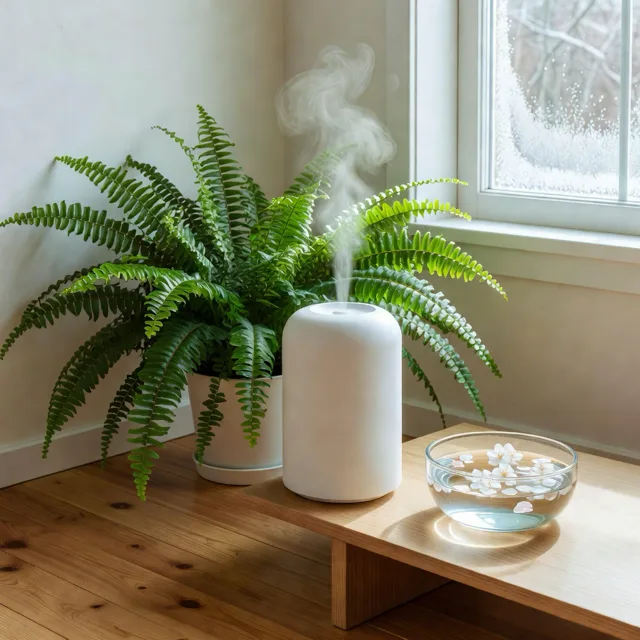
Your heater is running. The thermostat reads a comfortable 70 degrees. And your home is quietly turning into a desert. By January, indoor humidity in heated American homes can drop below 25% — drier than the Sahara. In TCM, that bone-dry air attacks your 肺 (fèi) — the Lung system — first: cracked lips, itchy skin, restless sleep, and a scratchy throat that no amount of water seems to fix.
In feng shui, dryness is an imbalance of the Water element. Your heating system pumps Fire energy into every room, and without a conscious counterbalance, that Fire burns through moisture, leaving stagnant, parched qi. The fix is not complicated, but it is specific: where you add moisture matters as much as how much you add.
This guide covers humidifier placement room by room (with Bagua awareness), plants that genuinely add moisture in low-light winter conditions, bedroom-specific rules, and a ventilation rhythm that refreshes qi without freezing your house.
Table of Contents
Why January Is the Driest Month Indoors
Cold air holds less water. When your furnace heats that already-dry outdoor air, relative humidity plummets further. The result is a feedback loop: dry air pulls moisture from everything — your skin, your wood furniture, your houseplants, your nasal passages.
In TCM, the Lung system governs the skin and controls the opening and closing of pores. When dry air depletes Lung yin, the body's first line of defense weakens. You might notice you catch colds more easily, wake up with a sore throat, or find your skin flaking no matter how much lotion you apply. The Water element is the energetic antidote — and January, as the peak of Water season, is paradoxically the month when indoor Water energy is most depleted by artificial heating.
| Symptom | TCM View | Feng Shui Angle |
|---|---|---|
| Cracked lips, dry skin | Lung yin depleted; body fluids not reaching the surface | Fire element (heating) overriding Water in the home |
| Restless sleep, dry throat at night | Yin deficiency worsens at night when yang should be dormant | Bedroom lacks Water element balancing |
| Static electricity everywhere | Excess dryness creates erratic qi movement | Moisture below functional threshold |
| Wood furniture cracking, paint chipping | Wood element drying out (Water generates Wood) | Without Water feeding Wood, both elements weaken |
Humidifier Placement by Room & Bagua
A humidifier is a literal Water element activator. Where you place it affects both air quality and feng shui energy. The general principle: place the humidifier where Water supports the sector's function, and avoid sectors where excess Water creates conflict.
| Room | Best Placement | Why |
|---|---|---|
| Living room | North sector or near the north wall | North = Water's home sector. A humidifier here reinforces the natural element, strengthening career and life-path energy. |
| Bedroom | At least 3 feet from the bed, on a nightstand or dresser | Close enough to moisten your breathing zone; far enough that you are not sleeping in a pool of damp qi. |
| Home office | Behind or beside you, not between you and the door | Water behind you = support. Water blocking the door = career obstacles (symbolically dampening incoming opportunity). |
| Kitchen | Away from the stove | Water and Fire clash (水火相冲) when placed directly opposite or beside the stove. Keep distance. |
| Nursery / kids' room | Away from the crib, elevated surface | Children's rooms benefit from gentle moisture but not direct mist on bedding. |
Plants That Add Moisture in Low Light
Plants release moisture through 蒸腾 (zhēngténg) — transpiration. A single medium-sized houseplant can release a modest amount of water vapor daily. More importantly, in feng shui, living plants represent the Wood element, and since Water generates Wood (水生木), placing plants alongside a humidifier creates a productive cycle that keeps both elements active.
January light is limited. These plants tolerate low-light conditions typical of heated homes in the northern hemisphere:
| Plant | Light Needs | Moisture Benefit | Feng Shui Role |
|---|---|---|---|
| Peace lily (白掌) | Low to medium indirect | High transpiration rate among common houseplants | Purifying energy; suitable for north or east corners |
| Boston fern | Indirect, moderate | Ferns are among the highest humidity-producing houseplants | Soft, flowing fronds represent gentle Wood qi |
| Pothos (绿萝) | Very low to bright indirect | Moderate transpiration; practically unkillable | Trailing growth activates stagnant corners; extremely forgiving |
| Lucky bamboo (富贵竹) | Low indirect | Grows in water, adding ambient moisture | Wealth and upward growth symbolism; east sector or wealth corner |
| Spider plant (吊兰) | Low to bright indirect | Moderate transpiration; sends out baby plants freely | Represents abundance and growth |
Bedroom Humidity Rules
The bedroom in winter is where dryness hits hardest. You spend 7–8 hours breathing recycled heated air. If your partner also uses a space heater, the room becomes even drier. Here are the rules:
| Rule | Details |
|---|---|
| Run the humidifier before bed, not all night | Start 1–2 hours before sleep to bring the room to 40–50% humidity. Many modern units have auto-shutoff at a set level. Continuous misting all night can make bedding damp. |
| Keep the unit off the nightstand directly beside your head | Mist drifting directly onto your face can cause congestion. Place it 3–6 feet away, ideally on a dresser or shelf at the room's north wall. |
| Clean it weekly | Standing water breeds bacteria and mold. A dirty humidifier pumps those into the air you breathe. White vinegar rinse weekly. |
| Skip the humidifier if you have a bathroom adjoining the bedroom | Leave the bathroom door open after your evening shower. The steam adds natural humidity. Close it once condensation clears. |
The Winter Ventilation Rhythm
Sealed winter homes trap stale qi. But opening windows in January feels absurd. The solution is a brief, intentional ventilation cycle that refreshes air without destroying warmth.
The 5-5-5 Method
Open a window on one side of your home for 5 minutes, twice a day — once in the morning after sunrise, once in the afternoon before sunset. That is it. Five minutes is enough for air exchange without significantly dropping room temperature. The key is cross-ventilation: if you can open a window on the opposite side simultaneously, the flush happens faster.
| Time | Action | Why |
|---|---|---|
| Morning (after sunrise) | Open window 5 min; turn off heater briefly | Morning air has the freshest qi. Clears overnight CO2 buildup. Aligns with the Lung's peak hour (3–5 AM) having just passed. |
| Afternoon (before sunset) | Open window 5 min; briefly let cold air in | Second air exchange prevents evening stuffiness. Cool air stimulates a gentle yin shift before sleep preparation. |
Common Water Element Mistakes
It is possible to overdo Water in winter. Water season (November through January) already carries strong Water energy; adding too much can tip the balance into dampness, lethargy, and emotional heaviness. Watch for these:
| Mistake | Why It Backfires |
|---|---|
| Humidifier running 24/7 with no hygrometer | Overshooting 60% creates mold risk and TCM dampness symptoms: heaviness, poor appetite, mental fog. |
| Large open water bowls on radiators | Common folk remedy, but stagnant water near heat breeds bacteria. If you do this, change the water daily and add a drop of tea tree oil. |
| Too many water features in one room | A fountain plus a humidifier plus a large fish tank in a small living room overwhelms the space with Water energy, weakening Fire (warmth, joy, motivation). |
| Blocking south sector with water features | South = Fire's home. Placing a fountain or large humidifier in the south directly conflicts with the sector's natural element. |
| Ignoring leaks as "more Water element" | Dripping faucets and leaks are not beneficial Water — they represent uncontrolled loss. Fix them immediately. |
Room-by-Room Humidity Audit
Before buying a single humidifier or plant, walk your home with this checklist. It takes ten minutes and tells you exactly where to act first.
| Check | What to Look For | If You Find It |
|---|---|---|
| Wood trim and door frames | Gaps appearing at mitered corners, or crown molding pulling away from the wall | The room is consistently below 30% humidity. Prioritize this room for a humidifier. |
| Piano or acoustic guitar | Instrument going out of tune faster than usual, or keys sticking | Musical instruments are the most sensitive humidity indicators in a home. Humidify this room immediately. |
| Static shocks | Regular static when touching doorknobs, light switches, or pets | Humidity is below 25%. Multiple rooms likely need attention. |
| Condensation on windows | Water droplets forming on the inside of window glass, especially in the bedroom | This room already has adequate or excess humidity. Do NOT add a humidifier here — the moisture is condensing because the glass is cold, which leads to mold risk. |
| Houseplant leaf tips | Brown, crispy tips on spider plants, ferns, or peace lilies | Plants are transpiring faster than they can absorb. Group them on a pebble tray and add a humidifier nearby. |
Balance Your Home's Elements
Every home has a unique elemental fingerprint. A personalized feng shui consultation reveals where Water, Fire, and the other elements need fine-tuning for your specific layout and BaZi profile.
Book Your Consultation