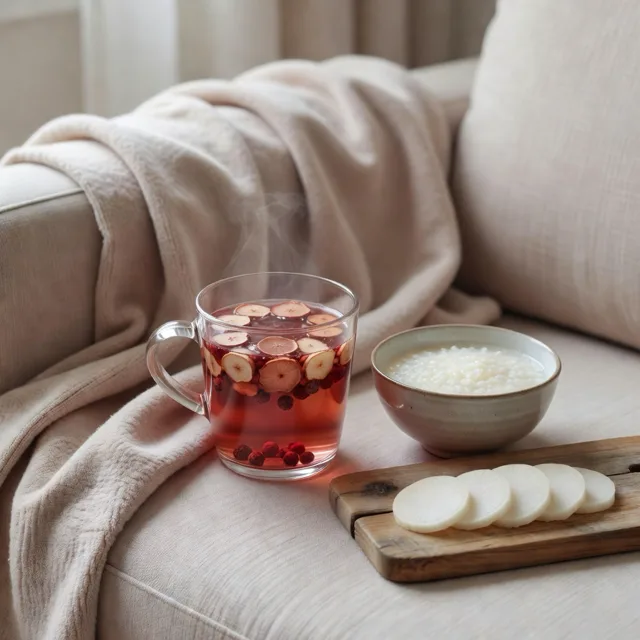
Two days of feasting. Two reunion dinners, trays of cookies, dumplings for breakfast, nian gao between meals. If your stomach feels like it has been staging a quiet protest since yesterday afternoon, you are right on schedule. Welcome to 初三 (chū sān) — Day Three of the Chinese New Year, Monday, February 8, 2027.
Traditionally, this is 赤口 (chì kǒu) — "Red Mouth" day. The custom says to stay home, avoid visiting, and keep conversations mild, because arguments are more likely today. The reasoning is practical: after two intense days of socializing and eating, tempers and stomachs are both running short. The old culture's prescription is elegant — rest.
In TCM terms, what you are feeling has a name: 食积 (shí jī) — food stagnation. Rich meals pile up faster than the Spleen can transform them. Dampness accumulates. Qi circulation slows. Your body is asking for exactly what 赤口 offers: a pause, a reset, and a few deliberate steps to get digestion moving again.
Table of Contents
What Two Days of Feasting Does (TCM View)
In TCM, the 脾 (pí) — Spleen system — is responsible for transforming food into usable qi and Blood. The 胃 (wèi) — Stomach — receives and breaks down what you eat. Together, they are the central engine of digestion. When you eat moderately, the engine hums. When you overload it with rich, greasy, sweet, and heavy foods across multiple large meals, the engine stalls.
食积 (shí jī) — food stagnation — is the TCM term for this backlog. The food sits in the middle, unprocessed. It generates 湿 (shī) — dampness — and sometimes 热 (rè) — heat — as the body struggles to deal with the excess. You might recognize the pattern:
| Sign | What You Feel | TCM Reading |
|---|---|---|
| Bloating and fullness | Stomach feels heavy even hours after eating | Food sitting in the Stomach, Spleen qi unable to move it |
| Loss of appetite | Food does not appeal, but you do not feel hungry either | Spleen's "transportation" function is overwhelmed |
| Thick, greasy tongue coating | A white or yellowish film on the tongue | Dampness and food stagnation generating turbid qi |
| Sluggishness and brain fog | Tired, heavy limbs, hard to concentrate | Dampness blocking clear yang from rising to the head |
| Loose stools or constipation | Digestion swings to either extreme | Spleen struggling to separate the clear from the turbid |
| Irritability or restlessness | Short-tempered, uncomfortable in your own body | Stagnant food generating heat that disturbs the spirit |
None of this is serious. It is the predictable aftermath of celebration. But if you ignore it and keep eating heavily through the rest of the New Year week, the stagnation deepens, dampness accumulates, and you enter spring already sluggish. Today is the pivot point.
The Hawthorn Tea Reset
山楂 (shān zhā) — hawthorn berry — is the single most famous digestive remedy in Chinese food therapy. Classically, it is described as sour and slightly warm, entering the Spleen, Stomach, and Liver channels. Its traditional use is specifically for dissolving food stagnation, particularly from meat and greasy foods — exactly what reunion dinners are loaded with.
Simple Hawthorn Tea
- 8-10 dried hawthorn slices (available at any Chinese grocery or online)
- 2 cups of boiling water
- A small piece of rock sugar or a teaspoon of honey (optional)
Place the hawthorn slices in a mug or small teapot. Pour boiling water over them. Steep for 10 minutes — the water will turn a warm amber. Add sweetener if the sourness is too sharp for you. Drink warm, ideally mid-morning or an hour after any meal today.
Hawthorn + Barley Variation
For extra dampness-draining support, add a tablespoon of roasted barley (大麦茶 dàmài chá, barley tea) to the brew. Barley is classically described as cooling and diuretic, helping the body clear the excess fluid that dampness produces. This combination is a standard Chinese household remedy during holiday seasons.
Make Today a Congee Day
After two days of elaborate meals, your Spleen needs the simplest food you can give it. That means 粥 (zhōu) — congee. Plain white rice congee with nothing more than a pinch of salt is the ultimate Spleen reset. It is warm, liquid, pre-broken-down, and requires almost no digestive effort.
What to Eat Today
| Meal | What | Why |
|---|---|---|
| Breakfast | Plain rice congee with a few slices of ginger and a drop of sesame oil | Ginger warms the Stomach and moves stagnant food. Congee is the gentlest possible meal. |
| Lunch | Millet congee with steamed radish or stir-fried greens | Millet specifically tonifies the Spleen. Radish breaks down stagnation (see below). |
| Dinner | Vegetable soup with tofu and leafy greens, or a small serving of noodles in broth | Keep it light and warm. No fried food, no heavy meat, no cold drinks. |
| Between meals | Hawthorn tea, barley tea, or warm water with a squeeze of lemon | Sip throughout the day. Warm fluids help dissolve stagnation and move dampness. |
If you have leftover reunion dinner food and cannot bear to waste it, have a small portion at lunch rather than dinner. The Spleen is strongest between 9 AM and 11 AM; by evening, its capacity wanes. Heavy leftovers at night will undo your reset. For more on building a congee habit, see our gut health guide.
The Humble Radish: Your Best Friend Today
萝卜 (luóbo) — daikon radish — is so highly regarded for digestion in Chinese culture that there is a saying: 冬吃萝卜夏吃姜 — "eat radish in winter, ginger in summer." Classically, radish is described as cool in nature, pungent and sweet in flavor, entering the Lung and Stomach channels. Its primary action is to move qi downward and dissolve food stagnation.
After heavy eating, radish does what your Stomach is struggling to do: push things through. Here are three simple ways to use it today:
- Radish slices in congee: Dice half a daikon radish and cook it into your congee during the last 20 minutes. The radish softens and infuses the porridge with its digestive properties.
- Simple radish soup: Simmer sliced radish with a few dried shrimp or a knob of ginger in water for 30 minutes. Season with a touch of salt. Drink the broth and eat the radish.
- Quick pickled radish: Slice radish thinly, toss with rice vinegar, a pinch of sugar, and a pinch of salt. Let it sit for 30 minutes. Serve as a side — the sour flavor from the vinegar also supports Liver qi movement.
A Gentle Walk — Not a Workout
The traditional advice for 初三 is to stay home. But within your home — or just outside it — a gentle walk is one of the best things you can do for stagnant digestion. In TCM, movement circulates qi. When food stagnation has blocked the middle, gentle movement helps restart the flow.
What Helps
- A 20-minute walk after lunch: Not brisk, not competitive, not tracked on an app. A slow, easy stroll. The Chinese saying is 饭后百步走,活到九十九 — "walk a hundred steps after a meal, live to ninety-nine."
- Indoor stretching: If the weather keeps you in, do 10 minutes of gentle stretching — focus on twists and side bends that gently compress and release the abdomen.
- Avoid intense exercise: A hard run or heavy gym session while your stomach is still processing two days of feasting will divert blood away from digestion. This is not the day for personal records.
If you practice any form of qigong, today is a good day for it. The slow, internal movements are designed to circulate qi without depleting it. Our winter detox guide has a section on gentle movement that works well here.
Abdominal Massage for Digestion
摩腹 (mó fù) — abdominal massage — is one of the oldest self-care techniques in TCM. It is traditionally described as helping the Spleen and Stomach move food, reduce bloating, and calm the middle.
How to Do It
- Lie on your back or sit comfortably with your spine straight. Wait at least 30 minutes after eating.
- Warm your hands by rubbing them together for 10 seconds.
- Place one palm flat on your navel. Place the other hand on top.
- Circle clockwise (from your perspective, looking down at your belly) in slow, gentle circles. Start small, around the navel, then gradually widen the circles to cover the entire abdomen.
- Do 36 clockwise circles. The pressure should be gentle and even — you are not kneading dough. If any area feels tender, slow down and lighten up; do not push through pain.
- Then reverse: 36 counterclockwise circles, gradually narrowing back to the navel.
Clockwise follows the direction of the large intestine and is traditionally said to promote downward movement — helpful for constipation and bloating. Counterclockwise is sometimes used for loose stools, but the combination of both directions is the standard general practice.
What the research says
Abdominal massage has been used in traditional Chinese practice for centuries to support digestive comfort. Some preliminary studies have explored its effects on motility and bloating, though the evidence base is still developing. As a gentle, non-invasive practice, it carries minimal risk for most people.
Early Night, Clean Slate
The best thing you can do for your digestion tonight is go to bed early. The Stomach channel is most active between 7 AM and 9 AM — your best digestion happens in the morning. But the Spleen and Stomach do their deep repair work while you sleep, particularly between 9 PM and 11 PM, which in the TCM organ clock belongs to the 三焦 (sān jiāo) — the Triple Burner — the system that regulates water metabolism and distributes warmth.
Evening Protocol
- Eat dinner before 6 PM if possible. Give your Stomach at least three hours to work before you lie down.
- No snacking after dinner. This is the hardest part during New Year week, when the coffee table is still piled with cookies, dried fruit, and candy. Put the snacks away. Out of sight is out of stomach.
- Warm foot soak: 15 minutes in warm water before bed. This draws energy downward, away from the overstuffed middle, and promotes deeper sleep.
- Lights out by 10 PM. The staying-up-late pattern of 除夕 and 初一 served a ritual purpose. Today, sleep serves a healing one.
Tomorrow's Plan
初四 (chū sì) — Day Four — is traditionally the day to welcome the Kitchen God (灶神 Zào Shén) back to the household after his annual report to heaven. For many people in the diaspora, it is also a return-to-work day. If your digestion is back on track tomorrow morning, you can resume normal eating — with moderation. If you still feel heavy, carry the congee-and-tea approach through one more day. There is no prize for rushing back to heavy meals.
The rest of the New Year week still has feasting ahead — 初五 brings the God of Wealth celebration with its own dumplings, and there are gatherings through 元宵 (the Lantern Festival on February 20). Pacing yourself now means you will actually enjoy those meals instead of dreading them.
⚠️ Disclaimer: The digestive strategies described here are based on traditional Chinese medicine food therapy and self-care practices. They are not medical treatments for gastrointestinal conditions. If you experience severe abdominal pain, vomiting, fever, or persistent digestive distress, consult a healthcare professional promptly.
Understand Your Digestion
Your constitutional type shapes how your Spleen and Stomach handle heavy meals. A BaZi reading reveals your digestive tendencies and the foods that work best for your system year-round.
Book Your Reading