农历: 丙午年 三月十五 (Fire Horse Year, 3rd Lunar Month Day 15)
宜 (Auspicious): 祈福 (Pray) · 开光 (Consecrate) · 纳采 (Start New) · 出行 (Travel)
忌 (Avoid): 动土 (Break Ground) · 安葬 (Burial)
🌿 "宜祈福·纳采" — the first day of May is auspicious for new beginnings! The perfect day to begin your Chinese Wellness journey.
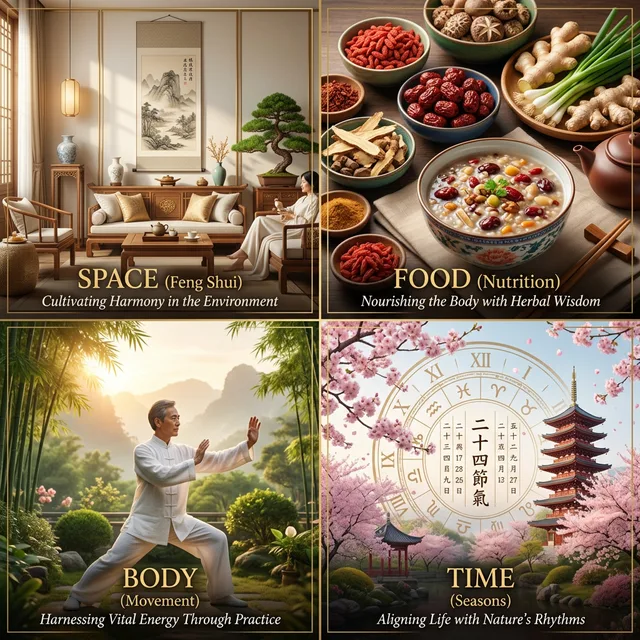
For the past two months, we've covered feng shui — the art of arranging your space for optimal energy flow. But here's what I want to share with you today: feng shui is only one quarter of the Chinese wellness system.
For over 5,000 years, Chinese civilization developed an integrated approach to living well. It wasn't just about where you put your sofa. It was about how you eat, how you move, how you rest, and how you align with nature's rhythms. This month, we're expanding our lens to cover the complete system.
Table of Contents
The 4 Pillars of Chinese Wellness
| Pillar | Chinese | Focus | Core Principle |
|---|---|---|---|
| 🏠 Space | 风水 (Fēng Shuǐ) | Your environment — home, office, landscape | External chi shapes your life. Align your space to support your goals. |
| 🍲 Food | 食疗 (Shí Liáo) | What you eat — as medicine, as energy | Food is the first medicine. The right food heals; the wrong food harms. |
| 🧘 Body | 养生 (Yǎng Shēng) | How you move, rest, and maintain your body | Cultivate life force. Prevention is better than cure. |
| 📅 Time | 节气 (Jié Qì) | Seasonal awareness — living with nature's calendar | Align with the seasons. What works in summer fails in winter. |
Pillar 1: Space (风水 Fēng Shuǐ)
You already know this one. But here's the deeper context: feng shui isn't just interior design with Chinese characteristics. It's part of a comprehensive system that recognizes your environment as an extension of your body.
| What We've Covered | What's Coming |
|---|---|
| Bedroom, kitchen, bathroom, living room, entryway | Pool & water features, digital feng shui, meditation rooms |
| Mirrors, colors, crystals, symbols | Airbnb feng shui, backyard BBQ layout, pet health spaces |
| Decluttering, staircase, garage | House hunting in Fire Horse Year, summer garden design |
Space shapes your external chi. But what about the chi inside your body?
Pillar 2: Food (食疗 Shí Liáo)
In Chinese medicine, there's a famous saying: "药补不如食补" — supplement with food before supplements with medicine. Food therapy (食疗) is the practice of eating specific foods to prevent illness, restore balance, and build vitality.
This isn't about exotic ingredients. Most Chinese food therapy ingredients are already in your pantry or available at any American grocery store.
| Concept | Chinese Term | What It Means | American Parallel |
|---|---|---|---|
| Food Temperature | 寒热 (Hán Rè) | Foods are classified as hot, warm, neutral, cool, or cold — not by physical temperature, but by their effect on the body | Similar to how spicy food "heats you up" even when served cold |
| Five Flavors | 五味 (Wǔ Wèi) | Sour, Bitter, Sweet, Pungent, Salty — each flavor targets a specific organ system | We know salt affects blood pressure, sugar affects energy — TCM maps ALL flavors to organs |
| Five Colors | 五色 (Wǔ Sè) | Green, Red, Yellow, White, Black foods each nourish a different organ | "Eat the rainbow" — Western nutrition agrees: food color indicates nutrient content |
| Seasonal Eating | 应季饮食 | Eat what nature provides in each season — cooling foods in summer, warming in winter | The farm-to-table movement mirrors this ancient principle perfectly |
We'll cover the Five Element Diet, Kitchen as Pharmacy, bone broth & congee, and warming vs. cooling foods. All using ingredients you can find at Whole Foods, Trader Joe's, or any regular grocery store.
Pillar 3: Body (养生 Yǎng Shēng)
养生 (Yǎng Shēng) literally means "nourishing life." It's the Chinese science of body maintenance — how to move, rest, breathe, and maintain your physical vessel so it lasts as long as possible in peak condition.
| Practice | Chinese Name | What It Does | Western Equivalent |
|---|---|---|---|
| Acupressure | 穴位按摩 | Pressing specific body points to relieve pain, stress, and organ issues | Acupuncture without needles. Increasingly used in Western physical therapy. |
| Tai Chi | 太极拳 | Slow, flowing movement that builds internal energy and balance | Often called "meditation in motion." Reduces fall risk in elderly — proven by Western studies. |
| Qi Gong | 气功 | Breathing exercises that circulate internal chi | Similar to breathwork in yoga. Activates parasympathetic nervous system. |
| Self-Massage | 推拿/按摩 | Specific rubbing, patting, pressing techniques for daily maintenance | Combines elements of Swedish massage + trigger point therapy + reflexology |
| Face Reading | 面诊 | Reading health signs from facial features and complexion | Dermatologists now study "skin mapping" — connecting breakout zones to organs |
Pillar 4: Time (节气 Jié Qì)
The Chinese calendar divides the year into 24 Solar Terms (二十四节气) — a system so significant that UNESCO listed it as an Intangible Cultural Heritage of Humanity in 2016.
Each solar term tells you: what to eat, how to exercise, what to focus on, and how your home should adapt. Living against the solar terms is like swimming against the current — possible, but exhausting.
| Season | Organ System | Focus | Key Action |
|---|---|---|---|
| 🌱 Spring | Liver (肝) | Growth, detox, rising energy | Eat green, gentle exercise, early rising, reduce anger |
| ☀️ Summer | Heart (心) | Joy, circulation, peak yang | Eat bitter/cooling foods, hydrate, nap at noon, express joy |
| 🍂 Autumn | Lungs (肺) | Harvest, release, letting go | Eat white/moistening foods, breathwork, early bedtime, release grief |
| ❄️ Winter | Kidneys (肾) | Rest, storage, deep reserves | Eat warm/black foods, conserve energy, sleep more, build reserves |
| 🌾 Late Summer | Spleen (脾) | Transition, digestion, center | Eat yellow/sweet foods, maintain routine, strengthen digestion |
May features two important solar terms: 立夏 (Lìxià - Start of Summer) around May 5 and 小满 (Xiǎomǎn - Grain Budding) around May 21. We'll cover both with dedicated articles for seasonal transition.
How the 4 Pillars Work Together
The genius of the Chinese wellness system is that all four pillars reinforce each other:
| Life Challenge | Space Fix | Food Fix | Body Fix | Time Fix |
|---|---|---|---|---|
| Poor sleep | Bed in command position, no mirrors facing bed | Warm milk with turmeric before bed, avoid cold foods at dinner | Press 涌泉 (Yongquan) point on sole of foot. Foot soak. | Sleep by 11pm (子时 - Gallbladder hour). No screens after 9pm. |
| Low energy | Clear clutter, open windows, add plants | Ginger tea, dates, warm breakfast (congee), avoid ice water | Morning stretching, deep breathing, face tapping | Align with 卯时 (5-7am) wake-up. Take a noon nap (午时). |
| Stress/anxiety | Add Water elements, blue tones, remove sharp corners | Chrysanthemum tea, celery, green vegetables (liver-soothing) | Press 太冲 (Taichong) point. Walk barefoot on grass. | Spring = liver season. Extra attention to liver care in spring. |
| Digestive issues | Kitchen feng shui fix, eating area optimization | Warm foods only, congee, ginger, zero ice, no raw foods | Press 足三里 (Zusanli) point. Belly massage clockwise. | Eat biggest meal 7-9am (胃时 - Stomach hour). |
Your May Roadmap
This month, we'll explore all four pillars through dedicated articles:
- 🏠 Feng Shui: Pool feng shui, digital feng shui, meditation room, summer garden, and more
- 🍲 Food Therapy: Five Element Diet, Kitchen as Pharmacy, warming vs cooling foods, tea guide, bone broth & congee
- 🧘 Body Wellness: Morning rituals, TCM body clock, acupressure points, face reading, self-massage
- 📅 Seasonal: 立夏 (Start of Summer), 小满 (Grain Budding), Mother's Day, Memorial Day
By the end of May, you won't just know how to arrange your living room — you'll know how to eat, move, rest, and live according to the same timeless principles that have kept Chinese civilization thriving for five millennia.
⚠️ Disclaimer: This article and all upcoming food therapy and body wellness articles discuss Traditional Chinese Medicine (TCM) perspectives on food, health, and wellness. This is cultural and educational content, NOT medical advice. Always consult your healthcare provider before making dietary or health changes. TCM perspectives complement but do not replace conventional medical care.
Chinese Wellness Consultation
Starting this month, we're offering comprehensive Chinese Wellness consultations that go beyond feng shui — integrating food therapy recommendations, body clock optimization, and seasonal living guidance with your existing space design.
Book Wellness Consultation