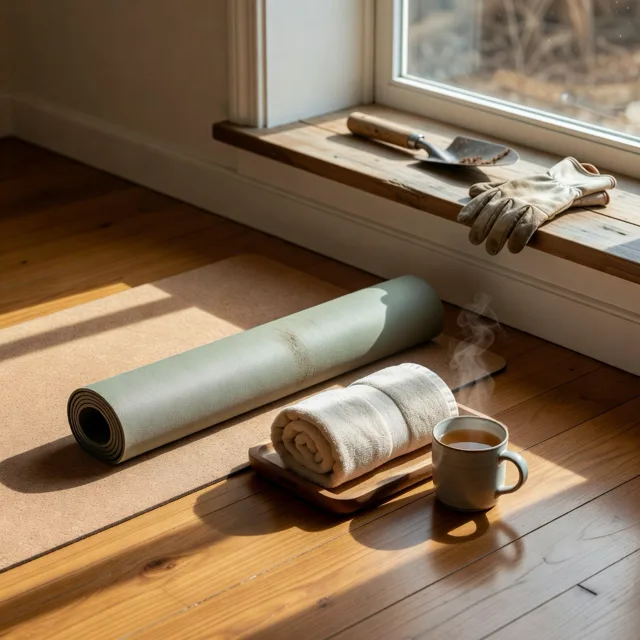
April is the month when two very different activities attack the same part of your body. On Saturday morning, you spend two hours in the garden — bending, digging, lifting bags of soil — and by Sunday your lower back is locked up. On Monday through Friday, you spend eight hours at a desk studying for exams or working through tax season, and by Friday your neck and shoulders are concrete. Same muscles. Same pain. Different causes.
In TCM, the back and neck are governed by the 膀胱经 (pángguāng jīng) — the Bladder channel, the longest meridian in the body, running from the inner eye over the head and all the way down both sides of the spine to the little toe. When this channel is stiff, cold, or blocked by Wind, the entire back and neck suffer. And April, with its combination of physical yard work, prolonged sitting, and unpredictable spring wind, is the season when the Bladder channel takes the most hits.
This guide covers the specific April risks, a traditional ginger compress method, and six gentle moves that protect the back and neck through the season. For the general daily meridian stretch routine, see our complete meridian stretches guide — we will not repeat it here.
Table of Contents
Why April Is Hard on the Back & Neck
Three forces converge in April to make back and neck problems more common than in any other spring month:
| Force | What Happens | TCM View |
|---|---|---|
| Gardening Season | Bending, lifting, kneeling — muscles that were dormant all winter are suddenly asked to work hard. | Sudden exertion strains the 筋 (jīn, sinews) before the Liver — which governs the sinews — has fully mobilized for spring. |
| Study & Tax Season | Long desk hours with poor posture. Head forward, shoulders rounded, lower back unsupported. | Prolonged sitting stagnates qi and Blood in the Bladder channel. The upper back and neck tighten as qi pools and stops moving. |
| Spring Wind | Cool breezes on a sweaty neck after exertion. Sleeping with a window open on a windy night. | 风 (fēng, Wind) enters through 风池 (fēngchí) and 风门 (fēngmén) — the "Wind Pool" and "Wind Gate" points on the neck and upper back — causing stiffness, pain, and sometimes headache. |
The result is the classic April complaint: "I just woke up with a stiff neck" or "I did some gardening and now I can barely stand up straight." In TCM, these are not random — they are predictable consequences of the season's specific demands on the body.
Warming Up Before Yard Work
You would warm up before a gym session. Yard work deserves the same respect — arguably more, because the movements are less controlled and the postures more awkward.
A 5-Minute Pre-Garden Warm-Up
- March in place for one minute: Get the blood moving, especially to the lower body. Swing your arms naturally.
- Standing hip circles: Hands on hips, circle the hips slowly in each direction, ten times. This warms the lower back and hip joints.
- Cat-cow standing: Hands on thighs, round the back (cat), then arch it (cow). Ten repetitions. This activates the entire spine.
- Neck rolls: Slow, gentle half-circles from one shoulder to the other. Five each direction. Never force the neck into a full backward circle.
- Wrist circles: Ten each direction. Gardening grips — trowels, hoses, pruners — load the wrists and forearms.
During Yard Work
- Kneel, do not bend: Use a kneeling pad. Bending at the waist with straight legs is the single most common cause of gardening back injuries.
- Lift with the legs: Bags of soil, pots, wheelbarrow loads — bend the knees, keep the load close to your body, and stand up using your legs, not your back.
- Switch sides: If you are raking or digging with one dominant hand, switch every ten minutes. One-sided repetitive motion strains the obliques and lower back.
- Cover your neck: A bandana, a hat with a neck flap, or a hood-up hoodie. If you are sweating and a cool breeze hits the exposed neck, Wind enters the 风门 (Wind Gate) point directly.
Desk Breaks: The 30-Minute Rule
Whether you are studying for AP exams, finishing tax paperwork, or working a regular desk job, the rule is the same: every 30 minutes, stand up and move for two minutes. This is not optional if you want to avoid the progressive tightening that turns into a locked neck by Friday.
The 2-Minute Desk Reset
- Stand and reach overhead: Interlace fingers, palms to the ceiling, stretch tall. Hold for ten seconds. Release.
- Shoulder rolls: Ten backward, then ten forward. Move slowly and make the circles big.
- Chin tuck: Standing tall, draw the chin straight back (not down) as if making a double chin. Hold five seconds, release. Five repetitions. This counteracts the forward-head position that desk work creates.
- Walk to the window: Look at something far away for 20 seconds. This resets the eyes and breaks the hunched-forward posture.
The Neck-and-Wind Connection
In TCM, 风 (fēng) — Wind — is the primary external pathogen of spring, and the neck is where it enters most easily. The acupoints 风池 (fēngchí, "Wind Pool," at the base of the skull) and 风府 (fēngfǔ, "Wind Mansion," at the center back of the head) are named for this vulnerability. When Wind enters these points, it can cause sudden stiff neck (落枕, luòzhěn), one-sided headache, or a "crick" that appears overnight without obvious cause.
Our spring wind guide covers the full Wind pathogen picture. For the neck specifically:
- Do not sleep with a window open directly behind your head: Cross-breezes in spring feel lovely but send Wind straight into the Wind Pool and Wind Gate while your defenses are down during sleep.
- Dry your hair before going outside: Wet hair in spring wind is a fast track to a stiff neck by the next morning.
- Wear a scarf or collar on windy days: Even when the temperature feels warm. The neck does not need insulation from cold — it needs protection from moving air.
The Hot Towel & Ginger Compress
When stiffness has already set in, a traditional ginger compress can bring relief. This is a home remedy described in classical Chinese medicine for warming the channels and moving stagnant qi and Blood in a sore area.
Basic Hot Towel Method
- Soak a hand towel in hot water (as hot as you can comfortably wring). Wring it out.
- Apply to the stiff area — lower back, upper shoulders, or back of the neck.
- Cover with a dry towel to hold the heat.
- Leave for 10 to 15 minutes. Reheat as needed.
Ginger-Enhanced Version
- Grate a thumb-sized piece of fresh ginger into a bowl of hot water.
- Let it steep for five minutes.
- Soak the towel in the ginger water and apply as above.
The ginger adds warming, qi-moving properties to the compress. In TCM, ginger (生姜, shēngjiāng) is classified as warm and pungent — it disperses cold and moves stagnation. The combination of heat and ginger's penetrating warmth is traditionally used for cold-pattern back and neck pain: the kind that feels better with warmth and worse in cold or damp weather.
What the research says
Ginger compresses are a traditional remedy. While the warming and circulation-promoting effects are well-described in classical texts, this is a home-care method, not a medical treatment. Persistent or severe pain should be evaluated by a healthcare provider.
6 Gentle Moves for Spring Relief
These six movements target the back and neck specifically. They are gentle, suitable for most adults, and take about ten minutes. Do them in the morning after a short walk, or in the evening before bed. If any movement causes sharp pain, stop immediately.
Move 1: Cat-Cow (on the Floor)
Start on all fours, hands under shoulders, knees under hips. Inhale: drop the belly, lift the chest and tailbone (cow). Exhale: round the spine, tuck the chin and tailbone (cat). Move slowly. Eight to ten repetitions.
What it does: Mobilizes the entire spine, segment by segment. Warms the Bladder channel and the Governing Vessel (督脉, dū mài).
Move 2: Gentle Seated Twist
Sit on the floor with legs extended. Bend the right knee and place the right foot outside the left thigh. Place the left elbow on the outside of the right knee and gently twist to the right. Hold for five breaths. Switch sides.
What it does: Releases tension in the obliques and the muscles along the sides of the spine. In TCM, twisting moves stagnant Liver qi — especially valuable in spring.
Move 3: Wall Angels
Stand with your back flat against a wall, feet six inches out. Press your arms against the wall in a "goal post" position (elbows at 90 degrees). Slowly slide your arms up and down the wall, keeping contact. Ten repetitions.
What it does: Strengthens the upper back muscles that counteract desk hunch. Opens the chest and shoulders without straining the neck.
Move 4: Hip Hinge
Stand with feet hip-width apart, hands on hips. Keeping the back straight and knees slightly bent, hinge forward from the hips until your torso is at about 45 degrees. Hold for three seconds, then stand up by squeezing the glutes. Eight repetitions.
What it does: Trains the correct bending pattern for gardening and lifting. Strengthens the lower back and glutes — the muscles that protect the lumbar spine.
Move 5: Neck Side Stretch
Stand or sit tall. Drop the right ear toward the right shoulder — gently, without forcing. Place the right hand lightly on the left side of the head for a mild stretch. Hold for 20 seconds. Switch sides. Three each side.
What it does: Lengthens the upper trapezius and the muscles along the side of the neck that tighten from desk work and Wind exposure.
Move 6: Child's Pose (Wide Knees)
Kneel, spread the knees wide, and fold forward with arms extended, forehead on the floor. Breathe deeply into the lower back. Hold for one minute.
What it does: Decompresses the entire spine. Quiets the nervous system. In TCM terms, this posture encourages qi to descend — helpful when stress and frustration have driven energy upward into the head and neck.
For a complete daily routine that covers the full body, see the Liver qi stretches from February and the winter back health guide.
When Pain Needs a Professional
These moves and compresses are for mild to moderate stiffness and soreness. See a healthcare provider if:
- Pain radiates down the arm or leg: This may indicate nerve involvement and needs evaluation.
- Numbness or tingling in the hands, feet, or fingers.
- Pain does not improve within 3–5 days of rest, gentle movement, and warm compresses.
- You cannot turn your head more than 45 degrees in either direction.
- Pain follows a fall or impact: Even a minor gardening stumble can cause injury that home care cannot address.
- Fever accompanies neck stiffness: This is a medical emergency — seek care immediately.
TCM home care is a first-response toolkit, not a replacement for professional diagnosis. A good acupuncturist, physical therapist, or orthopedist can identify the specific problem and treat it directly. Do not let pride or a preference for self-care delay evaluation when the symptoms warrant it.
⚠️ Disclaimer: The exercises and compress methods in this article reflect traditional TCM practices. They are not medical advice. If you have existing spinal conditions, recent injuries, or are pregnant, consult your physician or physical therapist before trying these movements.
Find Your Weak Channels
A BaZi and body-type reading reveals which meridian channels are most vulnerable in your chart — and the seasonal habits that protect them. Let's map your spring body plan.
Book a Wellness Consultation