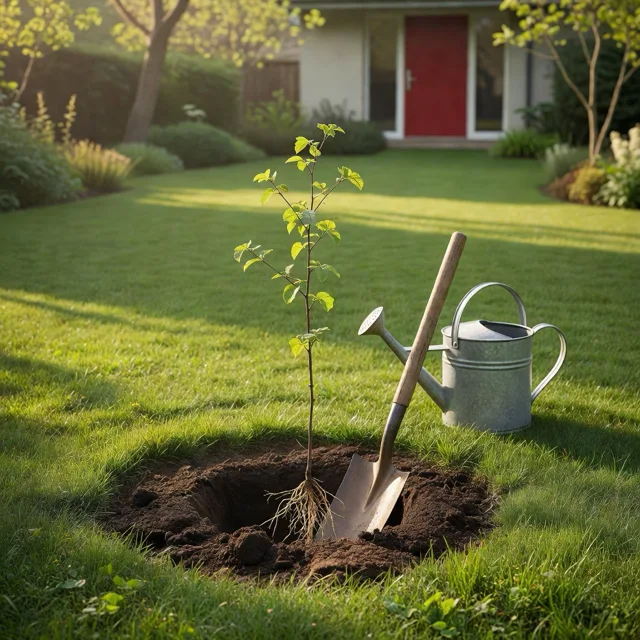
Tomorrow is Arbor Day — Friday, April 30, 2027 — the day the United States has celebrated tree planting since 1872. If you have been thinking about adding a tree to your yard, this is the day. But before you grab a shovel and start digging, there is something worth considering: in feng shui, a tree is not just a tree. It is a living, growing element that shapes the qi of your property for decades.
Where you plant, what you plant, and how far from the house it stands all matter. Chinese tradition has specific guidance on trees near the home — some of it practical (roots, shade, falling branches), some of it symbolic (species that invite fortune vs. species that carry less auspicious associations). And in 2027, there is a year-specific rule that every gardener should know: do not dig in the Southwest or West sectors of your yard this year.
This is not a garden design article — our garden feng shui guide and the front yard guide cover layout in depth. This is a tree-specific planting guide for Arbor Day 2027, grounded in feng shui tradition and adapted for American yards.
Table of Contents
The 2027 No-Dig Rule: Southwest & West
In classical feng shui, two annual afflictions dictate where ground should not be broken each year. In 2027:
| Affliction | Sector | What It Means |
|---|---|---|
| 太岁 Tai Sui (Grand Duke Jupiter) | Southwest | The Tai Sui resides in the Southwest this year. Tradition holds that digging, excavating, or starting major earthwork in the Tai Sui sector invites misfortune. This applies to tree planting if it involves significant digging — a large hole for a balled-and-burlapped tree, for example. |
| 三煞 San Sha (Three Killings) | West | The San Sha occupies the West in 2027. Similar caution applies: avoid breaking ground, removing trees, or heavy landscape construction in the West sector. |
The yard work article covers what does and does not count as "disturbing" these sectors. For Arbor Day specifically:
- Planting a tree in the Southwest or West this year: Traditionally cautioned against, because it requires digging a significant hole.
- Watering, weeding, and tending existing trees in those sectors: Fine. Routine care is not ground-breaking.
- Planting in containers in those sectors: Acceptable, since no ground is broken.
This is stated as traditional practice, not superstition. Many feng shui practitioners observe these annual rules; whether you follow them is your choice. If you do, the good news is that most of the yard remains open for planting.
Distance from the Door: The Mouth of Qi Rule
The front door is the 气口 (qì kǒu) — the Mouth of Qi — where energy enters your home. A tree planted directly in front of the door, blocking the path from the street, creates a barrier that restricts the flow of qi, opportunity, and even light into the house.
The traditional guidelines
- No single large tree centered directly in front of the door: This is one of the most widely cited feng shui tree rules. A tree trunk framed in the doorway creates the character 困 (kùn, "trapped") — a tree (木) inside a box (口). Whether the etymology is folk or formal, the practical point stands: a blocked entrance feels restricted.
- Offset planting is fine: A tree to the left or right of the front path, framing the approach rather than blocking it, is positive. Paired trees on either side of the walkway create a welcoming "guard" formation.
- Shade is welcome, obstruction is not: A large tree that provides dappled shade over the front yard without blocking the door sightline is a gift. The key is whether the door can "see" the street and the street can "see" the door.
Front vs. Back: Where Tall Trees Belong
In the classical landscape model of feng shui, the ideal property has four guardians: the 玄武 (xuán wǔ) — Black Tortoise — at the back (tall support), the 朱雀 (zhū què) — Red Phoenix — at the front (open space), the 青龙 (qīng lóng) — Green Dragon — on the left, and the 白虎 (bái hǔ) — White Tiger — on the right (facing out from the front door).
| Position | Guardian | Tree Guidance |
|---|---|---|
| Back of the house | Black Tortoise | This is where tall, sturdy trees belong. They provide "mountain support" behind the home — shelter, privacy, and a sense of stability. Evergreens are ideal: they provide year-round support. |
| Front of the house | Red Phoenix | Keep the front relatively open. Ornamental trees, flowering trees, and smaller species work well here. Nothing so tall that it looms over the roof or so dense that it darkens the entryway. |
| Left side (facing out) | Green Dragon | Traditionally, the Dragon side can be slightly taller or more active than the Tiger side. A taller tree on the left is classically acceptable. |
| Right side (facing out) | White Tiger | Tradition suggests keeping the right side slightly lower or quieter than the left. Smaller trees, shrubs, or no tree at all. |
Species & Symbolism
In Chinese tradition, certain trees carry specific symbolic meanings. While not all of these grow in every US climate zone, several have close equivalents or are available at specialty nurseries.
| Tree | Chinese Name | Symbolism | US Growing Notes |
|---|---|---|---|
| Peach | 桃 (táo) | Longevity, protection, romance. Peach wood is classically believed to ward off negative energy. | Zones 5-9. Needs full sun, well-drained soil. Produces fruit in 2-3 years. |
| Plum | 梅 (méi) | Perseverance, renewal. The plum blooms in late winter while snow is still on the ground — a symbol of endurance through hardship. | Zones 4-8. Extremely cold-hardy. Early spring blooms. |
| Osmanthus | 桂 (guì) | Noble achievement, wealth. 桂 sounds like 贵 (guì, "precious" or "noble"). | Zones 7-10. Fragrant autumn blooms. Limited to warmer climates. |
| Ginkgo | 银杏 (yín xìng) | Longevity, resilience. One of the oldest tree species on Earth. Temples often have ancient ginkgos. | Zones 3-8. Extremely adaptable. Choose male cultivars to avoid the fruit's odor. |
| Maple | 枫 (fēng) | Beauty, balance. The red autumn leaves represent the Fire element and transformation. | Zones 3-9 depending on variety. Native maples (red, sugar) are excellent choices for American yards. |
| Pine | 松 (sōng) | Longevity, integrity, unwavering character. Along with bamboo and plum, pine forms the "Three Friends of Winter" (岁寒三友). | Zones 2-9 depending on species. Evergreen. Ideal for backyard Black Tortoise support. |
For US homeowners choosing a native tree, the symbolism is less important than the practical fit. A well-placed red maple or white oak provides the same feng shui "support" function as any traditional Chinese species. Choose what thrives in your climate and soil.
Trees to Avoid Near the Home
Chinese tradition cautions against certain tree types near the house. Some of these rules are purely cultural; others have practical roots.
- Weeping trees near the front door: Weeping willows, weeping cherries, and similar drooping forms are traditionally associated with sadness and downward energy. The practical concern: they can block light and create a dark, damp entryway. They are beautiful but better placed at the far end of the garden or beside water features.
- Thorny trees near bedrooms: Hawthorn, honey locust, and other thorny species carry "sharp" qi. By custom, they are kept away from bedroom windows where the sharp energy could disturb sleep.
- Dead or dying trees anywhere on the property: A dead tree is stagnant qi made visible. In feng shui, it represents decline. Remove dead trees promptly — Arbor Day is a perfect occasion to replace one.
- Trees with invasive roots near the foundation: This is practical, not symbolic. Willows, silver maples, and certain poplars send roots toward water and sewer lines. Planting them near the house creates real structural risk over time.
Where to Plant This Year
Given the 2027 annual chart, here are the best sectors for new tree planting:
| Sector | Why It Works |
|---|---|
| Southeast | Star 8 (Prosperity) sits here. A healthy new tree in the SE introduces growth energy that supports wealth. Choose a flowering or fruit-bearing species for additional symbolic value. |
| South | Star 4 (Academic) occupies the South. A tree here supports the study and growth energy of the sector. A moderate-sized species that does not block light into the house is ideal. |
| Northeast | While Star 3 (Conflict) sits here, a stable, slow-growing tree can actually stabilize the sector's restless energy. An evergreen provides grounding without adding agitation. |
| Northwest | Star 1 (Victory) is here. A tree in the NW supports career and opportunity energy. This is also a good position for a tall "support" tree if the NW is your backyard. |
Avoid planting new trees in the Southwest and West this year. The tradition is clear on this point, and the Tai Sui and San Sha guidance applies directly. If these are your only available planting spots, consider planting in containers instead, or waiting until the sectors rotate next year.
Arbor Day Planting Checklist
| Step | Details |
|---|---|
| 1. Choose the sector | Use a compass. Confirm the planting spot is not in the SW or W. SE, S, NE, and NW are this year's best sectors. |
| 2. Choose the species | Match to your USDA hardiness zone, soil type, and sun exposure. Consider symbolism if it matters to you, but prioritize what will thrive. |
| 3. Check the door sightline | Stand at your front door. Will the mature tree block the view to the street? If yes, offset the placement. |
| 4. Dig the right hole | Twice the width of the root ball, same depth. Do not plant too deep — the root flare should be at soil level. |
| 5. Water thoroughly | Soak the root zone after planting. Mulch 2-3 inches around the base, keeping mulch away from the trunk. |
| 6. Set a care schedule | A new tree needs regular watering for the first two years. Mark your calendar for weekly checks through the summer. |
Plant With Purpose
Your yard is an extension of your home's feng shui. A personalized landscape consultation considers the annual chart, your property's orientation, and your BaZi chart to recommend the best plantings for lasting harmony.
Book Your Consultation