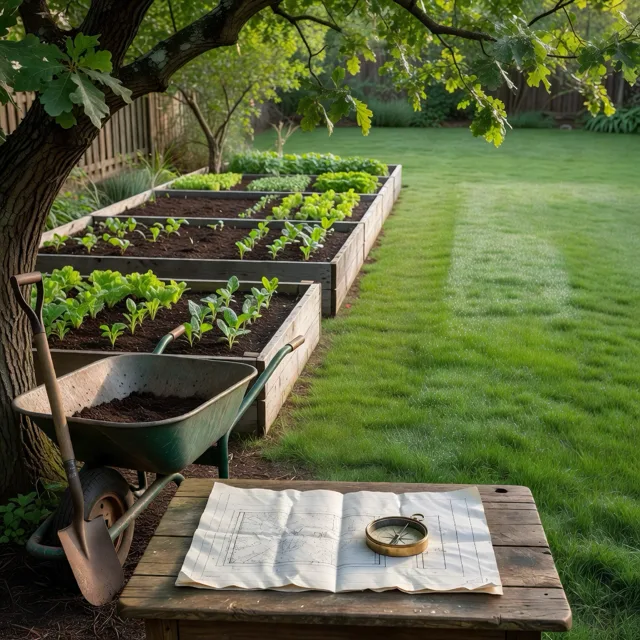
Spring has fully arrived, and every gardener in the country is itching to get outside. But if you follow classical feng shui, April 2027 comes with a single rule that matters more than any planting tip: know where not to dig before you break ground.
In the traditional system, two annual afflictions restrict the compass directions where heavy digging, tree removal, and construction should be avoided. For 2027, 太岁 (Tài Suì) — the Grand Duke Jupiter — occupies the Southwest, and 三煞 (Sān Shā) — the Three Killings — spans the West. Disturbing the earth in these sectors is classically believed to invite setbacks, delays, and even health trouble for the household.
The good news is that the rest of your yard is wide open. The 2027 flying star chart places the auspicious Star 8 in the Southeast and the literary Star 4 in the South, making both sectors ideal destinations for this year's new growth. Let me walk you through exactly how to map your yard and make the most of this season.
Table of Contents
The Two No-Dig Zones in 2027
Classical feng shui identifies annual afflictions that rotate on predictable cycles. Two of them directly affect outdoor work:
| Affliction | 2027 Location | Compass Range | Traditional Rule |
|---|---|---|---|
| 太岁 Tai Sui (Grand Duke Jupiter) | Southwest | Roughly 202.5–247.5 degrees | Do not break ground, excavate, demolish, or start construction facing into this sector. |
| 三煞 San Sha (Three Killings) | West | Roughly 247.5–292.5 degrees | Do not disturb the earth with heavy digging, tree felling, or major landscaping changes. |
The Tai Sui article covers these afflictions in full detail, including indoor rules and traditional remedies. For outdoor purposes, the message is straightforward: leave the Southwest and West sectors of your property quiet this year. No new garden beds, no stump removal, no fence post holes, no heavy machinery.
How to Find These Sectors in Your Yard
You need a compass — your phone's compass app works well enough for yard-level accuracy.
Step-by-step
- Stand at the center of your yard (or the approximate center of your lot). If your property is irregular, use the center of the main backyard area.
- Face due south and note the compass reading. South is 180 degrees.
- Sweep the compass to the right (clockwise). The Southwest zone — Tai Sui territory — runs from roughly 202.5 to 247.5 degrees (centered on 225°). The West zone — San Sha territory — continues from roughly 247.5 to 292.5 degrees (centered on 270°).
- Mark the boundaries mentally or with stakes. Together, the restricted area covers roughly one-third of the compass, spanning from the lower part of Southwest through the entire West sector.
For most American homes with a rectangular lot, this means one side or rear corner of the yard falls within the restricted range. If your entire backyard happens to face Southwest or West, that limits significant digging this year — but as the next section explains, plenty of yard activities are still perfectly fine.
What Counts as "Disturbing" (and What Doesn't)
This is where most people over-worry. The classical prohibition is about disturbing the earth — breaking through the ground surface with force. Normal gardening maintenance is not the same as breaking ground.
| Activity | OK in Tai Sui / San Sha Zones? | Why |
|---|---|---|
| Watering, weeding, mulching | Yes | Surface care. You are maintaining, not breaking ground. |
| Planting flowers or herbs in existing beds | Generally yes | Small holes for transplants in already-worked soil are gentle disturbance. Avoid deep digging for new beds. |
| Mowing the lawn | Yes | No earth disturbance. Mow normally. |
| Pruning shrubs and trees | Light pruning yes; heavy cutting no | Shaping is fine. Removing a large tree or heavy limbs is a significant disturbance. Classically, felling a tree is treated like breaking ground. |
| Digging new garden beds | No | This is exactly the kind of earth disturbance the tradition warns against. |
| Installing fence posts, deck footings | No | Deep holes with machinery or post-hole diggers. Move to a different sector or defer to next year. |
| Using a rototiller or backhoe | No | Heavy machinery is the strongest form of earth disturbance. |
| Placing pots, furniture, decorations | Yes | Nothing is being dug. Place freely. |
Where to Direct New Growth
With two sectors restricted, six remain open. But not all directions are equally supportive this year. The 2027 annual star chart points to two particularly strong sectors for planting and growth:
| Sector | 2027 Star | Why It Favors Growth | What to Plant or Place |
|---|---|---|---|
| Southeast | Star 8 (Wealth) | Star 8 governs prosperity and material growth. The Southeast is also Wood's native sector. Planting here aligns financial and natural growth. | New flower beds, fruit-bearing plants, money plants, healthy trees. A thriving Southeast garden amplifies wealth energy. |
| South | Star 4 (Academic/Literary) | Star 4 is the 文昌 (Wénchāng) star of scholarship and creativity. The South's Fire element feeds recognition. Greenery here supports children's study and creative projects. | Flowering plants, a reading bench, four stalks of bamboo (classical 文昌 cure), or a small herb garden for mindful harvesting. |
| North | Star 5 (use with care) | Star 5 requires quieting, not activating. Keep the North garden tidy and maintained, but avoid major new projects here too. A metal wind chime is the classical cure. | Maintain existing beds. Add a six-rod metal wind chime to weaken the star's earth energy through the Metal element. |
| East | Star 7 (keep quiet) | Star 7 is best left undisturbed. Avoid adding metal chimes or noisy features. Gentle greenery is fine. | Keep existing plants healthy. No metal wind chimes or loud water features. |
| Northeast | Star 3 | Star 3 can bring disputes. A touch of Fire element calms it. | Red or purple flowering plants. A solar-powered garden light. |
| Northwest | Star 1 (Career/Wisdom) | Star 1 is benevolent and supports career. Water and Metal elements support it. | A small water feature or bird bath. White flowering plants (Metal element). |
For full garden feng shui design principles, including path layout, the five-element planting cycle, and rockery placement, see our evergreen guide. If you garden on a balcony or windowsill, the same directional logic applies — just work with pots instead of beds.
Month-by-Month Yard Plan
Here is a season-long plan that respects the 2027 chart while making the most of your outdoor space.
| Month | Priority | Details |
|---|---|---|
| April | Plan and prep | Compass-check your sectors. Clean up winter debris (all areas fine). Start new beds in the SE and S. Order plants. Maintain SW/W beds as they are. |
| May | Plant and grow | After 立夏 (May 6), summer energy supports active planting. Focus new installations in the SE (wealth sector). Add herbs in the S for study support. |
| June-July | Water and maintain | Keep all areas watered and weeded. The SW and W still get full maintenance — just no new excavation. Enjoy blooms in the SE and S. |
| August-September | Harvest and transition | Harvest herbs and vegetables. Begin autumn cleanup. Still no major digging in SW/W until after 立春 2028. |
| October-November | Wind down | Mulch beds for winter. Remove spent annuals. Plan next year's SW and W projects for 2028 when the afflictions shift. |
Apartment Balconies and Small Patios
If your outdoor space is a balcony or small patio, the sectors still apply. Stand at the center of your outdoor space, take a compass reading, and note which direction each edge faces.
For most balconies, you are working with one or two sectors. If your balcony faces Southwest or West, avoid repotting into new containers with heavy soil work on the balcony itself. Do the repotting indoors or in a different location, then carry the finished pots outside. This respects the tradition without limiting your gardening.
If your balcony faces Southeast or South, you are in luck — that is where the strongest growth energy sits this year. Fill it with healthy plants, a small herb garden, and good lighting.
Keeping It Practical
I want to be honest with you: these are traditional guidelines, not laws of physics. Millions of gardeners dig in every direction every spring without incident. If your only sunny spot happens to be in the Southwest, you can still garden there — just be aware of the tradition, do your maintenance gently, and save the big excavation projects for sectors that welcome them this year.
The real value of the annual chart for gardeners is that it gives you a focus. Instead of spreading effort everywhere, pour your creative energy into the Southeast and South. Build the garden that supports your family's prosperity and your children's growth. Let the Southwest and West rest this year. They will have their turn.
For the front yard specifically, the same compass rules apply. Check which direction your front faces and plan accordingly.
Map Your Garden's Best Sectors
Every home's layout is different. A personalized BaZi and home consultation reveals exactly where your property's strongest growth energy sits in 2027 and how to work with it.
Book Your Consultation