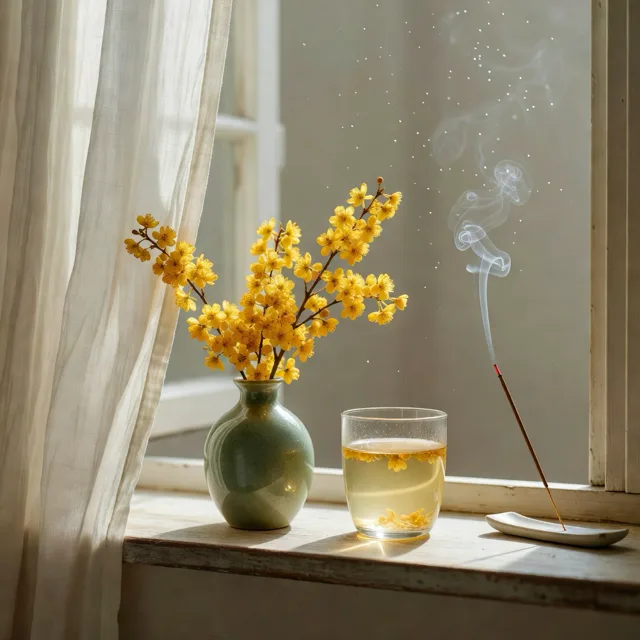
If you have ever walked through a Chinese neighborhood in October and caught a wave of sweet, honeyed fragrance drifting from a small tree you almost missed, you have met 桂花 (guìhuā) — osmanthus. It blooms for just a few weeks in early autumn, and its scent is unmistakable: warm, apricot-like, faintly peachy, with a depth that synthetic air fresheners cannot touch.
In feng shui, scent is not decoration. It is an active tool for managing qi. A stale-smelling room does not just feel unpleasant — it signals stagnant energy. A room that smells clean and alive signals movement, vitality, and clarity. Autumn is Metal season, the season of purification and letting go, and scent is one of the most direct ways to put that principle into practice inside your home.
This guide covers which scents work best for autumn, how to place them room by room, and a simple ventilation ritual for clearing out the stale qi that accumulates as windows close and heating turns on. For a deeper look at essential oil use, see our essential oils guide.
Table of Contents
Why Scent Matters in Feng Shui
Feng shui works with all five senses, but scent is the most underused. You can spend thousands on furniture placement and color palettes, but if your home smells like last week's cooking oil, the energy tells a different story. Here is how scent functions as a feng shui tool:
- Scent moves qi. Fragrance disperses through a room the way qi does — flowing around obstacles, settling in corners, fading where air stagnates. A well-placed scent source acts like a gentle fan for the room's energy.
- Metal season demands clarity. Autumn's Metal element governs the Lung, which in TCM opens to the nose. October is when your sense of smell is most attuned and most affected by what you breathe. The right scent supports Metal's work of purification and focus.
- Stale scent = stale qi. A musty closet, a damp basement smell seeping upstairs, cooking smoke that never fully clears — these are not just odors. They are signs that qi has stopped moving in that space. Clearing the smell clears the stagnation.
The Best Autumn Scents
Not every pleasant fragrance suits every season. Spring calls for light florals. Summer favors mint and citrus. Autumn needs warmth, depth, and grounding — scents that match Metal's character of clarity without coldness.
| Scent | Character | Best Use |
|---|---|---|
| 桂花 (guìhuā) — Osmanthus | Warm, sweet, honeyed, slightly fruity. Classically associated with nobility and auspiciousness (桂 sounds like 贵, meaning precious). | Living room, dining area. The signature autumn scent. Use dried osmanthus sachets or osmanthus essential oil in a diffuser. |
| 檀香 (tánxiāng) — Sandalwood | Deep, woody, grounding. Traditionally burned in temples and meditation spaces for centuries. | Study, meditation area, or any room where you need focus and calm. A single incense stick, not a cloud of smoke. |
| 沉香 (chénxiāng) — Agarwood | Rich, complex, resinous. Considered one of the most precious incense materials in Chinese culture. | Entryway or living room for special occasions. A small amount goes a long way — this is a scent of depth, not volume. |
| Citrus (orange peel, yuzu, bergamot) | Bright, clean, uplifting. Cuts through heaviness and stale air quickly. | Kitchen, bathroom, any room that feels sluggish. Dried orange peel on a radiator is the simplest method. |
| Cinnamon / Cassia (桂皮 guìpí) | Warm, spicy, gently stimulating. Activates yang energy without overwhelming. | Kitchen and dining area. A few cinnamon sticks simmered in water on the stove scent the whole floor naturally. |
Room-by-Room Scent Placement
Different rooms have different energy needs. Here is how to match scent to space — think of it as the aromatic layer on top of your room feng shui.
| Room | Recommended Scent | Method |
|---|---|---|
| Entryway | Citrus or osmanthus | A small reed diffuser or a sachet hung near the door. The first scent you encounter sets the tone for the entire home. |
| Living Room | Osmanthus or light sandalwood | Electric diffuser on a side table, away from direct sunlight. Run it for 30-60 minutes at a time, not all day. Qi needs rhythm, not saturation. |
| Kitchen | Citrus or cinnamon | Simmer orange peel and cinnamon sticks in water after cooking to replace food odors. Open the window for 10 minutes first to flush old air. |
| Study / Home Office | Sandalwood or rosemary | Focus-enhancing scents only. One drop of sandalwood or rosemary oil on a ceramic dish near your desk. Less is more in a work space. |
| Bedroom | Lavender (light) or none | The bedroom is the exception. Keep scent minimal — a faint lavender sachet in a drawer is enough. No diffusers running overnight, no incense. Sleep needs stillness, not stimulation. |
| Bathroom | Eucalyptus or citrus | A few drops of eucalyptus oil on a cotton ball placed near the vent. Clears dampness and refreshes a space that naturally accumulates stale qi. |
The Stale Qi Ventilation Ritual
As temperatures drop, we close windows and turn on heating. Within a week, the air inside feels different — heavier, thicker, slightly stale. In feng shui, this is qi stagnation caused by lack of circulation. Here is a simple weekly ritual to reset your home's air and energy.
The 10-Minute Flush (Do This Every Saturday Morning)
- Open opposing windows in at least two rooms to create cross-ventilation. Even if it is cold outside, 10 minutes of fresh air will not freeze your home.
- Turn off the heat during the flush so you are not wasting energy heating outdoor air.
- Walk through each room and briefly open closet doors, cabinets, and any closed spaces where air sits still all week.
- After closing the windows, light a single stick of sandalwood or walk through the home with an herbal bundle (dried mugwort or sage) to re-scent the space with intention.
- Close closets and cabinets once the new scent has circulated for a few minutes.
This is not ceremony for its own sake. You are physically replacing stale air with fresh air and then setting the new air's character with a clean scent. The entire process takes 10-15 minutes and the difference in how the home feels is immediate.
Osmanthus Tea & Sugar: The Edible Tie-In
桂花 is not just for smelling — it is edible, and Chinese cuisine has been using it for centuries. Osmanthus connects the home's aromatic feng shui to the kitchen and the dining table.
桂花茶 (Guìhuā Chá) — Osmanthus Tea
Steep 1 teaspoon of dried osmanthus flowers in hot water for 3-5 minutes. The tea is golden, mildly sweet, and has a gentle warming property. In TCM, osmanthus is classified as warming and is traditionally used to dispel cold and harmonize the Stomach. It pairs beautifully with oolong or green tea as a blended brew.
桂花糖 (Guìhuā Táng) — Osmanthus Sugar
Layer fresh osmanthus flowers with granulated sugar in a clean jar. Seal and store for two weeks. The result is a fragrant sugar that can be stirred into warm water, spooned over desserts, or used to sweeten congee. It keeps for months and makes a thoughtful autumn gift — a small jar of osmanthus sugar carries the season's best energy into someone else's kitchen.
What NOT to Do
| Mistake | Why It Backfires |
|---|---|
| Synthetic fragrance overload | Plug-in air fresheners, cheap scented candles, and aerosol sprays mask odors without clearing stale qi. They add chemical residue to already stagnant air. Use natural sources: real dried flowers, quality essential oils, or incense made from actual plant materials. |
| Scent in the bedroom at night | Running a diffuser overnight or burning incense before bed overstimulates the senses when you need stillness. The bedroom should smell clean and neutral. If you diffuse during the day, turn it off at least one hour before sleep. |
| Mixing too many scents | Osmanthus in the living room, sandalwood in the hall, citrus in the kitchen, lavender in the bedroom — all at once creates confusion, not clarity. Choose one dominant scent for the common areas and let other rooms stay neutral or use a complementary note. |
| Never opening windows | No amount of fragrance fixes stale air. Scent is the final layer, applied after ventilation — not a substitute for it. If you only do one thing from this article, do the weekly ventilation flush. |
| Incense without ventilation | Burning incense in a sealed room fills the space with smoke rather than scent. Crack a window or run a fan on low. The scent should drift through the room, not sit in it like fog. |
⚠️ Disclaimer: Scent-based feng shui is a traditional practice combining spatial philosophy with aromatic intention. Essential oils should be used as directed and kept away from pets (some oils are toxic to cats and dogs) and small children. If you have asthma, allergies, or respiratory conditions, consult your doctor before using incense or diffusers. Osmanthus tea and sugar are traditional foods; those with pollen allergies should test carefully.
Home Energy Reset
Scent is just one layer of your home's energy. A professional feng shui walk-through identifies stagnation points, elemental imbalances, and room-by-room adjustments for the season ahead.
Book Home Consultation