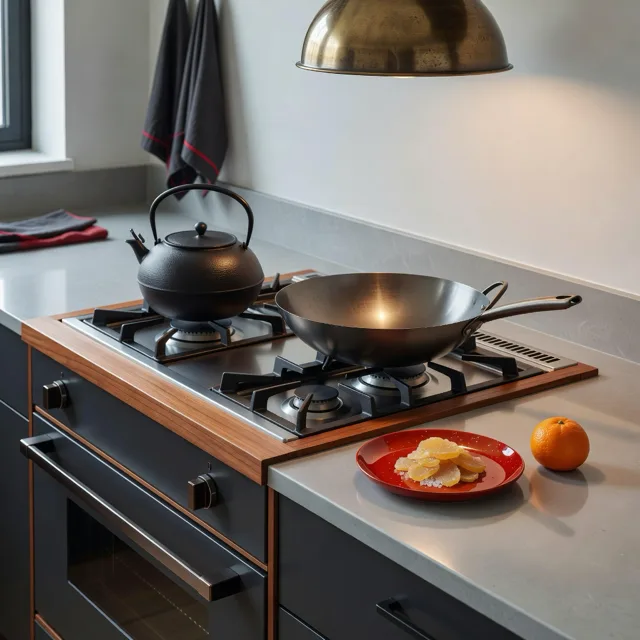
In Chinese culture, the stove is not just where you cook. It is the 火口 (huǒkǒu) — the mouth of fire — and traditionally considered the single most important object in the home for generating wealth and health. The logic is direct: the stove feeds the family. A well-maintained stove means the family is well-nourished. A neglected stove means the family's fortune is being neglected.
This matters more in 腊月 (làyuè) — the 12th lunar month — than at any other time of year, because on 小年 (xiǎonián), January 30, 2027, the 灶神 (zàoshén) — Kitchen God — traditionally ascends to heaven to report on the household's conduct. What he sees in your kitchen is, symbolically, what gets reported. A clean, well-functioning stove reflects a household that takes care of itself. A greasy, broken one tells a different story.
For the complete kitchen feng shui framework, see the kitchen feng shui guide. This article focuses specifically on the stove and what to do about it before Chinese New Year.
Table of Contents
Stove Placement Rules
Most of us cannot move our stoves — they are plumbed in. But understanding the classical placement rules helps you know whether your kitchen needs compensating adjustments, and it matters if you are renovating or building.
| Rule | Traditional Reasoning | Practical Fix If Violated |
|---|---|---|
| Stove should not face the front door | The fire's wealth energy escapes directly out the main entrance. This is considered one of the most significant feng shui violations in classical texts. | Place a screen, island, or tall plant between the stove and the door's sightline. If the door is visible but not directly opposite, a curtain on the kitchen entrance can soften the line. |
| Stove should not sit beside the sink | Fire and Water elements in direct clash. The sink (Water) and stove (Fire) side by side create elemental tension. Classically, this is called 水火相冲 (shuǐ huǒ xiāng chōng). | If they are adjacent, place a small wooden cutting board or a green plant between them. Wood mediates between Water and Fire in the productive cycle (Water grows Wood, Wood feeds Fire). |
| Stove should have a solid wall behind it | The cook needs 靠山 (kàoshān) — back support. An open-backed stove (island installation with no wall behind) leaves the cook vulnerable and the fire unsupported. | If the stove is on an island, a raised backsplash or a shelf behind the cook's position provides symbolic backing. |
| Stove should not sit under a beam | 压灶 (yā zào) — a beam pressing down on the stove — is said to suppress the fire's upward energy and create pressure on the cook. | If a beam is overhead, install two bamboo flutes tied with red ribbon on the beam (a classical feng shui cure), or add overhead lighting to lift the energy. |
| Stove should not face the toilet door | The bathroom's water/waste energy clashing with the stove's fire/nourishment energy is considered unhygienic in both feng shui and common sense. | Keep the bathroom door closed. Add a heavy curtain if the door tends to stay open. |
Burner Rotation
If your stove has multiple burners, use them all. In feng shui, each burner represents a channel of wealth energy. A burner that sits unused for months gathers dust and stagnant qi. Its fire potential is wasted.
This does not mean you need to cook elaborate meals on every burner simultaneously. It means rotating which burner you use for your morning tea, your daily cooking, and your weekend projects. Aim to use every burner at least once a week.
While you are checking burners, verify that each one ignites reliably. A burner that clicks but does not light is worse than one you simply never use — it symbolizes effort without result, ambition without follow-through. Fix it or have it repaired before 小年.
The 腊月 Fix List
Between now and January 30, address as many of these items as you can. They combine practical kitchen maintenance with the traditional pre-CNY cleaning spirit.
| Priority | Task | Why Now |
|---|---|---|
| 1 | Deep-clean the stovetop and oven | Grease buildup = accumulated stagnant energy on your primary wealth generator. The Kitchen God should see a clean stove. |
| 2 | Clean or replace the range hood filter | The exhaust system carries away cooking smoke and stale qi. A clogged filter blocks this exit and recirculates old energy. |
| 3 | Fix broken burners or igniters | All fire sources should function. Dead burners = dead wealth channels. Call a technician if needed. |
| 4 | Replace chipped or cracked cookware | Damaged pots and pans represent fractured fortune. New cookware for the new year is a traditional upgrade. |
| 5 | Clear and organize the spice cabinet | Expired spices have no flavor and no qi. Discard anything older than a year and restock what you actually use. For more on wealth drains in the home, see the wealth drains guide. |
| 6 | Check the pilot light or gas connection | Safety first, feng shui second. A stable flame is the foundation of a healthy kitchen. |
The Kitchen God Tradition
灶神 (zàoshén), the Kitchen God, is one of the most enduring figures in Chinese folk religion. Traditionally, a small image or shrine of the Kitchen God sits near the stove. On 小年 (the 23rd day of the 12th lunar month — January 30, 2027, in the northern tradition; the 24th day, January 31, in southern regions), the Kitchen God ascends to the Jade Emperor's court to deliver his annual report on the family.
The Sweet Offering Custom
To ensure a favorable report, families traditionally smear 关东糖 (guāndōng táng) — a sticky malt sugar candy — on the Kitchen God's image. The symbolism is layered: the sweetness encourages sweet words in the report, and the stickiness physically prevents the Kitchen God from saying anything unfavorable by sealing his lips.
After the offering, the old image is burned to send the Kitchen God on his way, and a new image is placed near the stove on New Year's Eve. In modern practice, even families who do not maintain a Kitchen God shrine can honor the tradition by:
- Deep-cleaning the stove and kitchen on or before January 30
- Placing a small dish of candy or sweets near the stove as a symbolic offering
- Lighting a stick of incense in the kitchen as a mark of gratitude for the year's meals
You do not need to be religious for this to work as a feng shui practice. The Kitchen God tradition is, at its core, a reminder to maintain the most important appliance in your home, express gratitude for the nourishment it provides, and enter the new year with a clean, functioning kitchen.
Common Stove Feng Shui Mistakes
| Mistake | Why It Matters |
|---|---|
| Using only one burner on a four-burner stove | Three-quarters of your stove's wealth-generating potential sits dormant. Rotate burners weekly. |
| Storing items on top of the stove when not cooking | Covering the fire element with clutter suppresses its energy. Keep the stovetop clear when not in use. |
| Letting grease build up around burners for months | Grease is congealed, stagnant energy on your fire source. Clean spills as they happen, deep-clean monthly. |
| A broken oven light that never gets replaced | Darkness inside the oven = hidden, unseen energy in your wealth generator. Let there be light. |
| Placing a mirror reflecting the stove | This is debated in feng shui — some schools say doubling the burners doubles wealth, while others say it creates fire-element excess. In 腊月, err on the side of simplicity: remove the mirror and let the stove stand on its own merits. |
Pre-CNY Stove Deep Clean Protocol
A thorough stove cleaning before the Kitchen God's departure is not just symbolic — it is practical maintenance that extends your stove's life and improves your cooking. Here is the step-by-step approach.
| Step | Action | Details |
|---|---|---|
| 1 | Remove grates, caps, and drip pans | Soak all removable parts in hot water with dish soap for 30 minutes. For heavy grease, add 2 tablespoons of baking soda to the soak water. |
| 2 | Scrub the stovetop surface | Use a paste of baking soda and water for stubborn stains. Apply, let sit 15 minutes, then scrub with a non-scratch sponge. Avoid abrasives on glass-top stoves. |
| 3 | Clean burner ports | Use a toothpick or thin wire to clear each burner port of food debris. Clogged ports cause uneven flames — the fire equivalent of blocked qi channels. |
| 4 | Degrease the backsplash | Hot water, dish soap, and a microfiber cloth. Oil splatters behind the stove accumulate invisibly but create a film of stagnant energy over the wall. |
| 5 | Reassemble and test every burner | Once everything is dry, reassemble and ignite each burner. Verify the flame is steady and blue. A yellow or flickering flame signals incomplete combustion — call a technician. |
| 6 | Wipe knobs and controls | These are the most frequently touched surfaces in the kitchen. Grease and grime on knobs = dirty hands controlling your wealth fire. Wipe with a damp cloth and dry. |
Kitchen Energy Audit
Your kitchen's fire element placement directly affects your home's wealth potential. A professional assessment identifies what is working and what needs adjusting before the Fire Goat year arrives.
Book Kitchen Audit