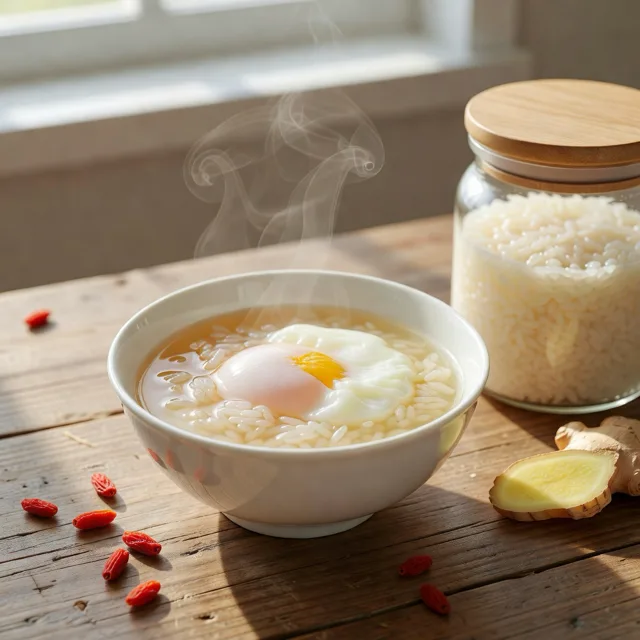
酒酿 (jiǔniàng) — fermented sweet rice wine — is one of China's oldest living foods. Made by fermenting glutinous rice with a yeast starter (酒曲 jiǔqū), it produces a fragrant, mildly alcoholic porridge-like mixture that has been used in Chinese kitchens and traditional medicine for centuries. And in deep winter, there is one preparation that stands above the rest: 酒酿蛋 (jiǔniàng dàn) — sweet rice wine egg soup.
This is the breakfast that Chinese mothers and grandmothers make when the cold gets serious. It's what women have traditionally eaten postpartum to rebuild Blood and warmth. It's what you want on a January morning when the temperature outside is brutal and you need something that warms you from the inside out in five minutes flat.
If you've had tangyuan (汤圆) at 冬至, you already know the family this dish belongs to — warm, sweet, nourishing, and deeply tied to the idea of reunion and restoration.
Table of Contents
What Is 酒酿?
酒酿 is fermented glutinous (sticky) rice. The process is simple: cooked glutinous rice is mixed with a powdered yeast starter (酒曲), packed into a jar, and left to ferment for 2–3 days at warm room temperature. The yeast breaks down the rice starch into sugars and produces a small amount of alcohol — typically in the range of 1–3%, comparable to kombucha.
The result is a sweet, fragrant, slightly fizzy mixture of soft rice grains swimming in a milky, aromatic liquid. It tastes like a gentle rice pudding that's been touched by wine. The Chinese name literally means "wine fermentation" — it's the sweet, early stage of the rice-wine-making process, stopped before it becomes actual wine.
| Property | Details |
|---|---|
| 🍚 Base | Glutinous (sticky) rice, fermented with 酒曲 yeast starter |
| 🍶 Alcohol Content | Trace amounts, roughly 1–3%. Low, but present — not alcohol-free. |
| 🌡️ TCM Nature | Warm, sweet |
| 🫁 Organ Channels | Spleen, Stomach, Kidney |
| 📦 Where to Buy | Chinese grocery stores (refrigerated section), labeled as "sweet rice wine," "fermented rice," or "酒酿" |
| ⏳ Shelf Life | Refrigerated: 2–3 weeks. Fermentation continues slowly even in the fridge, making it more sour and alcoholic over time. |
The TCM View
In traditional Chinese medicine, 酒酿 is classified as warm and sweet. It is described as having the ability to invigorate Blood circulation, warm the channels, and aid digestion. The fermentation process is traditionally understood to make the rice more readily absorbed — the yeast has already begun the breakdown that your Spleen would otherwise need to do.
| TCM Action | Explanation |
|---|---|
| 🩸 Invigorates Blood (活血) | Classically, fermented foods are described as moving Blood and warming channels. This is why 酒酿 is the traditional postpartum food — it is said to help circulate Blood that has been depleted. |
| 🌡️ Warms the Middle (温中) | The warm nature enters the Spleen and Stomach, supporting digestive warmth. In January, this counteracts the cold that tends to slow digestion. |
| 💨 Promotes Qi Flow (行气) | The slight alcohol content is traditionally described as helping qi flow through channels that may be constricted by cold. This is the "warmth spreading through you" feeling after a bowl. |
| 🍚 Easy to Digest | Fermentation pre-digests starches. For people with weak Spleen qi who struggle with heavy winter foods, 酒酿 offers nourishment without the digestive burden. |
Buying vs Making 酒酿
| Option | Pros | Cons |
|---|---|---|
| 🛒 Buy ready-made | Instant convenience. Available at most Chinese grocery stores in the refrigerated section. Consistent quality. Ready to cook with immediately. | Some brands add sugar or preservatives. Freshness varies. Cost is higher per serving than homemade. |
| 🏠 Make at home | Freshest possible. No additives. Deeply satisfying. One batch lasts 2–3 weeks in the fridge. Ingredients cost very little. | Requires 酒曲 (yeast balls, available at Chinese grocery stores or online). Takes 2–3 days to ferment. Temperature-sensitive — too cold and it won't ferment; too hot and it sours. |
Quick Homemade Method
- Cook 2 cups glutinous rice (soak 4 hours first, then steam for 25 minutes).
- Cool to body temperature — the rice must not be hot or it kills the yeast.
- Crush 1 酒曲 ball into powder. Mix thoroughly into the cooled rice with 2 tablespoons of cool water.
- Pack into a clean glass jar. Press flat, make a hole in the center (this lets you see when liquid pools, a sign fermentation is working).
- Cover loosely (not airtight — gas needs to escape). Wrap the jar in a towel and keep in a warm spot (around 28–30°C / 82–86°F) for 48–72 hours.
- Check at 48 hours: if the center hole has filled with sweet liquid and the mixture smells fragrant and sweet (not sour), it's ready. Refrigerate to stop fermentation.
Classic 酒酿蛋 Recipe
This takes five minutes. It's the fastest warm Chinese breakfast you can make.
| Step | Method | Time |
|---|---|---|
| 1. Boil water | Bring 1.5 cups of water to a boil in a small pot. Add 2–3 slices of fresh ginger. | 2 min |
| 2. Add 酒酿 | Stir in 3–4 tablespoons of 酒酿 (both the rice grains and the liquid). Return to a gentle simmer — do not boil hard, or you'll cook off the fragrance. | 1 min |
| 3. Add egg | Crack 1 egg directly into the simmering liquid. For egg-drop style, beat the egg first and drizzle it in while stirring. For a poached egg, slide it in whole and let it set gently. | 1–2 min |
| 4. Finish | Add 10–12 goji berries and a pinch of rock sugar (or honey after removing from heat). Stir once. Serve immediately in a warm bowl. | 30 sec |
The result is a fragrant, slightly sweet, golden-tinged soup with wisps of egg, plump goji berries, and soft rice grains. It smells like a warm kitchen on a cold morning — which is exactly what it should be.
Buying & Storing 酒酿
If you're buying rather than making, a few practical pointers will save you from a bad jar.
How to judge freshness at the store
- Check the date: 酒酿 is a living, fermenting product. Buy the jar with the latest production date, not just the furthest expiration. Fresher is sweeter and milder; older is more sour and boozy.
- Look at the rice grains: In a fresh jar, the grains should be mostly intact and sitting in a milky-white or slightly translucent liquid. If the grains have dissolved into a uniform paste or the liquid has turned yellow-brown, the fermentation has gone too far — the flavor will be harsh and overly alcoholic.
- Smell when you open it: Good 酒酿 smells fragrant, sweet, and faintly wine-like. If it smells sharply sour (like vinegar) or yeasty in a bread-dough way, it has over-fermented. A mild tang is normal; a punch in the nose is not.
- Avoid jars with added preservatives when you can. The best commercial 酒酿 has two ingredients: glutinous rice and 酒曲 (yeast starter). Some brands add sugar, which is acceptable. Anything with a long ingredients list is a processed approximation.
Storing an opened jar
- Refrigerate immediately after opening. Cold slows fermentation dramatically but does not stop it. The 酒酿 will continue to get slightly more sour and alcoholic over time, even in the fridge.
- Use within 10–14 days of opening for the best flavor. After two weeks, it's still safe to eat but noticeably more tart. By three weeks, most people find the sourness unpleasant for sweet preparations — though some cooks deliberately age it for savory dishes.
- Always use a clean, dry spoon to scoop from the jar. Introducing moisture or food particles speeds up unwanted bacterial growth. Never eat directly from the jar and put it back.
- If you made too much, freeze the excess in ice-cube trays. Pop out individual cubes and store in a freezer bag. Each cube is roughly one tablespoon — drop a few frozen cubes directly into simmering water for a quick 酒酿蛋 without thawing first.
Variations
| Variation | How | Best For |
|---|---|---|
| 🍡 酒酿小汤圆 (with mini tangyuan) | Drop 15–20 frozen mini tangyuan (plain or sesame-filled) into the simmering 酒酿 before adding the egg. Cook until they float (2–3 minutes). | A heartier breakfast or dessert. The glutinous rice dumplings make it more filling and add a satisfying chew. |
| 🔴 酒酿红枣蛋 (with red dates) | Add 3–4 pitted red dates to the water at the start. Let them simmer for 3 minutes before adding 酒酿 and egg. | Extra Blood-nourishing. The dates add natural sweetness and a richer color. Traditionally recommended for women or anyone with Blood deficiency signs. |
| 🥛 酒酿牛奶蛋 (with milk) | Replace half the water with whole milk. Add the milk after the 酒酿 so it doesn't curdle from high heat. Simmer very gently. | A modern fusion that adds creaminess and extra protein. Popular with children who find the pure 酒酿 flavor too strong. |
| 🫚 Double-ginger version | Add both fresh ginger slices AND a teaspoon of brown sugar (which is warming). Skip the rock sugar. | For very cold constitutions. Maximizes the warming effect. Good on the coldest mornings between 小寒 and 大寒. |
Who Should Skip or Adjust
| Group | Guidance |
|---|---|
| 🚫 Children under 3 | 酒酿 contains trace alcohol. Do not serve to young children. Older children (over 5–6) can have a small amount cooked thoroughly — the cooking reduces but does not eliminate all alcohol. |
| 🍷 Alcohol-sensitive individuals | Despite the low alcohol content, some people are sensitive to even trace amounts (especially those with the ALDH2 gene variant common in East Asian populations). If alcohol causes facial flushing, headache, or discomfort, skip 酒酿 or cook it longer at a gentle simmer to reduce the alcohol content. |
| 🤰 Pregnancy | The trace alcohol makes this one to discuss with your healthcare provider. While traditionally used postpartum, opinions on use during pregnancy vary. When in doubt, skip it. |
| 🔥 Heat-type constitution | If you tend to run hot (red face, irritability, dry mouth, constipation), reduce the ginger and skip the brown sugar. The 酒酿 itself is warming enough without amplifiers. |
| 🩺 Diabetic or blood sugar concerns | 酒酿 is high in easily absorbed sugars from the fermentation process. If you manage blood sugar, use a small portion (1–2 tablespoons) and skip added sweetener. Monitor your response. |
⚠️ Disclaimer: 酒酿蛋 is a traditional Chinese food preparation, not a medical treatment. TCM descriptions of Blood-warming and channel-opening are traditional frameworks, not biomedical claims. 酒酿 contains trace alcohol — not suitable for young children, those avoiding alcohol, or during pregnancy without medical guidance. The postpartum use described is a cultural tradition; consult your healthcare provider for postpartum dietary advice.
Your Winter Nourishment Plan
酒酿蛋 is one piece of a complete winter food therapy strategy. Your BaZi chart reveals which flavors, temperatures, and foods your constitution needs most this season.
Book a Consultation