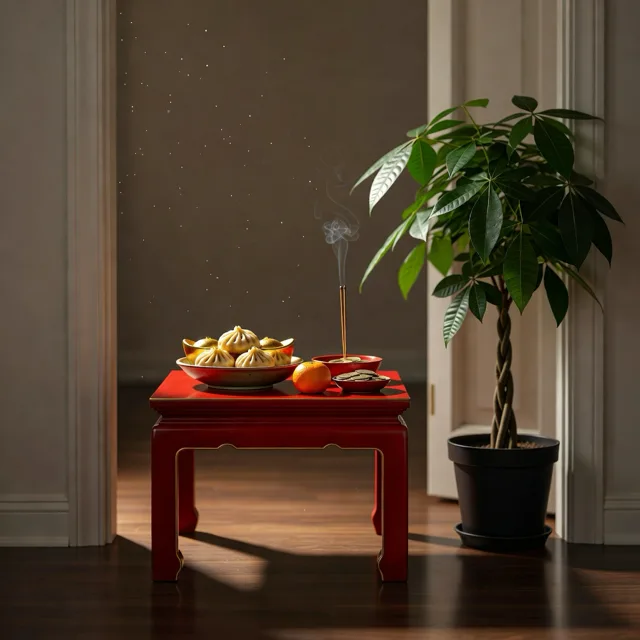
Wednesday, February 10, 2027 — 初五 (chū wǔ) — is one of the most energetic days in the entire Chinese New Year season. This is 破五 (pò wǔ), literally "Breaking the Fifth." The taboos and restrictions of the first four days are lifted. Shops reopen. Firecrackers explode at dawn. And across China and Chinese communities worldwide, families perform one of the year's most beloved rituals: 迎财神 (yíng cái shén) — welcoming the God of Wealth.
If you have spent the past four days being careful — no sweeping, no sharp words, no breaking things — today is the release. The energy shifts from cautious reverence to active invitation. You are not just ending restrictions; you are opening the door, literally and figuratively, to prosperity.
This guide adapts the tradition for a Western household. You do not need a shrine or firecrackers. You need intention, a clean entry, a pot of dumplings, and a willingness to greet the year's abundance with both hands open.
Table of Contents
Why Day Five Matters
The first four days of the Chinese New Year are wrapped in taboos. No sweeping (you might sweep away good fortune). No washing hair on Day One. No sharp words. No lending money. No breaking things. These customs, rooted in centuries of folk practice, are meant to protect the fragile new energy of the year from being disrupted before it settles.
初五 ends all of that. The word 破 (pò) means "to break through." Every restriction that applied from 初一 through 初四 is formally lifted. The Chinese saying goes: 初五不破,则不立 — "if Day Five does not break through, nothing new can be established." For a detailed look at the full 15-day custom cycle, see our CNY customs and taboos guide.
In practical terms, this is the day that life resumes its normal rhythm. Shops hang red banners and set off firecrackers to announce they are open for business. Families sweep the house for the first time since New Year's Eve. And the God of Wealth is formally invited in — because now the house is ready to receive abundance.
Who Is the God of Wealth?
财神 (cái shén) — the God of Wealth — is not a single figure but a family of deities in Chinese folk religion. The most commonly venerated include:
| Name | Title | Known For |
|---|---|---|
| 赵公明 Zhào Gōngmíng | 武财神 (Martial God of Wealth) | The most popular God of Wealth. A fierce, protective figure often depicted riding a black tiger. Associated with protection of wealth. |
| 比干 Bǐ Gān | 文财神 (Civil God of Wealth) | A historical minister legendary for his integrity. Known as the patron of honest business. Often shown holding a jade ruyi scepter. |
| 范蠡 Fàn Lǐ | 文财神 (Civil God of Wealth) | A historical figure who made and gave away three fortunes. Patron of merchants and entrepreneurs. Also known as 陶朱公 Táozhūgōng. |
| 关羽 Guān Yǔ | 武财神 (Martial God of Wealth) | The God of War who also protects wealth. Patron of loyalty and righteousness in business. Seen in many Chinese restaurants and shops. |
| 五路财神 Wǔ Lù Cái Shén | Five-Direction Wealth Gods | A group representing wealth coming from all directions — East, South, West, North, and Center. Often invoked together on 初五. |
The point of 迎财神 is not worshipping any particular deity. It is an act of invitation and openness — telling the universe you are ready to receive. Whether you approach this as a spiritual practice or a cultural ritual, the gesture carries the same energy: you are clearing the path and opening the door.
The 破五 Sweep: Clearing Out Poverty
For four days, you have not swept the floor (or if you have, you have swept inward to keep fortune inside). Today, you sweep it all out. This is 送穷 (sòng qióng) — "sending away poverty." The accumulated dust, crumbs, and debris of the festival days represent the old, the stale, and the poor energy that has nowhere to go until today.
How to Do It
- Start from the back of the house and sweep toward the front door. You are pushing stale energy outward.
- Sweep it out the front door if your home layout allows. Traditionally, the debris is swept to the door and then collected and discarded — never left in a pile inside.
- Be thorough: under furniture, behind doors, in corners. The places where dust hides are the places where stagnant energy accumulates.
- After sweeping, mop with clean water. Some families add a splash of rice vinegar or a drop of essential oil to the mop water for a fresh scent.
If you have been cleaning normally all week (because, in a modern household, five days without sweeping feels absurd), that is perfectly fine. The symbolic version still works: do one intentional, thorough sweep today, front to back, with the conscious thought of clearing the old to make room for abundance.
Entry Refresh: Opening the Door to Wealth
Wealth enters through the front door. This is feng shui's most fundamental principle, and on 初五 it is activated deliberately. After your sweep, turn your attention to the entryway.
- Open the front door early: In China, many families open their doors before dawn on 初五 to be the first to welcome the God of Wealth. If dawn is too ambitious, open your front door when you wake up and let fresh air into the entryway for at least five minutes.
- Clean the threshold: Wipe down the door frame, the handle, and the area just outside. A dirty threshold blocks incoming energy.
- Check your doormat: Is it worn out? Stained? A fresh, clean doormat is one of the simplest wealth activations in feng shui. If yours is due for replacement, today is the day.
- Turn on the lights: Brightness represents Fire energy, which activates and attracts. Turn on the entryway light. If you have a porch light, leave it on through the evening. Light draws good energy inward.
- Fresh flowers or greenery: Place a small vase of fresh flowers or a healthy green plant near the entrance. Living energy at the door signals growth and welcomes abundance.
For a deeper guide to the entryway as a wealth channel, see our wealth corner guide and the 2027 wealth corner refresh.
Ingot Dumplings: The 初五 Tradition
Dumplings on 初五 are not optional — they are the centerpiece of the day's tradition. The shape of a dumpling mirrors the 元宝 (yuánbǎo) — the gold and silver ingots that served as currency in imperial China. Eating dumplings on the day you welcome the God of Wealth is eating "gold ingots" — symbolically filling yourself with prosperity.
初五 Dumpling Customs
- Make them at home if you can: The act of wrapping dumplings is itself the ritual. Each fold wraps in a wish for the year.
- Fold them tightly: The edges must be well sealed. An open dumpling leaks — and on this day, you do not want your wealth leaking out.
- Make an auspicious number: Even numbers are preferred. Some families make exactly 168, because 一六八 sounds like 一路发 (yī lù fā) — "prosperity all the way." More practically, make as many as your family will enjoy.
- Eat them with enthusiasm: Do not count how many you eat. Today is not a day for dietary restraint. The symbolism of fullness matches the wish for abundance.
A Simple Home Ritual for Western Households
You do not need a formal altar, incense, or a Wealth God statue to participate in 迎财神. Here is a simple, respectful adaptation for any home:
Morning (Before Noon)
- Open the front door and windows for five minutes. Let the morning air flow through. While you do this, hold a clear intention: "This home is open to abundance."
- Light a candle at the entryway: A simple candle — white or gold — placed safely near the front door for a few hours. If you have a brass lamp, this works beautifully. Fire at the entrance activates incoming wealth energy.
- Set a small offering table: This can be as simple as a clean plate on a side table near the front door. On it, place three items that represent abundance to you — perhaps an orange (prosperity), a handful of coins, and a piece of candy (sweetness in business). This is not worship; it is setting an intention in physical form.
- Say something aloud: In Chinese tradition, you might say "财神到!" (cái shén dào — "The God of Wealth arrives!") or "恭喜发财" (gōng xǐ fā cái — "Wishing you prosperity"). In English, a simple "Abundance is welcome here" works just as well. The spoken word activates the intention.
Afternoon
- Make or prepare dumplings. Cook them for an early dinner or a late afternoon meal.
- Share: If you can, share food with a neighbor or friend today. Generosity on the day of the Wealth God is considered especially auspicious — what you give out circulates back.
Evening
- Keep the lights on: Leave the entryway light burning through the evening. In areas where the tradition is strong, some families keep a light burning all night on 初五.
- Clear the offering plate before bed. Eat the orange. Spend the coins on something small tomorrow — the first purchase of the year carries symbolic weight.
The First Transaction of the Year
In Chinese business culture, the first sale or purchase after 初五 is significant. Shops that have been closed since New Year's Eve reopen with ceremony: red banners, firecrackers, lucky prices, and extra warmth toward the first customer. The first money exchanged sets the tone for the year's commerce.
For you, this might be as simple as:
- Buy something small and useful on Wednesday: a new notebook for your goals, a fresh plant for your home, a bag of quality tea. Make it intentional — this is your first financial exchange in the Goat Year.
- Pay for it in person if possible: The physical exchange of money, face to face, is more energetically significant than a silent online checkout.
- Avoid lending money today: Tradition advises against lending on 初五, as the money you send out may not return.
- Receive graciously: If someone gives you a gift today, accept it with both hands and genuine thanks. 初五 gifts carry extra goodwill.
Your 2027 Wealth Map
Where prosperity flows in your home this year depends on the flying star chart and your personal BaZi. A consultation reveals your strongest wealth sectors and the timing that works in your favor.
Book Your Consultation