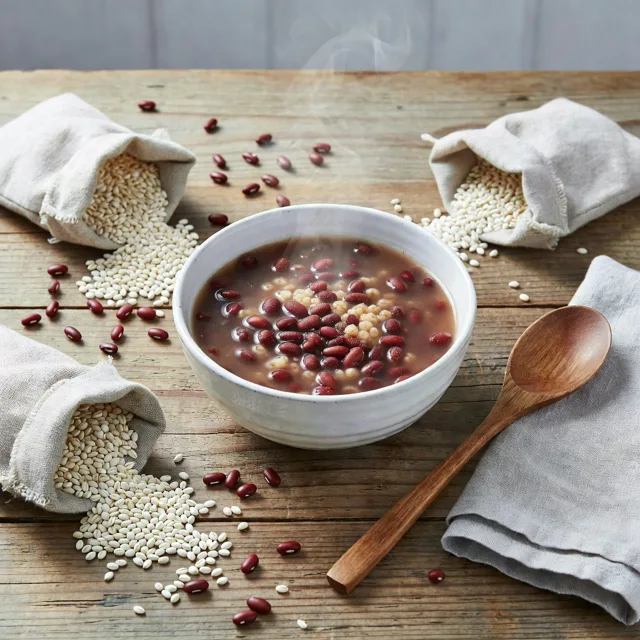
If you have spent any time reading about TCM food therapy, you have encountered this pair: 赤小豆 (chì xiǎo dòu) — small red bean (adzuki bean) — and 薏米 (yì mǐ) — Job's tears (coix seed). Together, they form the most widely used damp-draining combination in the entire Chinese food therapy tradition. Not the most exotic. Not the most expensive. Just the most effective at what they do.
And what they do matters most right now. December brings a specific kind of 湿 (shī) — dampness — that is different from summer's damp-heat. Winter dampness comes from indoor heating drying the air while heavy, rich foods weigh down the Spleen. The body retains fluid it cannot transform. You feel it as morning puffiness, heavy limbs, foggy thinking, sticky stools, and a general sluggishness that no amount of coffee seems to fix.
This article gives you the full picture: why winter dampness builds, how this pair works, three ways to prepare it, and a 7-day plan you can start this week. For a broader look at dampness in TCM, see our dampness elimination guide.
Table of Contents
Why Winter Dampness Is Different
Summer dampness is obvious — humid air, sweaty skin, damp-heat. Winter dampness is sneakier. It builds from the inside out.
| Source | How It Creates Dampness |
|---|---|
| Central heating | Dries the air, but paradoxically, the body compensates by retaining more internal fluid. Dry outside, damp inside. |
| Heavy winter food | Stews, roasts, cheese, cream, alcohol — all delicious, all hard for the Spleen to transform. What the Spleen cannot transform becomes dampness. |
| Less movement | Cold weather reduces outdoor activity. Less movement means less circulation to help the Spleen move fluid. Dampness pools. |
| Holiday eating | December is a month of parties, desserts, and heavy meals. The Spleen gets overwhelmed. By January, many people carry a visible layer of puffiness that is not fat — it is fluid the Spleen could not process. |
In TCM, the 脾 (pí) — Spleen — is the organ responsible for transforming food and fluid. When it is overwhelmed, fluid accumulates as dampness. The red bean and barley pair works specifically by strengthening the Spleen's ability to drain that fluid out.
The Red Bean & Barley Pair: How It Works
| Ingredient | TCM Properties | Role in the Pair |
|---|---|---|
| 赤小豆 (chì xiǎo dòu) — Small Red Bean / Adzuki | Neutral-to-slightly-warm. Enters Spleen, Heart, and Small Intestine channels. Promotes urination and drains dampness. | The drainer. Pulls accumulated fluid from tissues and channels it out through the urinary system. Also nourishes Heart Blood. |
| 薏米 (yì mǐ) — Job's Tears / Coix Seed | Cool nature. Enters Spleen, Lung, and Kidney channels. Drains dampness, strengthens the Spleen, clears heat. | The transformer. Strengthens the Spleen so it can process fluid properly going forward — not just drain what is already stuck. |
Important: 薏米 Is Cool
Raw 薏米 has a cool thermal nature. In winter, when the body already tends toward cold, this can be an issue for people with cold constitutions. The traditional solution is to dry-fry the barley before cooking: toast it in a dry pan over medium heat, stirring constantly, until it turns slightly golden and fragrant. This shifts its nature from cool to neutral, making it safe for winter use. Most TCM practitioners recommend this step from 寒露 (Cold Dew, October) onward.
Who It Suits & Who Should Adjust
| Group | Guidance |
|---|---|
| People with dampness signs | Morning puffiness (especially face and hands), heavy limbs, foggy thinking, loose stools, thick tongue coating — this pair is made for you. Safe as a food for daily use in moderation. |
| Cold constitutions | If you run cold (cold hands and feet, aversion to cold drinks, pale tongue), always dry-fry the barley first and add 3-5 slices of fresh ginger to the pot. The ginger counterbalances the barley's cool nature. |
| Pregnancy | Traditional caution advises against 薏米 during pregnancy, as it is classified as having a slippery nature that could theoretically promote uterine movement. This is a traditional precaution — consult your OB-GYN or a qualified TCM practitioner. |
| Weak digestion | If your Spleen is very weak (chronic loose stools, no appetite, fatigue after eating), start with small amounts and cook the congee longer than usual to break down the beans fully. Adding red dates helps support the Spleen. |
3 Ways to Prepare It
1. Congee (粥)
The classic method, and the gentlest on digestion. Soak 30g red beans and 30g barley (dry-fried) overnight. Combine with 8 cups of water in a pot, bring to a boil, then simmer on low for 60-90 minutes until the beans are soft and the liquid is slightly thickened. Add a few slices of ginger for warmth. Season lightly with rock sugar or leave unsweetened. Eat as breakfast or a late-afternoon snack. For more on the congee method, see our November guide.
2. Tea (茶)
Faster and more portable. Dry-fry 20g barley until golden. Add 20g red beans and 15g red dates. Place in a large thermos. Pour boiling water over the ingredients. Seal and steep for at least 2 hours (or overnight). Drink the liquid throughout the day. Refill with hot water once before discarding the ingredients. This is the office-friendly version — brew it in the morning and sip all day.
3. Dessert Soup (糖水)
For when you want something more satisfying. Cook the congee as above but with less water (6 cups instead of 8) for a thicker consistency. In the last 15 minutes, add a handful of lotus seeds and 10 goji berries. Sweeten with brown sugar. Serve warm as a light evening dessert. This version bridges food therapy and comfort food — it tastes like a treat but functions as medicine.
Buying & Storage Notes
Look for 赤小豆 and 薏米 at any Chinese grocery store — they are inexpensive pantry staples. Buy them dried and in bulk. Stored in an airtight container in a cool, dark place, both will keep for at least a year. If you dry-fry a large batch of barley at once (200-300g), store the toasted barley separately and label it so you do not confuse it with the raw version. Pre-toasted barley is ready to cook whenever you need it, which makes weekday preparation much faster.
7-Day Rotation Plan
You do not need to eat red bean and barley every single day. A rotation keeps it effective without monotony, and gives your Spleen variety.
| Day | Preparation | Addition |
|---|---|---|
| Monday | Red bean barley congee | + ginger (3 slices). Warming start to the week. |
| Tuesday | Red bean barley tea (thermos) | + red dates (3). Sip throughout the workday. |
| Wednesday | Rest day — plain millet congee | Give the formula a break. Millet strengthens the Spleen on its own. |
| Thursday | Red bean barley congee | + dried tangerine peel (陈皮, 1 small piece). Helps move qi and aids digestion. |
| Friday | Red bean barley tea (thermos) | + goji berries (10). Adds Kidney and Liver nourishment. |
| Saturday | Dessert soup version | + lotus seeds + brown sugar. Weekend treat. |
| Sunday | Rest day — warming bone broth or soup | Balance the week's draining with something nourishing and rich. |
Tips & Common Mistakes
| Mistake | Fix |
|---|---|
| Using raw barley in winter | Always dry-fry first from October through March. Raw barley is too cool for cold-weather use and can weaken the Spleen further. |
| Confusing 赤小豆 with 红豆 | 赤小豆 (small adzuki) is the therapeutic variety. 红豆 (larger red bean) is sweeter but weaker in damp-draining action. Use the small, dark ones. |
| Adding rice to the congee | Traditional TCM congee for dampness omits rice. Rice (especially glutinous rice) is itself slightly damp-producing. If you need a smoother texture, add a small amount of regular white rice, but keep the beans and barley as the majority. |
| Drinking it ice cold | Even though barley is cooling, drinking the tea or congee cold defeats the purpose. Warmth helps the Spleen transform and transport. Always consume warm. |
| Expecting overnight results | Dampness accumulates over weeks and clears over weeks. Give the 7-day plan two full cycles (14 days) before evaluating. Tongue coating and morning puffiness are the first signs to watch. |
⚠️ Disclaimer: Red bean and barley congee is a traditional food therapy, not a medical treatment. The concept of "dampness" (湿) is a TCM framework — it does not correspond directly to any single Western medical diagnosis. If you experience persistent bloating, edema, or unexplained weight gain, consult your physician. Traditional caution advises against Job's tears (薏米) during pregnancy — consult your OB-GYN. People with kidney disease should monitor fluid intake and consult their doctor before increasing bean-based foods.
Your Dampness Profile
Is dampness your main pattern, or is something else going on? A BaZi body-constitution analysis identifies your dominant imbalance and builds a targeted food therapy plan for winter.
Book Constitution Analysis