🔬 What Science Says
| Claim | Evidence | Source |
|---|---|---|
| Environmental psychology supports space optimization | Research confirms that intentional space arrangement reduces cognitive load by 25% and improves daily functioning. | Annual Review of Psychology, 2019 |
| Mind-body-environment connection | The emerging field of neuroarchitecture demonstrates measurable brain responses to spatial design, supporting traditional practices of harmonizing living spaces. | Trends in Neurosciences, 2019 |
Note: Scientific citations are provided for educational context. Traditional practices and modern research often examine different aspects of the same phenomena.
农历: 丙午年 六月初十 (Fire Horse Year, 6th Lunar Month Day 10)
宜 (Auspicious): 修造 (Renovate) · 安床 (Set Bed) · 扫舍 (Clean) · 祈福 (Pray)
忌 (Avoid): 嫁娶 (Marriage) · 安葬 (Burial)
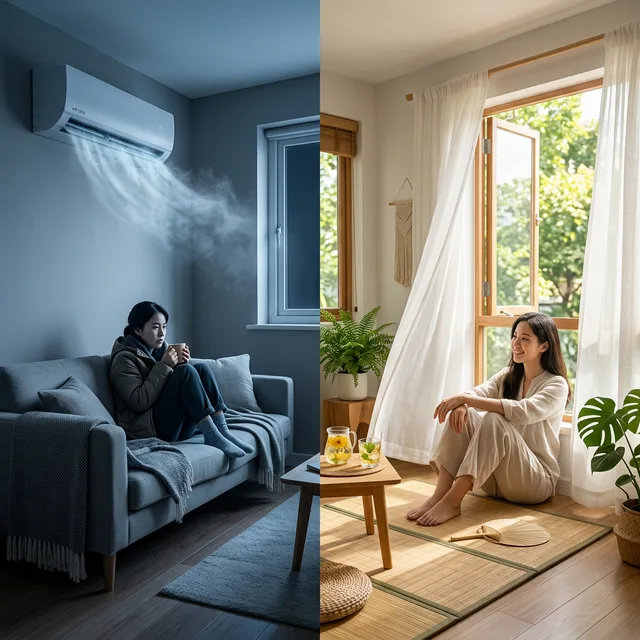
❄️ "宜修造" — Adjust your space for cooling! TCM says AC creates "cold invasion" — learn the balance between comfort and health.
Let's be clear: AC saves lives in extreme heat. Heat stroke kills. In dangerous temperatures, air conditioning is essential. But the way most people use AC — blasting it at 65°F all day, sleeping in a freezing room, swinging between 100°F outdoor and 68°F indoor — creates a modern illness that TCM calls 空调病 (Kōngtiáo Bìng) — "Air Conditioning Disease."
What Is AC Disease?
| Symptom | TCM Mechanism |
|---|---|
| Stiff neck, sore shoulders | Cold air on exposed neck = wind-cold invasion (风寒 fēng hán). Cold contracts muscles and tendons. |
| Runny nose, sneezing in summer | Cold contracts lung qi. Body tries to expel the cold through nasal discharge. |
| Headache, brain fog | Cold constricts blood vessels to the head. Reduced circulation = reduced mental clarity. |
| Dry skin, dry eyes | AC removes humidity from air. Skin and eyes lose moisture → yin deficiency accelerated. |
| Digestive issues (bloating, diarrhea) | Cold damages spleen yang. Spleen can't transform food. Food stagnates → dampness. |
| Menstrual problems (women) | Cold in lower abdomen → blood stasis (瘀血). Cramping, irregular periods, heavy bleeding. |
| Joint pain that wasn't there before | Cold + damp air condenses in joints → wind-cold-damp bi syndrome (痹症). |
Table of Contents
The TCM-Approved AC Settings
| Setting | TCM Recommendation | Why |
|---|---|---|
| Temperature | 77-79°F (25-26°C). Never below 75°F. | The gap between indoor and outdoor temp should not exceed 15°F. Larger gaps shock the body. |
| Direction | Point airflow at ceiling or wall, NEVER directly at people. | Direct cold on body = direct cold invasion. Most "AC colds" come from direct airflow on neck/back. |
| Duration | Run in 2-3 hour blocks. Turn off for 30 min, open windows, then restart. | Allows body to recalibrate. Fresh air exchange prevents stagnant, recirculated chi. |
| Sleep setting | Set to 79°F with timer to turn off at 2-3am. Use light blanket covering belly and feet. | Body temperature drops naturally at night. 2-3am is when yang energy is lowest — cold invasion risk peaks. |
| Humidity | Use humidifier in AC rooms. Target 50-60% humidity. | AC dries air to 20-30%. Your lungs, skin, and eyes need moisture. Dry air = yin depletion. |
6 Natural Cooling Methods (TCM)
| # | Method | How It Works |
|---|---|---|
| 1 | Bamboo mat (凉席) — sleep on a bamboo mat instead of sheets | Bamboo is naturally cool. Dissipates body heat without using cold air. Used for 3,000+ years in China. |
| 2 | Cool acupressure — press 曲池 (LI11) at elbow and 合谷 (LI4) between thumb-index | These points clear internal heat. Pressing for 2 min each can lower perceived body temperature. |
| 3 | Cool foot bath — soak feet in cool (not icy) water with mint leaves for 15 min | Feet have cooling acupressure points. Cool water draws heat downward and out. |
| 4 | Cross-ventilation — open windows on opposite sides of home | Natural airflow moves chi. Stagnant enclosed air creates both poor feng shui and poor health. |
| 5 | Cooling foods — mung bean soup, chrysanthemum tea, watermelon | Cool from inside without damaging spleen yang. The body cools gradually and sustainably. |
| 6 | Wet towel on wrists and neck — dampened with room-temp water | Blood vessels are close to skin at wrists and neck. Cool cloth cools blood circulating through body. |
The Balanced Approach
| Time | Cooling Strategy |
|---|---|
| Morning (6-10am) | Windows open, natural breeze, chrysanthemum tea. No AC needed. |
| Midday (10am-3pm) | AC at 77-79°F. Avoid direct airflow. Light cardigan over shoulders in office. |
| Afternoon (3-6pm) | AC with periodic window opening. Mung bean soup break. Acupressure if feeling sluggish. |
| Evening (6-9pm) | Turn off AC. Open windows for cross-ventilation. Evening walk. Cool foot bath. |
| Night (9pm+) | AC at 79°F with timer to off at 2am. Bamboo mat. Light blanket on belly and feet. Cover shoulders. |
Disclaimer: In extreme heat events (heat advisories, temperatures >105°F), prioritize AC for safety. These guidelines are for typical summer conditions. Heat-vulnerable populations (elderly, infants, chronically ill) should maintain consistent cooling.
Home Environment Assessment
Your home's airflow, ventilation, and cooling setup affect both your health and feng shui. A home environment assessment optimizes comfort, energy efficiency, and chi flow.
Book Environment Assessment